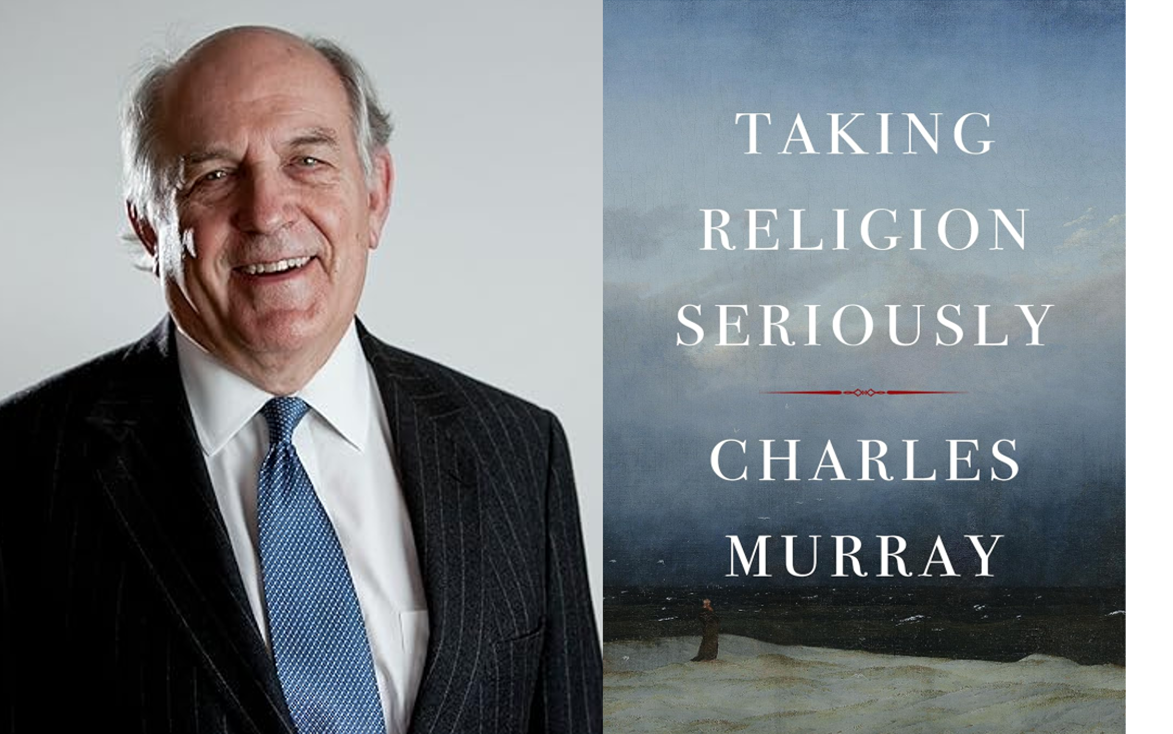
Charles Murray’s latest book, “Taking Religion Seriously,” differs from many of his works. It is autobiographical, slim rather than thick, and focused on a subject other than those featured in his other books.
He even admitted in it that he may be wrong. Yet it will be no less controversial. It is about Murray’s transformation from a skeptical agnostic after college to a believing Christian today.
No one was more surprised than Murray himself. After all, as his wife Catherine put it, “Smart people don’t believe that stuff anymore.” Yet Catherine did, and she, as Murray put it in the book, has “an extraordinary intellect, was fully self-aware, and wasn’t deluding herself in any way.”
He wanted to follow her path, but decided he suffered from a perceptual deficit in spirituality. He had to find his own way.
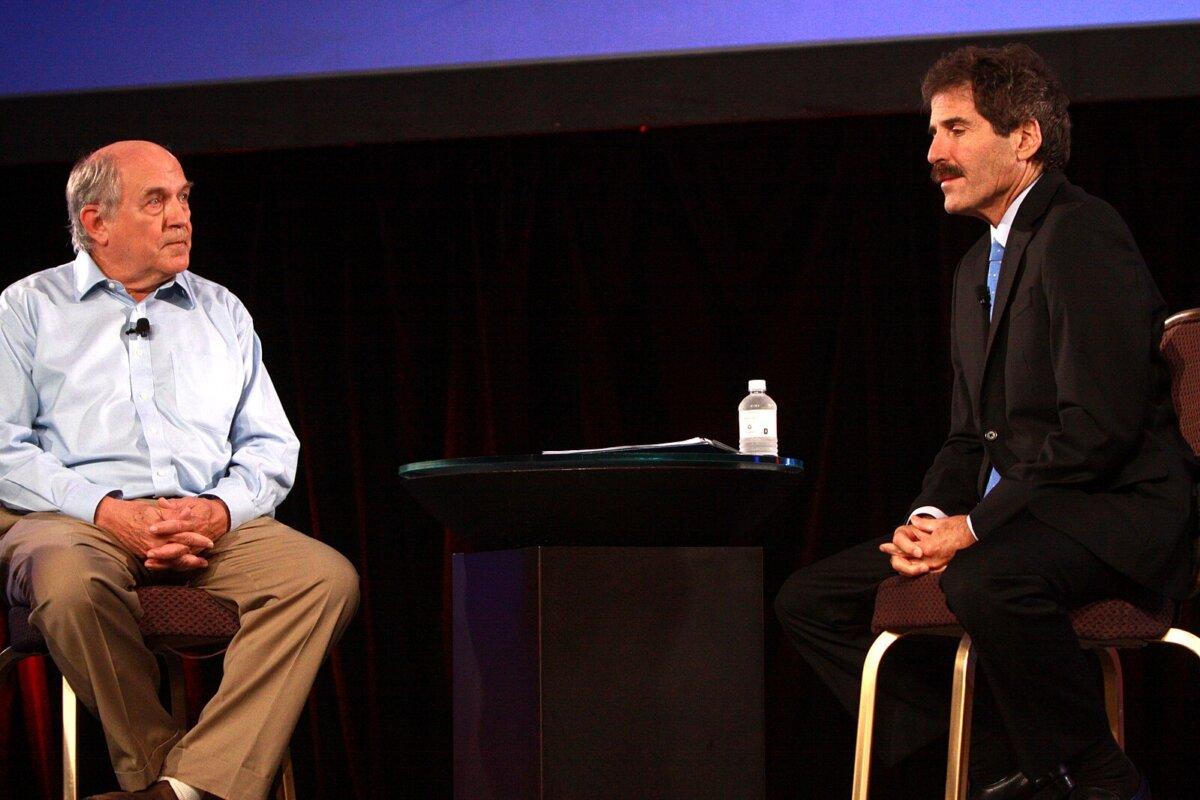
Charles Murray (L) and John Stossel speaking at the 2013 FreedomFest in Las Vegas, Nev. (Gage Skidmore/CC BY-SA 2.0)
Path to God
“Taking Religion Seriously” documents that path. Murray felt insufficiently receptive to spiritual experiences to travel that road. He took a different direction, one he was comfortable with: a deep study by examining subjective data.
His journey had two major parts. The first was his transformation from an agnostic to one who believes in the existence of God. The second led him to acceptance of Christianity.
The chapters of the first section detail events, ideas, and people that transformed him from an agnostic to accepting God’s existence. It opens discussing his wife’s shift. She emerged from an agnostic whose intellectual hero was T.H. Huxley, who coined the word “agnostic,” to someone religious.
Catherine decided her love for their first daughter, Anna, “was far more than evolution required.” This discovery led Catherine to rediscover spirituality and begin attending services at a Friends Meeting House.
Scientific Phenomena
Then, Murray discussed how he began to feel mathematics and physics pointed to the existence of a creator. The mathematical simplicity of scientific phenomena niggled at him. Why were complex problems described with simple equations? This was followed by the discovery of the question, “Why is there something rather than nothing?” Murray concluded that, absent a creator, the answer was an infinite regression.
In the next chapter, he looked at how the Big Bang theory mimics the creation story of Genesis. More than that, Martin Rees’s book, “Just Six Numbers,” swayed Murray. The numbers discussed reveal a finely tuned universe, one which could not exist with miniscule differences in the values of six dimensionless physical constants fundamental to its existence.
Excursions studying fields like psi, near-death experiences, and terminal lucidity further led Murray to conclude phenomena existed which could not be explained as the product of material interaction. All of this led Murray to accept the existence of God.
C.S. Lewis
In the second section, Murray related his discovery of C. S. Lewis, and Lewis’s book “Mere Christianity.” It forced Murray to look more seriously at Christ’s claims of divinity. Lewis stated claims about Jesus that Murray found difficult to reject, especially since Lewis always seemed to anticipate and refute Murray’s counterarguments.
This led Murray into a deep investigation into the authors and authenticity of the Gospels and Acts of the Apostles, and of the historicity about the life of Christ. His Virgil for this part of the journey was physicist-turned-Anglican priest, John Polkinghorne. Polkinghorne’s book “The Faith of a Physicist” deeply influenced Murray.
In these chapters, Murray discussed how he came to believe there was something about the historical Christ that could only be explained as miraculous. Jesus believed himself to be the Son of God, as did his disciples in certain ways. This caused Murray to reject believing they were victims of self-delusion.
Murray described himself as a religious amateur. He does not expect readers to accept his road to Christianity as the road, or even the best one. In the book, he stated it was the only road that worked for him. Readers can take religion seriously, “in the same way that Chinese history or plate tectonics can be taken seriously—by reading a lot, thinking about what you’ve read and bouncing your reactions off people who know more that you do.”
To assist readers, every chapter has reading lists, and sidebars detailing significant works on the subject being discussed. In many cases, especially in the second section, the lists include works on both sides of an issue. It invites readers to make their own journey of discovery, considering information outside those provided in “Taking Religion Seriously” and to go into greater detail.
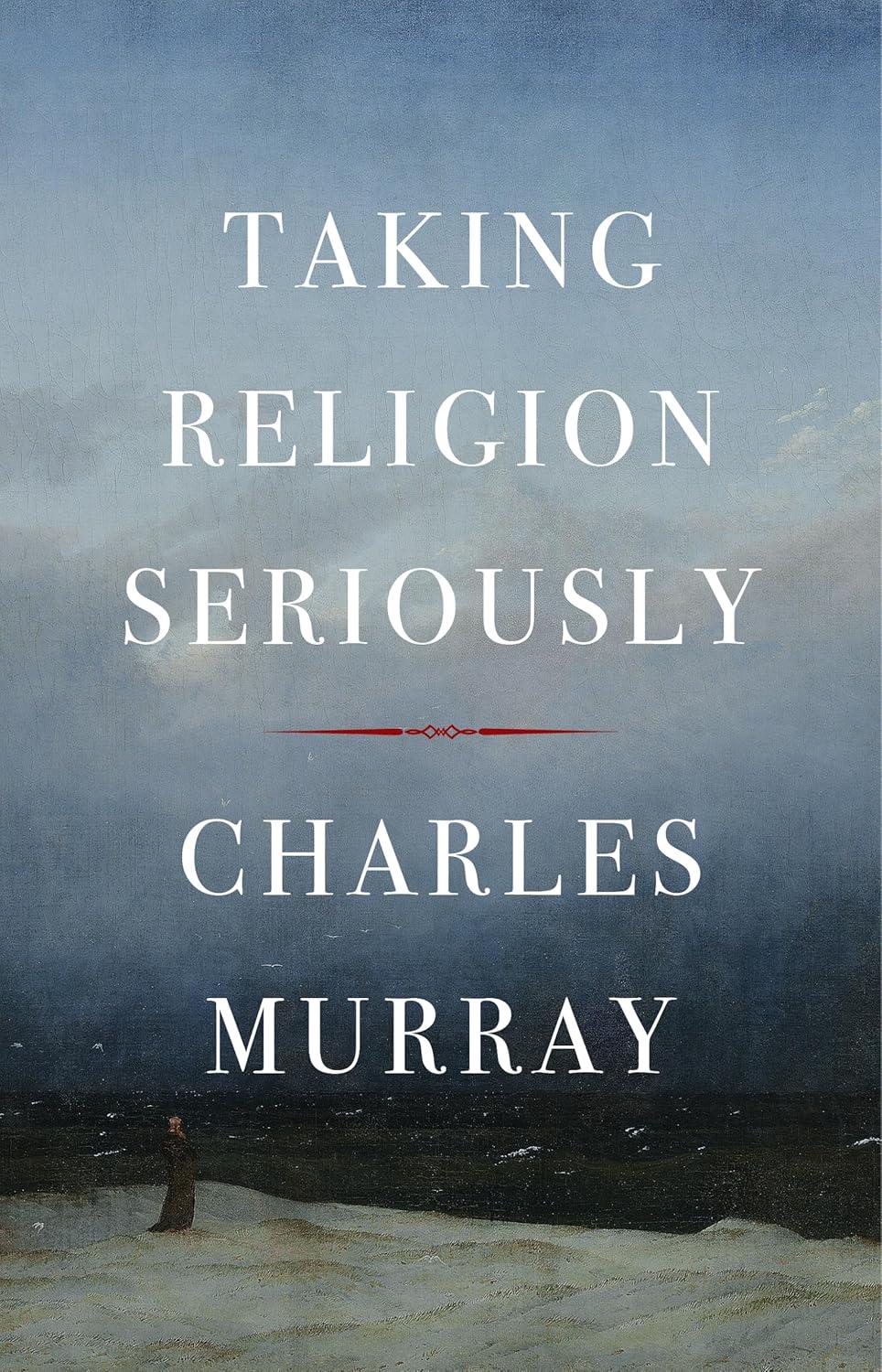
Everyone's path to God is different as Charles Murray attests.
Some might compare “Taking Religion Seriously” to C.S. Lewis’s “Surprised by Joy,” Lewis’s own story of his path to Christianity. The author noted Lewis played a major part in his conversion.
Murray has not yet embraced the orthodox Christianity of Lewis, nor does he claim the spiritual dimension possessed by Lewis. Murray stated that his is a more objective approach. He closed stating, “I have yet to experience the joys of faith,” adding, “I sometimes feel like I am a little boy whose nose is pressed against the window, watching a party I cannot attend. I am not yet done trying to join the party.”
“Taking Religion Seriously” is worth reading, whether the reader is an atheist, agnostic, or Christian. It offers a window into the thoughts and soul of a leading public intellectual, working through a difficult problem.
In it, the author is not asking for agreement with his conclusion. He asks only for serious consideration of his arguments. They are worth serious consideration.
‘Taking Religion Seriously’
By Charles Murray
Encounter Books: Oct. 14, 2025
Hardcover, 152 pages
What arts and culture topics would you like us to cover? Please email ideas or feedback to features@epochtimes.nyc