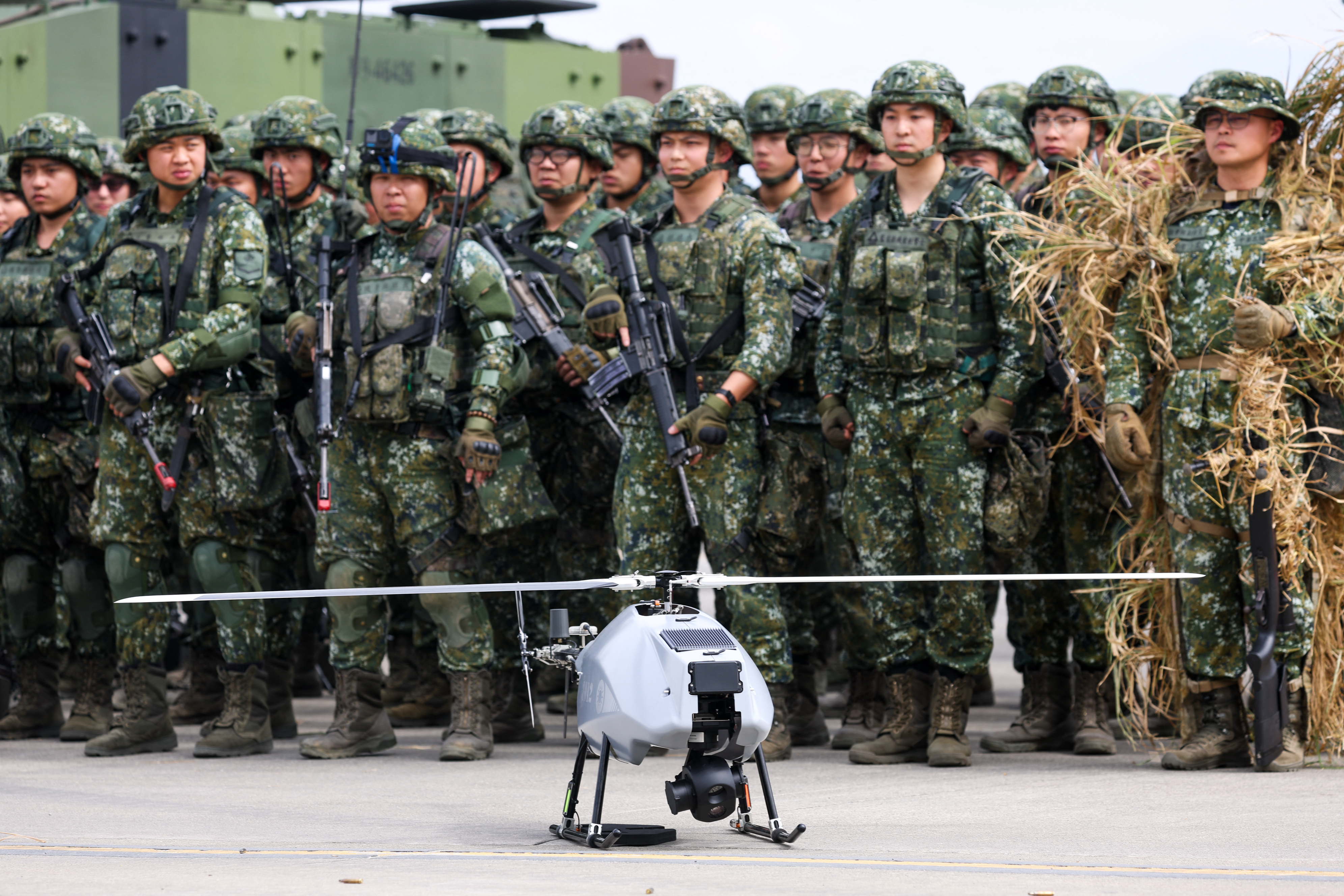

Taiwan’s current “porcupine” defense strategy is “insufficient” to deter China’s military aggression, and it needs to adopt an operational concept called “hellscape,” which would rely on mass drone deployment for asymmetric defense, according to a new report published by the Washington-based Center for a New American Security (CNAS) on Feb. 26.
The report, titled “Hellscape for Taiwan: Rethinking Asymmetric Defense,” examines a scenario in which China invades Taiwan with a massive amphibious assault across the Taiwan Strait after first bombarding the island.
The Taiwanese military, instead of trying to blunt the initial bombardment, should focus on surviving it, the report argues. Under the “hellscape” concept, Taiwan would then strike when China is “most vulnerable”—as its forces cross the Taiwan Strait.
To implement the concept, Taiwan would need to deploy tens of thousands of aerial drones, unmanned surface vessels, and underwater vehicles, effectively turning the Taiwan Strait into a “hellscape.”
Ultimately, the concept is to prevent China’s military, the People’s Liberation Army (PLA), from “transporting enough troops to Taiwan to conquer the island,” particularly in a wartime environment marked by “extensive communications and GPS jamming.”
“The question is no longer whether Taiwan can win a conventional war, but whether China can stomach the operational chaos, massive casualties, and strategic uncertainty that an invasion would bring,” the report reads.
“By making invasion prohibitively costly and dangerously unpredictable, Hellscape strengthens deterrence and reduces the likelihood that Beijing would launch an attack in the first place.”
The report’s authors—Stacie Pettyjohn, senior fellow and director of the Defense Program at CNAS, and Molly Campbell, a research assistant at the same program—said such a concept would suit Taiwan’s current situation, citing its “limited stockpiles of expensive weapons” and a military balance of power that “increasingly favors Beijing.”
Drone Strategy
To put the concept into operation, the authors urge Taiwan to prepare distinct military responses for the “four geographical and operational layers” of the hellscape.
For the outermost layer, which stretches about 25 miles to 50 miles from the Taiwan coast, the Taiwanese military should deploy waves of long-range kamikaze drones, uncrewed underwater and surface vessels, and decoy drones, supported by long-range antiship cruise missiles, to “thin the flotilla” of Chinese ships and make the ships that continue onward to Taiwan “softer targets.”
“Facing mixed drone and missile raids, Chinese forces would have little time to distinguish sophisticated threats from decoys, forcing them to engage everything. This would rapidly deplete shipboard interceptors, leaving the fleet vulnerable to follow-on attacks,” the report reads.
The next layer, spanning about 3 miles to 25 miles offshore, would see Taiwan deploy sea and aerial minefields, drones, and drone boats, supported by missile strikes, to “disorganize the landing craft [and] throw them off schedule.”
The third layer, stretching from about 3 miles to Taiwan’s shores, would see the Taiwanese military, benefiting from clear sight lines, focus on destroying incoming Chinese landing craft using first-person-view drones, rockets, and other short-range systems.
This would be followed by attacks on the fourth layer, or Taiwan’s beaches, which would see the Taiwanese military use antitank missiles, antiship missiles, rockets, and loitering munitions on ships, accompanied by antipersonnel drones.
“Taiwan could defeat a Chinese amphibious assault at the water’s edge with the Hellscape concept,” the report reads. “By incorporating drones into a layered, asymmetric dense-in-depth strategy, Taiwan could have enough cross-domain precision fires to repel a Chinese invasion.”
Recommendations
The authors said Taiwan would need to overcome several obstacles before the concept could realistically be implemented.
One key challenge is scaling up Taiwan’s drone industry. The island currently produces about 8,000 to 10,000 small drones per year. By comparison, Ukraine manufactures roughly 200,000 drones per month, for a total of about 4.5 million in 2025.
“Taiwan’s drone industrial base is hampered by high manufacturing costs—driven by the imperative to source parts outside the PRC—and continued technological reliance on allies like the United States,” the report reads, referring to China’s official name, the People’s Republic of China.
To overcome the challenge, the authors said the current Taiwanese administration, headed by President Lai Ching-te, should allocate a greater portion of defense spending to fund domestic drone production and procure uncrewed capabilities, rather than invest in large, exquisite platforms such as fighter jets.
Taiwan’s drone manufacturers should continue building ties with European counterparts and expand the emerging non-China drone alliance, according to the report.
The authors also warned that Taiwan’s military needs to refine its operational doctrine for drone warfare.
“Taiwan appears to be wedded to traditional drone employment concepts, neglecting creative yet simple kill chains that could better exploit asymmetric advantages against a larger adversary,” the report reads.
To solve the issue, the Taiwanese Defense Ministry should regularly hold “Drone Labs,” sessions that bring together soldiers, conscripted personnel, and experts to “rapidly prototype, test, and refine drone tactics,” according to the report.
“The Hellscape concept is grounded in Taiwanese self-sufficiency and seeks to identify a theory of victory that is not reliant on the United States,” the authors wrote.