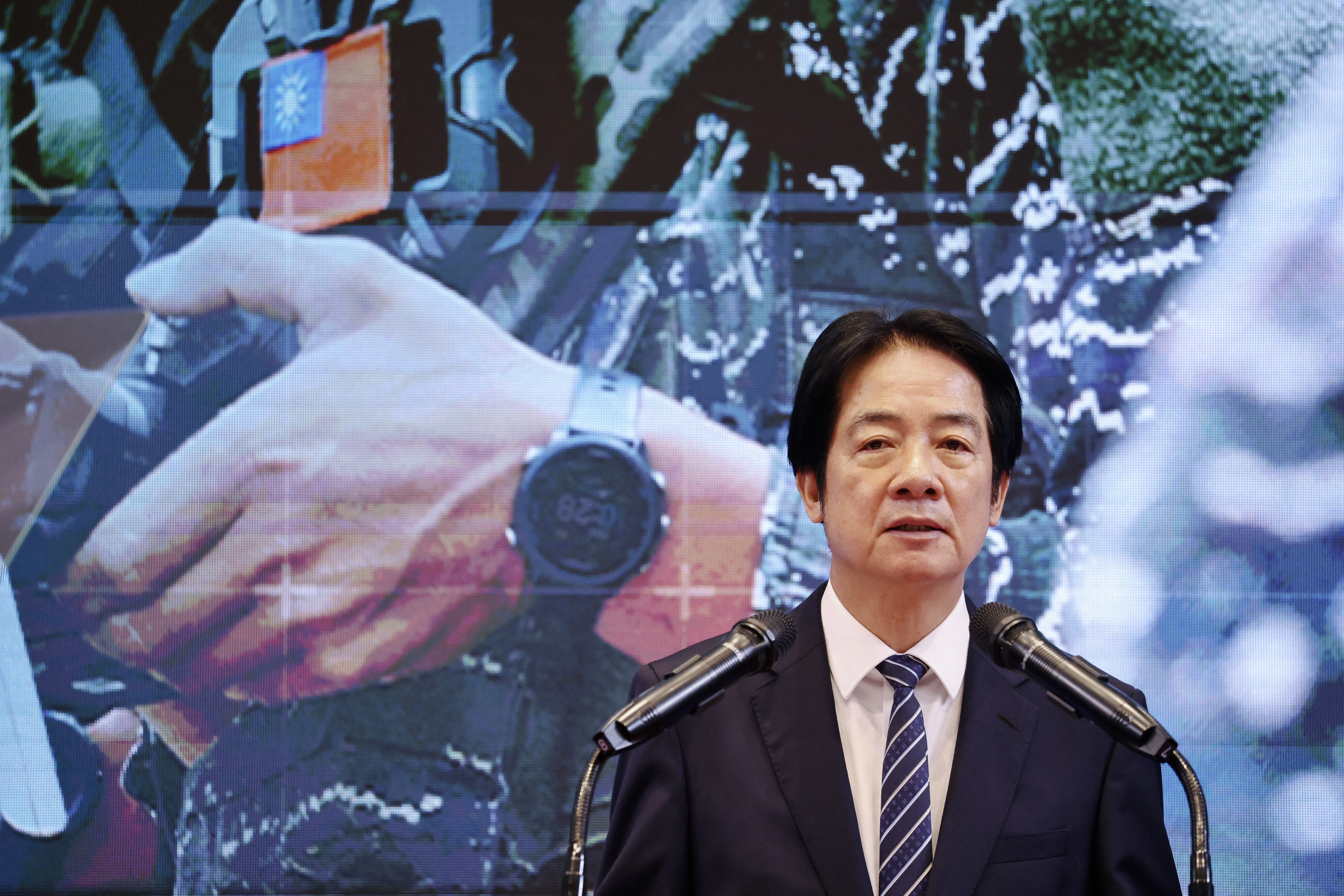

TAIPEI, Taiwan—China is “accelerating” its military preparations to achieve its goal of forcibly seizing Taiwan by 2027, Taiwanese President Lai Ching-te warned on Nov. 26, while announcing a special defense budget of $40 billion to confront the Chinese military threats.
Speaking at a press conference in the presidential office, Lai said the budget would be allocated over an eight-year period, from 2026 to 2033, for projects including the construction of a “Taiwan Dome,” an air defense system featuring high-level detection and effective interception capabilities.
“There is no room for compromise on national security,” Lai said, according to a translation of his remarks in Mandarin.
“National sovereignty and the core values of freedom and democracy are the very foundation of our nation.
“This is not an ideological struggle, nor a dispute over ‘unification versus independence.’ It is a struggle to defend ‘democratic Taiwan’ and to refuse to submit to being ‘China’s Taiwan.’”
The short-term goal of the special budget is to achieve a “high-level” of joint combat readiness against China before 2027 to effectively deter threats from China, Lai said. The ultimate goal, he added, is to build a defense force capable of “permanently safeguarding a ‘democratic Taiwan.’”
Wellington Koo, Taiwan’s defense minister, said at the press conference that the budget would also be used to purchase military items, including precision artillery, long-range precision-strike missiles, and equipment and systems jointly developed by Taiwan and the United States.
Lai added that history had proven that trying to compromise in the face of aggression brought nothing but “endless war” and “enslavement.”
Taiwan
Lai’s announcement comes as the Chinese Communist Party (CCP) is stepping up efforts to infiltrate Taiwan. Recently, Taiwan’s Mainland Affairs Council reported that 168 people were charged in 2024 for Chinese infiltration operations in Taiwan, compared with 86 in 2023 and 28 in 2022.
The CCP has also stepped up its military pressure on Taiwan in recent years. According to a report published by the Jamestown Foundation earlier this year, Taiwan’s defense ministry recorded the highest annual number of Chinese military aircraft sorties crossing the Taiwan Strait median line in 2024—3,070, up from 1,703 in 2023.
The CCP claims Taiwan as a breakaway province that should be “reunited” with the mainland, even though it has never ruled the self-governing island.
The United States has long been Taiwan’s primary arms supplier for its self-defense, despite the absence of formal diplomatic relations. Earlier this month, the Pentagon confirmed the sale of the National Advanced Surface-to-Air Missile System (NASAMS) to Taiwan.
For 2026, the Lai administration plans to increase its defense budget to 3.32 percent of its gross domestic product (GDP), or $30.3 billion, with a goal of reaching 5 percent by 2030.
During the press conference, Lai was asked about the ongoing diplomatic crisis between Beijing and Tokyo, after Japanese Prime Minister Sanae Takaichi said at a parliamentary meeting on Nov. 7 that a Chinese military attack against Taiwan would constitute a “survival-threatening situation” for her country.
“Constantly launching multifaceted threats and attacks against neighbouring countries at every turn is not the conduct expected of a responsible major power,” Lai said in response.
When asked about whether he was worried about U.S. President Donald Trump’s visit to China next year, Lai said the current U.S.–Taiwan relationship is “rock-solid.”
“Recently, before his trip to Asia, President Trump specifically emphasised that ‘Taiwan is Taiwan’ and President Trump [said he] personally respects Taiwan. These two brief statements say it all,” Lai said, referring to comments Trump made before departing for a trip in Asia last month.
During the Asia trip, Trump met with Chinese leader Xi Jinping on the sidelines of the Asia-Pacific Economic Cooperation (APEC) summit in South Korea.
On Nov. 24, Trump and Xi spoke on the phone, and the U.S. president later announced that he had accepted the Chinese leader’s invitation to visit Beijing in April next year.
US Response
The special defense budget will need to be passed by Taiwan’s parliament, which is currently dominated by opposition parties.
Cheng Li-wun, chairwoman of Taiwan’s largest opposition party, the Kuomintang, didn’t directly say that the party would vote against the special budget, but called on Lai to “step back from the brink.”
“I also hope the international community can understand that the people of Taiwan love peace and firmly desire peace. We want to stay far away from the flames of war, we want to avoid war,” Cheng told a party meeting.
Raymond Greene, director of the American Institute in Taiwan, which is the U.S. de facto embassy on the island, said Lai’s announcement marks “a major step towards maintaining peace and stability across the Taiwan Strait by strengthening deterrence,” according to a Facebook post.
“The United States supports Taiwan’s rapid acquisition of critical asymmetric capabilities needed to strengthen deterrence, consistent with the Taiwan Relations Act and decades of commitment across multiple U.S. Administrations,” Greene added.
“The entire world has a stake in ensuring that differences across the Taiwan Strait are resolved peacefully and free from coercion.”
Lai’s announcement was first made public in his opinion article published in the Washington Post on Nov. 25.
Sen. Roger Wicker (R-Miss.), chairman of the Senate Committee on Armed Services, said that Lai’s proposed $40 billion budget is “another demonstration of Taiwan’s resolve and commitment to its self-defense,” according to his X post on Nov. 25.
“We encourage our colleagues in Taiwan’s parliament to work with the Lai Administration on a bipartisan basis to swiftly enact this special budget into law. Doing so can demonstrate that legitimate political differences will be set aside when it comes to matters related to the urgent needs associated with the defense of Taiwan,” Wicker wrote.
Reuters and The Associated Press contributed to this report.