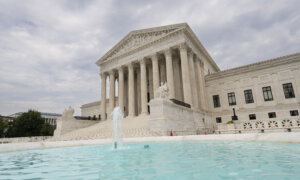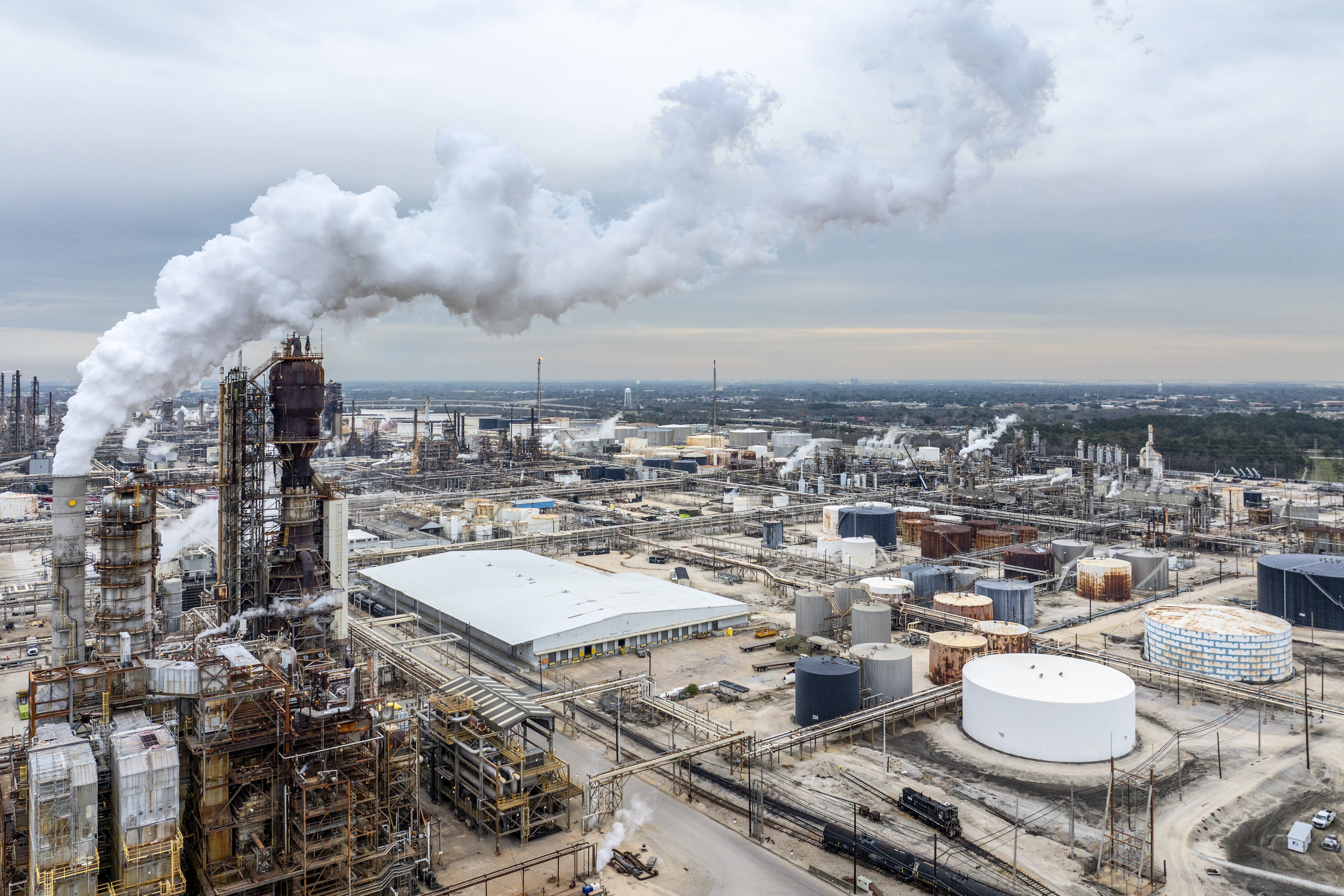

U.S. Supreme Court justices seem skeptical of local governments’ claim that they can use state laws to sue oil companies over the alleged effects of climate change.
Their comments came during oral argument on Oct. 5 in the case of Suncor Energy (U.S.A.) v. County Commissioners of Boulder County, the first of the court’s new term.
The city of Boulder and Boulder County in Colorado sued oil companies, alleging that they broke state laws by producing and selling hydrocarbons while concealing and misrepresenting the dangers of burning them.
The governments say that conduct worsened climate change and caused flood damage, greater wildfire risk, drought, and harm to public buildings and infrastructure.
They want the companies to pay for the alleged damage under Colorado law, arguing that their activities were a public and private nuisance, a trespass, unjust enrichment, and a civil conspiracy.
A public nuisance is an unreasonable interference with a right shared by the whole community, such as smoke from a factory fouling the air everyone inhales. A private nuisance is the same concept aimed at one person or property, such as a neighbor’s noise ruining the enjoyment of someone’s property. Trespass is a physical invasion of property without permission. Unjust enrichment refers to gaining a benefit at another’s expense without paying for it.
Although this case concerns the Boulder lawsuit, many states, such as California and Hawaii, as well as cities, such as Chicago and Baltimore, have filed lawsuits against energy companies, arguing that their products have an impact on the climate. In some suits, they also allege that the companies have misrepresented risks related to their products.
Suncor and its co-petitioner, Exxon Mobil, argue that the lawsuit is actually a backdoor attempt to regulate greenhouse gas emissions through Colorado courts. The Trump administration supports the companies’ position.
They say that federal law already controls those emissions, primarily through the federal Clean Air Act, and that it blocks states from using their own nuisance and other laws to assign blame and damages for climate change.
Allowing Boulder to proceed, they argue, would allow one state to disrupt a national system and reach conduct that occurs across the country and abroad.
A state-level trial court denied the companies’ motion to dismiss the Boulder lawsuit. A divided Colorado Supreme Court affirmed, holding that because Congress passed the Clean Air Act, state law was allowed to regulate interstate emissions. The companies appealed that ruling.
Suncor attorney Kannon Shanmugam told the justices during the oral argument, “If Boulder’s claims are allowed to go forward, some 90,000 municipalities across the country will have the ability to make national and international energy policy.”
The litigants could ask juries to impose “catastrophic damages on selected fossil-fuel producers,” he said, and “that is not the constitutional scheme that the Founders adopted.”
Shanmugam said Boulder’s theory in the case offers no principle limiting who could be sued.
“[Under it, Boulder] could tag me with personal jurisdiction when I am in Colorado in two weeks and sue me on a nuisance claim for refilling my car and thereby contributing to global climate change,” the lawyer said.
Boulder’s attorney, Kevin Russell, told Justice Clarence Thomas that there are constitutional limitations on which parties may be sued.
“The question here is not whether anything in the Constitution prohibits this lawsuit, but whether the specific theories” raised at the Colorado Supreme Court are valid, the lawyer said.
Thomas asked, “So you could just as easily sue large retailers of these products?”
Russell replied, “Nothing in the Constitution would prevent that.” After Thomas again pressed him, he added, “Nothing in our theory prevents that.”
Justice Amy Coney Barrett asked what would happen “if Colorado passed a law purporting to cap emissions in the other 49 states.”
“Is there any principle that would prevent that?” she asked.
She also asked whether a lawsuit for damages could lead to a cap on emissions in the other 49 states.
Russell said, “It isn’t the same thing.” A damages suit makes defendants pay for their conduct but does not prohibit them from “engaging in the conduct,” he said.
Justice Brett Kavanaugh said the Supreme Court has ruled four times since 1972 that the issues involved in this case are matters of federal law.
“As I read them together, [these precedents] make crystal clear that interstate air and water pollution are matters for federal law unless Congress specifically preserves state law,” the justice said. “That is through and through those four cases.”
Justice Elena Kagan compared the underlying lawsuit in the case to lawsuits against the tobacco industry decades ago.
“In multiple respects, this suit appears to be based on the old 1990s tobacco suits that were brought by states and local governments basically saying that Big Tobacco had made ... misrepresentations which had caused people ... to overuse the product, causing harm to those governments,” she said.
“I suppose the opioid litigation more recently follows the same model. This is chapter three. So if this is chapter three, were chapter one and two also preempted?”
Kagan seemed skeptical of the companies’ argument that suits such as Boulder’s are barred by the Constitution.
However, she told Russell that the companies could still prevail because the Clean Air Act already provides “an extremely complicated scheme” governing who regulates emissions and how.
She asked why the court shouldn’t just say, “This really does just get in the way of how Congress decided to regulate greenhouse gases.”
Justice Sonia Sotomayor questioned Shanmugam’s argument that Congress blocked state lawsuits by passing the Clean Air Act, saying that the court has allowed nuisance litigation under both state law and the Clean Water Act, another federal environmental statute.
“I don’t see why we wouldn’t permit it under the Clean Air Act, either,” Sotomayor said.
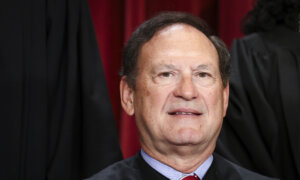
Justice Samuel Alito, who holds stock in energy companies, previously recused himself and did not participate in the oral argument. He did not explain the recusal.
With Alito not involved in the case, the U.S. Supreme Court could end up deadlocked in a 4–4 vote, which would leave the Colorado Supreme Court’s ruling in place.
The justices are expected to rule by June 2027 or July 2027.