
Pastor Bob Fu was in the middle of a national prayer rally in Washington when he got the call.
More than a hundred people had descended on Fu’s Midland, Texas, home, chanting slogans and waving flags.
They were there at the behest of a wealthy and vocal supporter of the Chinese Communist Party (CCP). The protests were part of a “kill traitors” campaign, with the goal of “purging” Fu, according to the influencer’s posts and videos.
He learned about the protest from his wife, who was home when busloads of people began arriving. He was soon being escorted back home by FBI agents.
Law enforcement agents believed there was a credible threat to his life.
“I was wanting to go out to talk to [the protesters] ... but the FBI agent said, ‘Sir, they only need one chance,’” Fu told The Epoch Times.
He later learned from law enforcement that many of the protesters—who showed up seven days per week from 9 a.m. to 4 p.m.—crossed state lines to protest against him, traveling from as far away as California, and were paid a daily fee.
That was in September 2020. Fu and his family spent a week sequestered at home, surrounded by a mob. Then law enforcement decided they couldn’t hold the protesters back indefinitely and moved the family into hiding.
Fu, his wife, and their children are U.S. citizens. His daughter spent the first months of her senior year of high school taking online courses while the family was in hiding.
They remained in an undisclosed location until one day before the presidential election in 2020, when the protests stopped—suddenly and completely.
Five years later, new legislation could prevent ordeals like the one Fu’s family endured, enabling victims to press charges and leading to investigations into CCP involvement.
This year, Texas became the first state to enact a law criminalizing transnational repression. The law went into effect on Sept. 1.
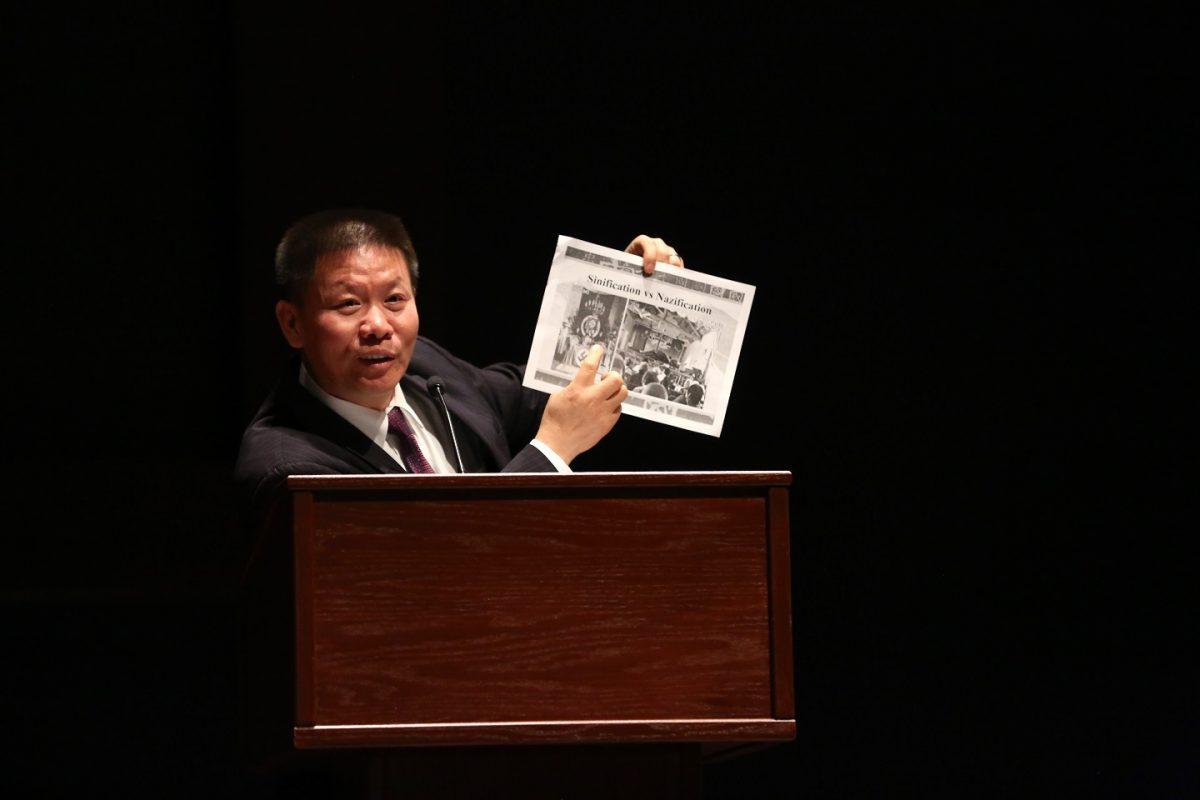
Bob Fu, president of China Aid, compares the CCP's Sinification and Hitler's Nazification at the press conference to announce the Formation of The Coalition to Advance Religious Freedom in China.<br/>(Jennifer Zeng/The Epoch Times)
Spotlight on Transnational Repression
While the name is new, the phenomenon of transnational repression is anything but, Rushan Abbas told The Epoch Times.
Abbas began speaking out about the plight of the Uyghur people in the 1980s.
After she participated in a protest in the United States in 1990, her father—a scholar at the height of his career—was forced to retire from his job in China’s Xinjiang region. A CCP-controlled council removed him from his position.
“That is transnational repression. ... We just didn’t know what to call it, there was no name,” Abbas said. “The reason we are hearing now more about transnational repression is, we were able to give it a name.”
In 2021, Freedom House published its first report on transnational repression, bringing global attention to the term. The human rights organization documented 608 cases of “direct, physical cases of transnational repression” since 2014.
Giving a name to the practice provided clear talking points and gave lawmakers specific points to address through policy, advocates say.
In 2022, then-Rep. Adam Schiff (D-Calif.) introduced the Stop Transnational Repression Act of 2022 to criminalize the practice. In 2023, Sen. Jeff Merkley (D-Ore.) introduced the Transnational Repression Policy Act to require sanctions on perpetrators. In 2024, Rep. Anthony D'Esposito (R-N.Y.) and Schiff introduced bills to aid and require the reporting of transnational repression.
None of those bills made it to the floor. Now lawmakers have reintroduced several of the previous bills and introduced a fresh crop of bills aimed at countering transnational repression.
Some of the new bills include Rep. August Pfluger’s (R-Texas) Countering Transnational Repression Act of 2025, which would direct the Department of Homeland Security to create a working group focused on the issue; Rep. Seth Magaziner’s (D-R.I.) Strengthening State and Local Efforts to Counter Transnational Repression Act; and Rep. Gabe Evans’s (R-Colo.) Law Enforcement Support and Counter Transnational Repression Act, which would require a public service announcement campaign about transnational repression.
Fu and Abbas have both testified to policymakers about CCP activity on American soil and assisted lawmakers’ efforts to draft legislation to counter the CCP’s overreach.
After Texas enacted its transnational repression law in early September, the California Senate passed a bill that would implement training to help law enforcement recognize and respond to transnational repression. The bill, SB509, is currently awaiting California Gov. Gavin Newsom’s signature.
According to a Freedom House report, the CCP “conducts the most sophisticated, global, and comprehensive campaign of transnational repression in the world.”
Due to the CCP’s “growing power internationally, its technical capacity, and its aggressive claims” on ethnic Chinese around the world, its transnational actions pose “a long-term threat to rule of law systems in other countries,” the report warns.
The CCP is not the only perpetrator. Iran, Turkey, Rwanda, Russia, and Saudi Arabia are also known to engage in transnational repression, with tactics ranging from assassination to cyber intimidation to holding family members hostage to using Interpol “red notices” to control dissidents’ mobility.
In June, the Group of Seven nations condemned transnational repression in a joint statement, calling for the development of a response framework to detect and stop it.
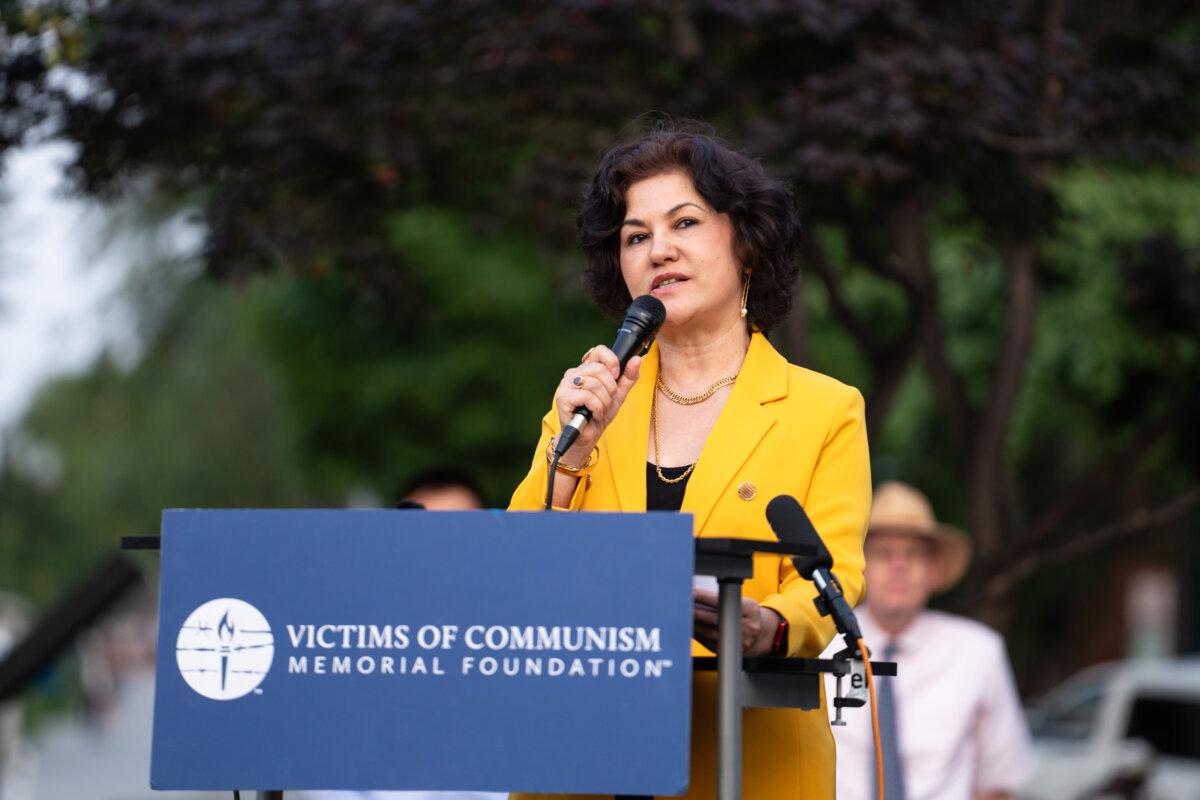
Campaign for Uyghurs founder Rushan Abbas speaks during an event commemorating the Tiananmen Square Massacre that happened in China on June 4, 1989, at the Victims of Communism Memorial in Washington on June 4, 2025. (Madalina Vasiliu/The Epoch Times)
Cybertactics Drive Transnational Repression
In subsequent annual updates to its transnational repression report, Freedom House has warned that the practice by authoritarian states is becoming an increasingly “normal” phenomenon. This acceleration is, in large part, due to cybertechniques.
Fu hasn’t seen a repeat of the 2020 mass protests but said he frequently receives threatening messages. And as he travels the country for his foundation and advocacy work, he has received calls from local police departments that have received bomb threats under his name.
When he traveled to Washington recently, he received a message that a taxi had arrived to deliver him to the Chinese Embassy—into the hands of the CCP.
The cyber component of transnational repression is constant and unending, according to Abbas. She has been the target of phishing campaigns and cyberattacks, which Google and Microsoft confirmed were carried out by Chinese state actors. Several ongoing social media campaigns appear to be aimed at attacking her character and misleading her followers.
Multiple accounts impersonate Abbas, including many spreading posts that claim her advocacy work is purely profit-driven. It’s a tactic that many targets of CCP transnational repression have experienced.
One account has posted photos of her at various events, with exorbitant price tags added to her wardrobe—claiming, for instance, that a $10 thrifted strand of pearls cost thousands.
Other social media accounts make slanderous claims that Abbas or her husband is having an affair. And when Campaign for Uyghurs or partner organizations post information about events, multiple posts will appear, seeming to promote the same event but listing the wrong date.
Abbas and her team report each post they encounter, but their reports usually go unanswered.
“It’s psychologically draining,” she said. “Every day I wake up and see something new.”
None of that deters her, she said. It was transnational repression that pushed Abbas into advocacy for Uyghurs full-time, after all.
Wang Zhiyuan, chair of the Global Service Center for Quitting the CCP, told The Epoch Times that his organization received several threats in April and May.
A grassroots movement to quit the CCP, called “tuidang” in Chinese, or “withdraw from the party,” has helped more than 452 million people withdraw from the CCP and its affiliated organizations. Wang’s online platform tracks and helps to process these withdrawals.
Wang said he received threats of bombings, mass shootings, and car “accidents.” The threats also named Falun Gong practitioners and supporters as targets. The organization’s information booth in New York City has also been physically attacked.
“America should stand up to the CCP’s show of force against groups like Falun Gong,” Wang said.
Falun Gong, also known as Falun Dafa, is a spiritual practice that teaches the principles of truth, compassion, and tolerance. Introduced to the public in China in the early 1990s, it gained widespread popularity, with 70 million to 100 million practitioners by the end of the decade, according to official counts.
In 1999, the CCP banned the practice and began a whole-of-state persecution to “eradicate” it. Falun Gong practitioners in China have been subjected to wrongful detention, torture, brainwashing, forced labor, and even death by forced organ harvesting.
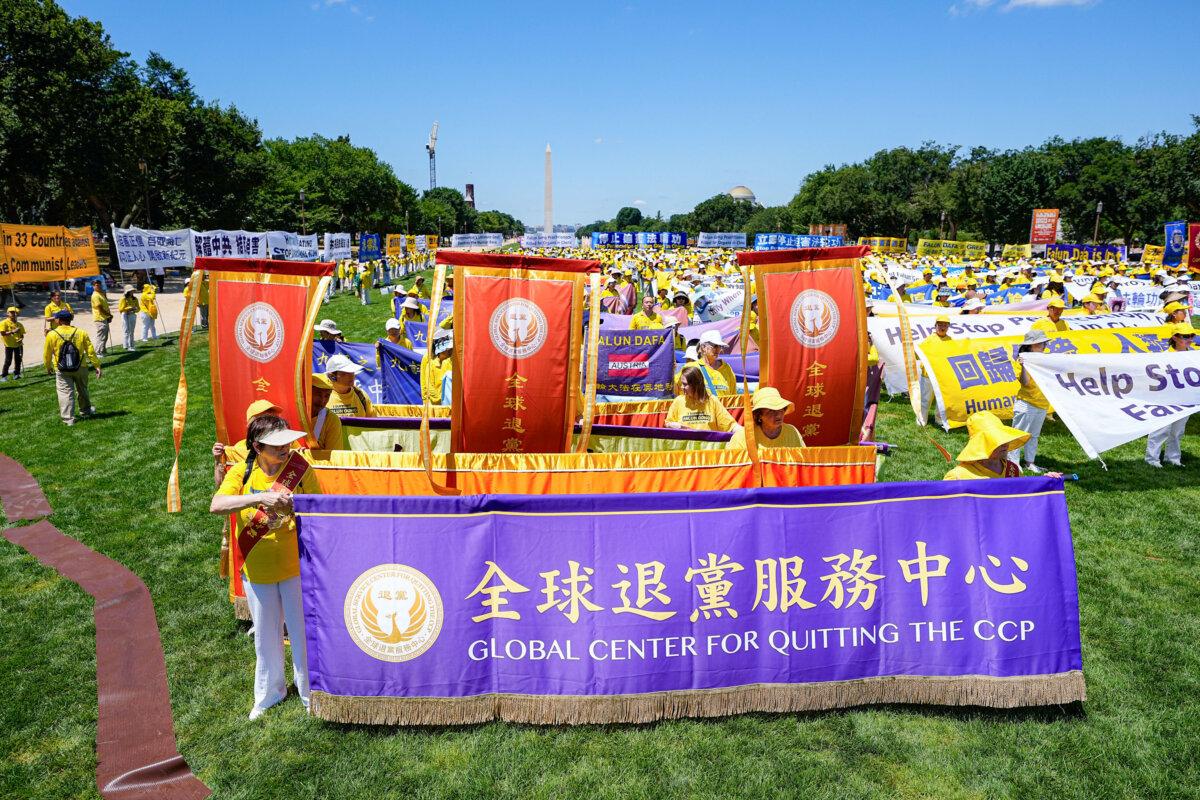
Falun Gong adherents take part in a rally calling for the end of the Chinese Communist Party’s 25 years of ongoing persecution of Falun Gong practitioners in China at the National Mall in Washington on July 11, 2024. (Larry Dye/The Epoch Times)
Victims Need Legal Framework
In 2018, Abbas participated in a Hudson Institute panel on the CCP’s persecution of Uyghurs. Six days later, her aunt and her sister, Gulshan Abbas, disappeared.
Although Abbas suspected the CCP had taken her sister in retaliation, she would not receive confirmation of that until 2020, when she learned that Gulshan had been secretly charged and tried for “terrorism” and sentenced to 20 years in prison.
“But there’s nobody, no law, no legislation or legal solution to protect us,” Abbas said.
Over the years, Abbas has made many statements to the FBI, but “nothing happens,” she said.
“They are very concerned, very diligent, caring, and they take detailed information—I’m deeply grateful for the attention and support they have shown,” she said.
“But the reality is, we still lack the essential legal framework to address effectively or confront transnational repression and hold state actors accountable for those abuses.”
And there’s no way to hold social media companies accountable for allowing the kinds of attacks she has experienced, she noted.
The CCP is trying to intimidate, silence, and discredit its critics, Abbas said, and a law that would criminalize transnational repression “is not only necessary, but long, long overdue.”
“For communities like the Uyghur diaspora, the Hong Kong activists, the Tibetans, the Falun Gong practitioners, and the Chinese dissidents, transnational repression is a reality that we live in our daily lives,” she said.
Fu says successful legislation “needs to have real teeth.”
“Those transnational repressers sent by the CCP, or even their volunteers here, should be held accountable to the maximum extent of the law. Especially those who are not American citizens, some are even illegal aliens—they should really immediately be deported,” he said.
Some policymakers say that some transnational repression involves actions that are already illegal—such as cyberstalking, attempts to bribe public officials, or acting as unregistered foreign agents.
To that end, some of the legislation introduced is aimed at comprehensive training for law enforcement.
Fu agrees that training is necessary. Back in 2020, he said, it was clear that law enforcement responding to his case didn’t really understand what was going on. Why were pro-CCP activists calling a Christian pastor a CCP spy? Why would the Chinese regime back efforts to send 100 to 200 people to a critic’s home halfway around the world?
Joel Ng, a Falun Gong practitioner in California’s Bay Area, was among those who briefed California state Sen. Anna Caballero’s office as she drafted legislation to give law enforcement training on transnational repression.
Ng says Chinese-speaking Falun Gong practitioners often gather near the Chinese Consulate in San Francisco to raise awareness of the CCP’s persecution of the spiritual practice.
Among them are those who experienced the persecution firsthand in China. They have come to expect harassment from pro-CCP activists as they hand out flyers about Falun Gong.
Twenty years ago, local law enforcement might have dismissed the incidents as personal arguments between Chinese, he said. In recent years, there is more awareness of the CCP’s transnational repression tactics.
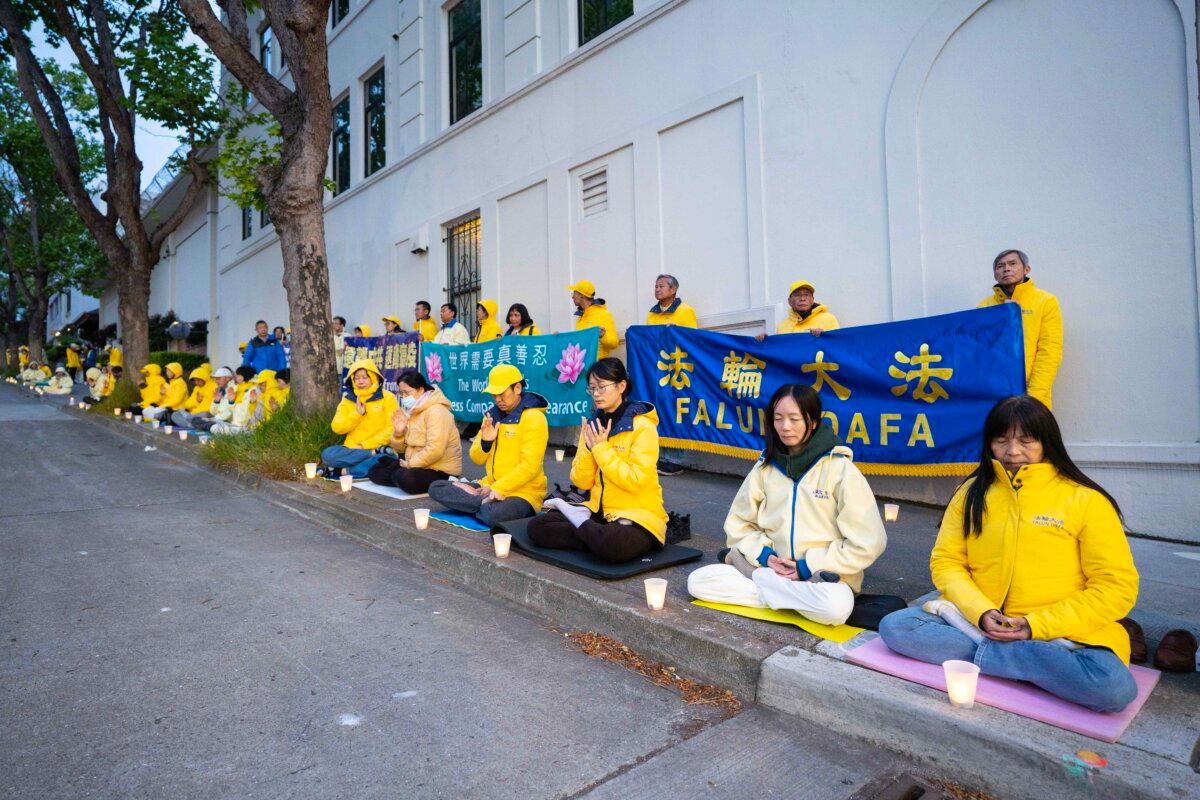
Practitioners meditating during a demonstration in front of the Chinese Consulate in San Francisco on April 25, 2025. (Gary Wang/The Epoch Times)
Capturing Public Opinion
As the phenomenon gained a name, human rights and religious freedom advocates have been vocal about the need to counter transnational repression.
Now, they warn, the CCP is engaging in influence operations that aim to reshape Americans’ views to match the Chinese regime’s.
They say that the CCP is encroaching on the United States’ national sovereignty, opening secret police stations on American soil, and taking advantage of U.S. institutions and legal protections to carry out its own agenda.
Sunny Guo, a Falun Gong practitioner in New York, said she was shocked to hear American teenagers parrot CCP propaganda earlier this year. It was something she had not heard since moving to the United States in 2014.
Whistleblowers revealed last year that CCP leader Xi Jinping had personally ordered an escalation of efforts to persecute Falun Gong overseas, focusing on organizations founded by Falun Gong practitioners.
Shen Yun Performing Arts, a company founded by Falun Gong practitioners, has been a primary target of the CCP’s renewed transnational repression efforts.
Its performances are seen by about 1 million audience members each year, and its programs include ethnic dances of minorities, including Mongolians and Tibetans, and story-based dances that show people practicing Falun Gong and the CCP’s persecution of the faith. The New York-based company says its mission is to revive 5,000 years of Chinese civilization through the arts, and its tagline is “China before communism.”
As Guo sold Shen Yun tickets at a shopping center in Long Island, New York, earlier this year, people used “exactly the words” the CCP used to describe Shen Yun or Falun Gong.
“I felt really sad. ... They’re so young, they’re just little kids, but they tell me very bad words about Shen Yun and Falun Gong ... exactly the words I heard in China,” Guo said.
Correction: A previous version of this article misstated the state Senate bill number of a Texas law criminalizing transnational repression. The Epoch Times regrets the error.