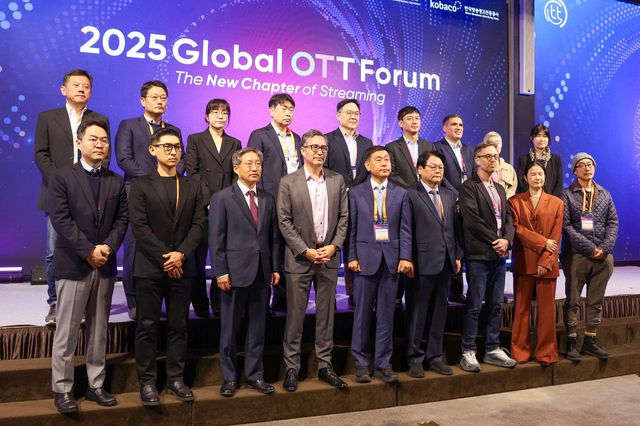
The global streaming industry is undergoing a profound transformation as it moves beyond traditional subscription models toward ad-supported and AI-powered business strategies. This shift took center stage at the 2025 Global OTT Forum, hosted by the Broadcasting, Media, and Communications Commission (BMCC) in Seoul, where more than 400 industry leaders and scholars gathered under the theme “The New Chapter of Streaming.”
The forum, held on Nov. 6, focused on the future of OTT (Over The Top) services—a term referring to digital platforms that deliver video content directly to viewers via the internet, bypassing traditional cable or broadcast channels. Popular examples include Netflix, YouTube, and Korea’s own TVING and Coupang Play. OTT platforms have revolutionized how audiences consume entertainment, giving users the freedom to stream movies, dramas, and live events anytime, anywhere.
Against this backdrop, the conference highlighted two powerful trends shaping the next phase of streaming: the rapid rise of AVOD (advertising-supported video-on-demand) as a sustainable revenue model, and the growing role of artificial intelligence (AI) in optimizing advertising efficiency, personalization, and audience engagement. At the same time, the event underscored Korea’s strategic ambition to help its homegrown K-OTT platforms expand onto the global stage.
AVOD Emerges as a Growth Engine
At the event, Sunghyun Cho, chief business officer of TVING, described AVOD as an irreversible trend and a stabilizing growth driver for OTT platforms. He predicted the global AVOD market would surge from 55 trillion Korean won (about $37.5 billion) in 2023 to 325 trillion Korean won (about $221.5 billion) by 2030.
Citing user behavior data, Cho noted that nearly half of all users globally—including 42 percent of Netflix users and 46 percent of TVING users—now choose ad-supported tiers. This signals a broad acceptance of ads in exchange for lower subscription costs. He emphasized that AVOD revenue is already a key growth engine for leading players, with Amazon Prime’s ad-supported revenue up 133 percent year-over-year.
Cho warned, however, that growth inevitably involves risk. Drawing a parallel with Google’s decision to introduce AI Overviews in its search results, he estimated that the new model would result in the loss of 10 percent to 20 percent of Google’s advertising revenue, as its most valuable ad placements would be sacrificed in pursuit of long-term AI leadership.
For example, he mentioned the 2025 animated film “K-Pop Demon Hunters,” produced by Sony Pictures and distributed by Netflix. While Sony earned approximately $20 million from the deal, Netflix generated an estimated $1 billion from distribution—a 50-fold difference. This example highlights how traditional models can cause content creators to miss significant growth opportunities.
AI Advertising: From Attention to Action
Hye Jeong Lee, head of CTV Partnerships at Moloco, stated that the future of streaming monetization lies in performance-based advertising powered by artificial intelligence.
She explained that although the global OTT audience exceeds 5.5 billion users, only a few platforms are consistently profitable. Citing YouTube’s turnaround, Lee said the platform’s shift toward action-oriented ad formats such as TrueView and Shop Now created an AI-driven cycle of learning, conversion, and reinvestment, turning attention into measurable business outcomes.
According to Lee, the current convergence of Connected TV (CTV) and AI is creating a new “performance media” ecosystem. Platforms such as Netflix and Amazon Ads are merging premium streaming attention with powerful e-commerce data, unlocking new advertising capital from fast-growth sectors such as gaming, beauty, and consumer goods.
Lee noted that AI technology is now capable of handling 660 billion ad requests per day using large-scale pattern recognition instead of personal identifiers. This development enables precise targeting while complying with strict global privacy rules.
Asia-Pacific Insights and Competitive Pressures
Closing the day’s sessions, Sam Yousif, managing director of AMPD Analytics, presented a data-driven overview of APAC streaming trends. He reported that subscription growth in Asia (excluding India) is slowing from an annual rate of 20 percent to 5 percent, as markets become more fragmented and competition intensifies.
According to Yousif, AVOD accounts for only 6 percent of total mobile digital time in South Korea, while YouTube dominates at 30 percent. With 70 percent of top-10 titles shared across multiple platforms, content exclusivity offers diminishing leverage in retaining subscribers.
The forum concluded with a discussion on illegal content distribution and strategies to safeguard the global competitiveness of K-content.
Zheng Xiangmei contributed to this report.