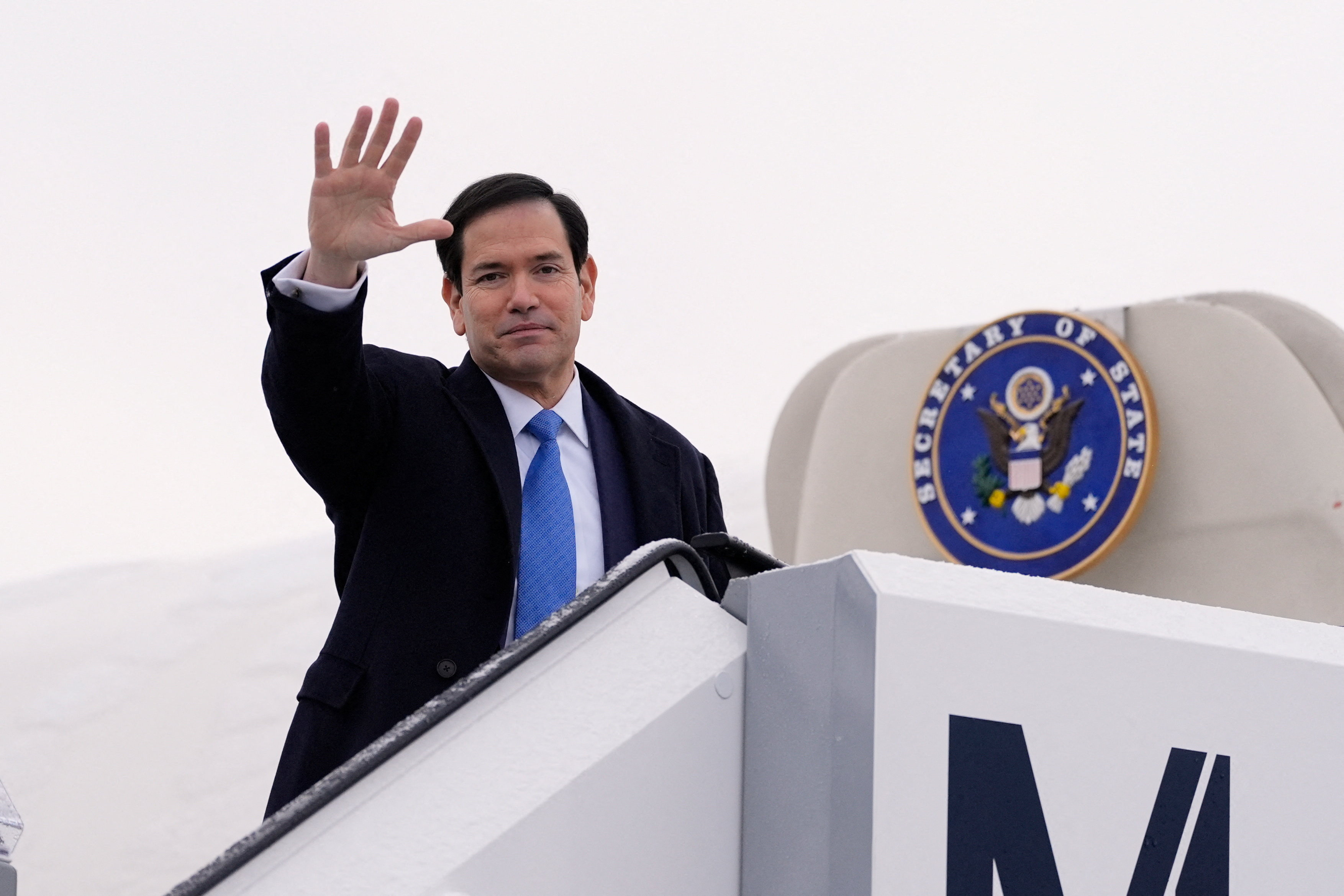
WASHINGTON—The Munich Security Conference wrapped up on Feb. 15, but Secretary of State Marco Rubio’s speech is still making waves in the United States and Europe.
At this year’s conference, Rubio delivered a speech on Feb. 14 with a strong warning to European leaders, telling them they have been trapped in a “dangerous delusion” since the fall of the Berlin Wall and the collapse of the Soviet Union.
Rubio said that the “euphoria of this triumph” led to a misguided belief that every country would become a liberal democracy, that borders no longer mattered, and that global trade rules would replace national economic interests.
Rubio’s speech made many European leaders uneasy, but he still received a standing ovation. Observers said his message resembled President Donald Trump’s earlier warnings to Europe, though Rubio delivered it in a more strategic way.
“What we saw in the speech was a masterclass in diplomacy by a U.S. statesman with substantial experience,” Fred Fleitz, who served on the National Security Council during Trump’s first term, told The Epoch Times.
Rubio’s effective strategy, according to Fleitz, was to open his speech by rejecting claims that the Trump administration is anti-Europe, plans to leave NATO, or believes the rules-based global order has ended.
“He just hit that out of the park by explaining that the U.S. and Europe have a long and historic relationship, that we need Europe, that America is ‘a child of Europe,’” said Fleitz, who is now vice chair at the America First Policy Institute.
During his speech, Rubio highlighted the strong historical ties between the United States and Europe, rooted in “shared history, Christian faith, culture, heritage, language, ancestry, and the sacrifices our forefathers made together.”
Rubio’s speech was considered less confrontational than Vice President JD Vance’s. In February 2025, Vance—in a speech at the same conference—criticized European leaders for clamping down on free speech and allowing mass migration. He said the biggest threat to Europe was “the threat from within, the retreat of Europe from some of its most fundamental values—values shared with the United States of America.”
European leaders welcomed Rubio’s tone.
“There’s a lot in the speech. It’s not just all stick. There’s a good amount of carrot too,” Luke Nichter, professor of presidential studies at Chapman University in Orange, California, told The Epoch Times.
“There’s a big section of the speech where Secretary Rubio really wants Europe to be stronger. He wants Europe to be stronger culturally, economically, and militarily.”
According to Fleitz, Rubio’s speech will encourage opposition movements in Europe.
The current leaders aren’t going to change their stance on migration and climate, he argued.
“But opposition movements in France, the UK, and Germany are already campaigning on these things, so Rubio is going to give them ammunition. If these leaders don’t change their policies, they'll be voted out,” Fleitz said.
‘The West’s Managed Decline’
Rubio criticized policies in Europe and the United States over the past several decades, which he described as contributing to “the West’s managed decline.”
“We made these mistakes together,” he said.
He argued that the excessive expansion of welfare states has come at the expense of national defense, noting that U.S. rivals have increased military spending and used hard power to pursue their national interests. He urged Europe to take greater responsibility for its own defense.
“To appease a climate cult,” Rubio continued, “we have imposed energy policies on ourselves that are impoverishing our people.”
He described decades of deindustrialization and the loss of supply chain sovereignty as “foolish” policies. He also said that mass migration remains a crisis that is destabilizing societies throughout the West.
He said that under Trump, the United States is now working to correct its course and urged Europe to join the effort.
“The speech was consistent with the recently released agency strategic plan for the U.S. Department of State,” Michael Walsh, a foreign policy expert, told The Epoch Times in an email. “It was the main theme for the Europe pillar just presented in a less formulaic style.”
The report released in January stated that Europe must regain its strength “to remain a useful partner for the United States.”
Europe’s Reaction
European leaders responded to the speech with measured reactions.
“I was very much reassured by [Rubio]. We know him, he’s a good friend, a strong ally,” European Commission President Ursula von der Leyen told German outlet Deutsche Welle after the speech.
German Foreign Minister Johann Wadephul told the same outlet, “I wouldn’t say that we have 100 percent overlapping between our priorities and the priorities from the U.S. side, but I would say this is really a common ground for a bright future between the United States and Europe.”
Speaking during a panel discussion at the Munich Security Conference hosted by Euronews, EU foreign policy chief Kaja Kallas dismissed the notion that Europe is in decline.
“Contrary to what some may say, woke, decadent Europe is not facing civilizational erasure. In fact, people still want to join our club,” Kallas said, citing countries that want to join the EU.
According to observers, many European politicians were unhappy with Rubio’s message, though they avoided publicly criticizing it.
“Most of us view politics from the cheap seats, where it looks like a bit of kabuki theater,” Nichter said. “What’s being said in public could be very different than what’s being said in private.”
Fleitz said that while most gave Rubio a big applause, they didn’t like the speech.
“They don’t want to change their policies,” he said.
It is unclear whether Rubio wrote his speech himself or received help from a speechwriter. The State Department did not respond to a request for comment.
Before joining the Trump administration as secretary of state, Rubio represented Florida in the U.S. Senate from 2011 to January 2025, serving on key committees, including the Senate Intelligence Committee and the Senate Foreign Relations Committee.
According to Fleitz, Rubio’s background and experience explain the authority he projected during the speech.
“He wasn’t just reading the speech. He knows this material.”