
Commentary
“Tolerance does not mean ‘anything goes.’ There must be zero tolerance towards all those who show no respect for the inalienable rights of the individual and who violate human rights. Zero tolerance must also be shown if, for example, weapons of mass destruction fall into the hands of Iran and possibly threaten our security.
“Iran must be aware of this. Iran knows our offer, but Iran also knows where we draw the line: A nuclear bomb in the hands of an Iranian president who denies the Holocaust, threatens Israel, and denies Israel the right to exist, is not acceptable!”
Amid U.S.-led preemptive and retaliatory strikes in Iran, you may be forgiven for thinking that this is an American president, speaking as recently as 2025 or earlier in 2026. It isn’t. It’s a European voice on U.S. soil: the German chancellor at the time, Angela Merkel, addressing the U.S. Congress in 2009, passionately arguing that better U.S.–European ties are crucial for a better world.
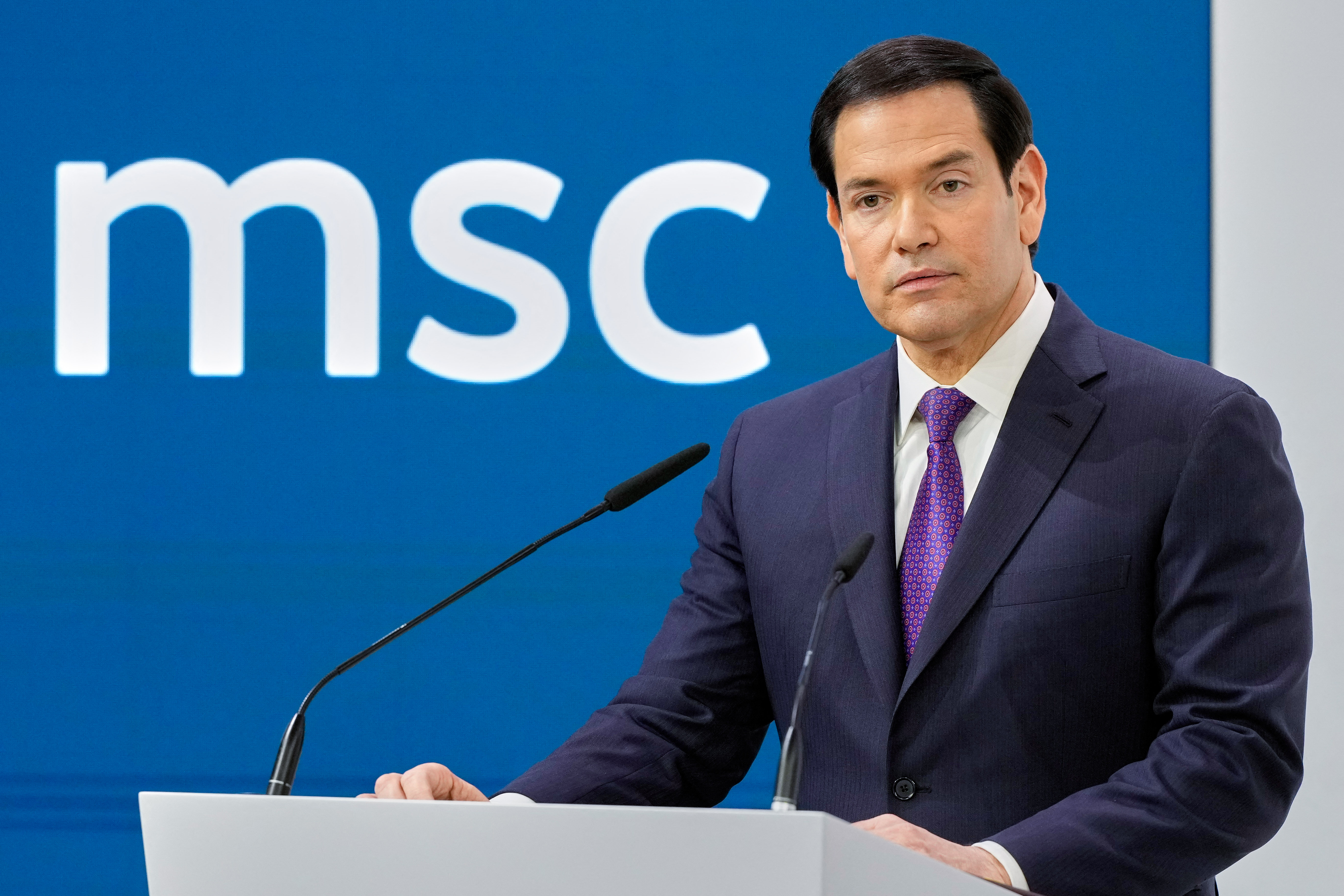
That’s a useful segue to another, more recent speech. This time, an American voice on European soil: Secretary of State Marco Rubio, addressing the Munich Security Conference on Feb. 14, 2026, inviting a renewed transatlantic alliance to reclaim and revive a declining West. Few recent foreign policy speeches have proved as controversial, or as divisive.
Yes, America’s and Europe’s joint victory against communism in the 20th century deserves praise. But Rubio cautioned that the reunification of east and west blocs and a subsequent era of prosperity and peace bred complacency, delusion, and dogmatism.
He said: “We embraced a dogmatic vision of free and unfettered trade, even as some nations protected their economies and subsidized their companies to systematically undercut ours—shuttering our plants, resulting in large parts of our societies being deindustrialized, shipping millions of working- and middle-class jobs overseas, and handing control of our critical supply chains to both adversaries and rivals.
“We increasingly outsourced our sovereignty to international institutions while many nations invested in massive welfare states at the cost of maintaining the ability to defend themselves. This, even as other countries have invested in the most rapid military buildup in all of human history and have not hesitated to use hard power to pursue their own interests.
“To appease a climate cult, we have imposed energy policies on ourselves that are impoverishing our people, even as our competitors exploit oil and coal and natural gas and anything else—not just to power their economies, but to use as leverage against our own. And in a pursuit of a world without borders, we opened our doors to an unprecedented wave of mass migration that threatens the cohesion of our societies, the continuity of our culture, and the future of our people.”
Rubio’s note of tough love to Europe may be, as some say, “unprecedented” or novel, but it isn’t new. So the implication, among a section of the commentariat, that it’s somehow different from what respected Western leaders have said for a century, is misplaced.
For instance, Howard French, a columnist at Foreign Policy magazine, called Rubio’s speech “dangerous.” Harvard University’s Mathias Risse wrote that by couching “civilizational panic” in the language of statecraft, Rubio’s ethic of Judeo-Christian Western expansionism gives human rights short shrift. And Stanford University’s Francis Fukuyama distinguished between Western civilization’s undeniably Christian origins and the Enlightenment-driven realpolitik it supposedly spawned.
Western Introspection
The United States, Rubio clarified, aspires to a transatlantic alliance that draws on the best, not the worst, of Western civilization. This is more than preserving and protecting a mere geography, it’s about nurturing an idea, an increasingly endangered idea. That’s in sync with what respected Western leaders have said over decades.
In 1946, Winston Churchill pictured communism’s threat to “Christian” civilization. He called for “Western democracies” to unite to protect and defend a way of life that mattered. Gratefully he thanked America for twice sending millions of its young men across the Atlantic to preserve Europe and therefore the world.
In 1982, President Ronald Reagan celebrated Western ideals of individual liberty and representative government but stressed the rule of law “under God.”
In 1988, British Prime Minister Margaret Thatcher, a longtime champion of transatlantic ties, called the Western Judeo-Christian tradition “infinitely precious” because it can “provide the moral impulse which alone can lead to that peace.”
In 1990, Czechoslovakian President Vaclav Havel singled out America as an ideal partner for Europe because it has “never been disrupted by a totalitarian system.”
In 2009, Merkel said, what brings (and keeps) Europe and America together is not just “shared history” but “shared values” around human dignity. Recalling the potentially ruinous wake of the fall of the Berlin Wall, she thanked “the 16 million Americans” stationed in Germany “over the past decades” without whose help Europe would have stayed divided.
Updating Western Introspection
How is Rubio’s message novel?
It reflects a relatively recent awakening among some European leaders to Western blind spots.
Recently, Italian Prime Minister Giorgia Meloni invoked Western philosopher Roger Scruton’s use of the word “oikophobia,” from the Greek “oiko” (or home) and “phobia” (or fear). She called this Western habit of self-loathing and aversion to one’s home “a mounting contempt, which leads [Westerners] to want to violently erase the symbols of [their] civilization, in the US as in Europe.”
Sure, analysts have long spotlighted the devastation caused by the “war on the West,” but this is probably the boldest articulation of it by a foreign policy chief.
Like Western voices before him, Rubio too envisages America’s leadership, but alongside a Europe unshackled by “guilt and shame,“ a Europe that recognizes this shared Western inheritance as “unique and distinctive and irreplaceable.” The United States, he said, refuses to be an orderly caretaker of the ”West’s managed decline.“ His callback to shared culture and shared values bears an edge of urgency because we ”do not live in a perfect world.”
The relatively good-faith world that welcomed Reagan’s offer of democracy as an ideal no longer exists. In an age of cyberattacks, artificial intelligence, and fake news, there are simply too many bad-faith actors weaponizing against the West an ethos of open borders, apocalyptic climate alarmism, grievance, entitlement, and reparations. Worse, many mainstream journalists, academics, and activists insist on rights divorced from responsibilities for everyone except the West.
Analysts now routinely write of the “waning of the West’s primacy” and a “post-Western” or “post-American” global order.
So Rubio chided Western “complacency.” He implied that although Europe frets over whether its every decision is more diverse, equitable, and inclusive of the geopolitical (not geographical) developing nations of the global south, others are scripting a world less representative of the West than ever. It’s fine for people to rally around catchy U.N. slogans such as “leave no one behind.” But what does one do, Rubio seemed to ask, when those same people start insisting that it’s the West that must be left behind?
Far from finger-wagging, Rubio acknowledged America’s joint responsibilities: “We made these mistakes together.” Few foreign policy speeches today allow for this sort of brave, honest, public introspection—or such an unsparing declaration of intent. He was hinting that mistakes will be made in the present and future, too, but should fear of not doing things well always prevent the West from doing the right things?
Yes, a bright future awaits the West, but only, Rubio insisted, if it stops rationalizing “the broken status quo.” He was inviting Europe to step up more as an equal now, economically, militarily, culturally. This isn’t an unprovoked call for Western hegemony, or as some say, “civilizational panic.” It’s a strategic response to a strategic undermining of the Western way of life.
Europe needn’t always agree with the speed or style of America’s response. But Rubio is hoping that it will at least now better recognize and respond to the novel challenges the West faces. When he said it is only because America cares about transatlantic ties that “Americans may sometimes come off as a little direct and urgent in [their] counsel,” he was echoing a European voice back to Europe.
More than 15 years ago, Merkel admitted that America and Europe have disagreements: “One may feel the other is sometimes too hesitant and fearful, or from the opposite perspective, too headstrong and pushy. And nevertheless, I am deeply convinced that there is no better partner for Europe than America.”
Correction: A previous version of this article misspelled the name of Italian Prime Minister Giorgia Meloni. The Epoch Times regrets the error.