If you can reach the end of your life feeling the way the first of Rachmaninoff’s “Symphonic Dances” feels, you’re going to be all right.
Go ahead—listen to this glorious statement of optimism and ecstasy. Preceding it with an analysis would be all wrong. I’ll still be here when you’re done. (Conducted by Tugan Sokhiev with the Berliner Philharmoniker, listen to the first dance only; you can turn to the others another time.)
Finished? You see, then. You’ve danced and sung your way through a field of innocent pleasure to a serene place of hymnlike peace. And you don’t even know how you got here. Those 12 minutes were spent not where you seem to be, but where you really are.
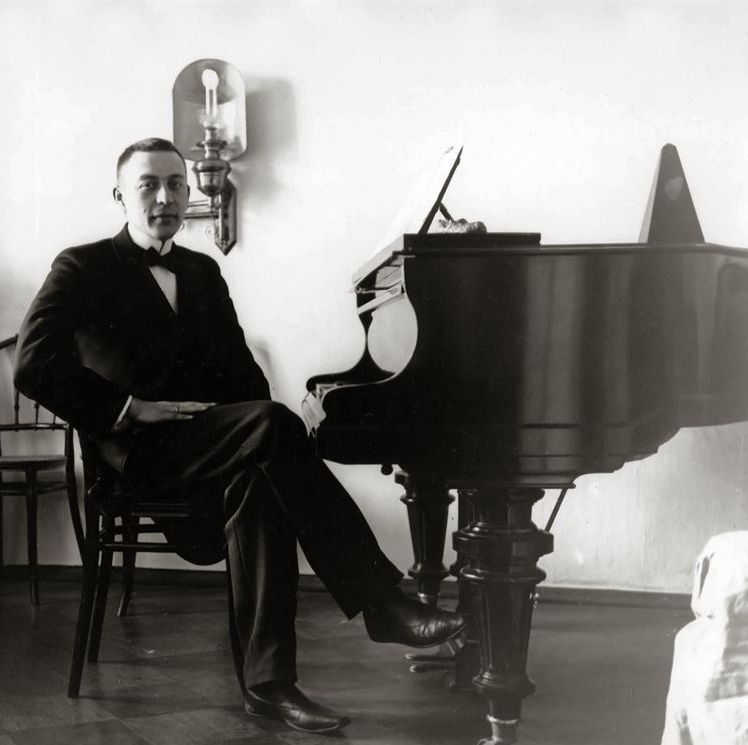
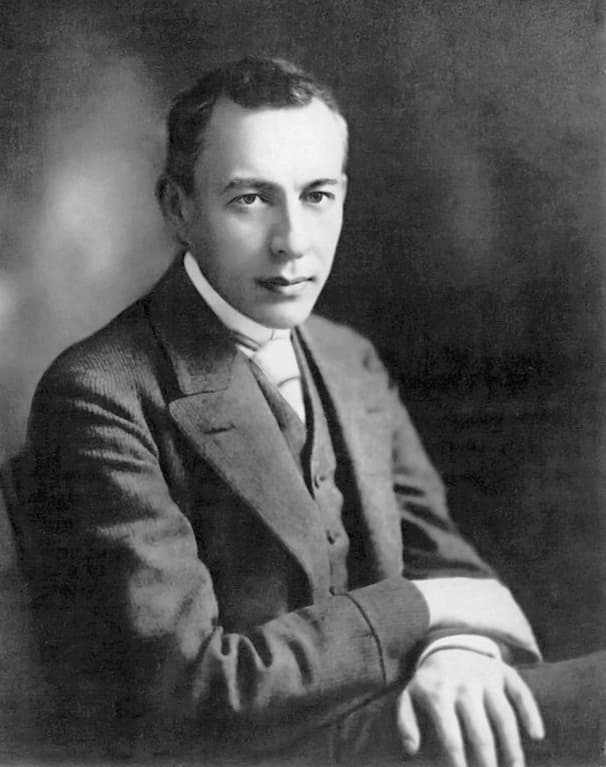
Sergei Rachmaninoff was one of the 20th century's most influential composers. (Public Domain)
A Final Statement in Exile
The “Symphonic Dances, Op. 45” was the final work of Sergei Rachmaninoff (1873–1943). It was 1940. The composer lived in Centerport on New York’s Long Island, far from the Russia of his birth, a country that had transmogrified into the Soviet Union, forcing his exile. He had already enjoyed enormous success as a composer and pianist, penning four piano concertos (five if you count the “Rhapsody on a Theme of Paganini”), three symphonies, dozens of solo piano pieces and choral music that has yet to be given its due. But he still had something to say.
The three pieces were originally called “Noon,” “Twilight,” and “Midnight.” Rachmaninoff withdrew the titles but kept their respective sensibilities of pure light, fading light, and absence of light. The first is especially successful in celebrating the cloudless revelation of midday, evocative of Friedrich Nietzsche’s “Great Midday,” the peak of illumination and truth.
How does he do it? Rachmaninoff, like (arguably) all great Western composers, and perhaps a few not-great ones, had discovered the following paradox: While music consists of melody, harmony, and rhythm, in the deepest Western traditions melody is harmonic, harmony is rhythmic, and rhythm is melodic. The musical experience is an indivisible whole, with aspects intertwined.
Let’s listen again to the opening of Symphonic Dance No 1. (Listen)
At the start, the simplest little eighth-note pulse—pure rhythm. What emerges immediately? A bit of melody in the form of a dropping three-note motif. At 0:22, harmony, in the form of big block chords punctuated by timpani, sets the key of C minor. With all three elements firmly in place, the three-note melodic motif becomes a full-blown melodic subject (0:41). This will get kicked around and turned upside down until at 1:06 an intense two-chord cadence pulls all the previous material together. The subject is developed extensively. At 2:32 to 2:33 comes another potent, two-chord cadence.
At 2:58, the oboe signals a key change in preparation for what might be called the final great songlike melody of the composer’s melody-drenched life. Rachmaninoff composed most of his famous melodies for the piano, naturally enough, considering his fame as a great pianist. One was written for the voice: his famous “Vocalise.”
An Unexpected Voice: The Saxophone
He wrote this one for … the alto saxophone? One theory is that Rachmaninoff was impressed with the orchestrations made for Broadway shows by Robert Russell Bennett, which used saxophone prominently; or perhaps he was simply searching for new timbres and the saxophone was about as new—and as American—as one might imagine.
The solo is long, sustained, and ineffably beautiful, unwinding over roughly two minutes, accompanied only by other wind instruments. At 5:35, violins and cellos take up the melody, accompanied by piano and harp, with woodwinds joining later. At 7:57, the bass clarinet initiates a return to the opening theme in all its rhythmic glory.
That would seem to be it, but no: At 10:42, the strings produce a serene halo of C major over the whole proceeding, concluding our dance with a hymnlike coda.
Bright with rhythms, deep with beauty, orchestrated with an ear to produce fresh combinations of color, Symphonic Dance No. 1 is one of my feel-good pieces, an assurance of something good in an uncertain universe.
What arts and culture topics would you like us to cover? Please email ideas or feedback to features @epochtimes.nyc.