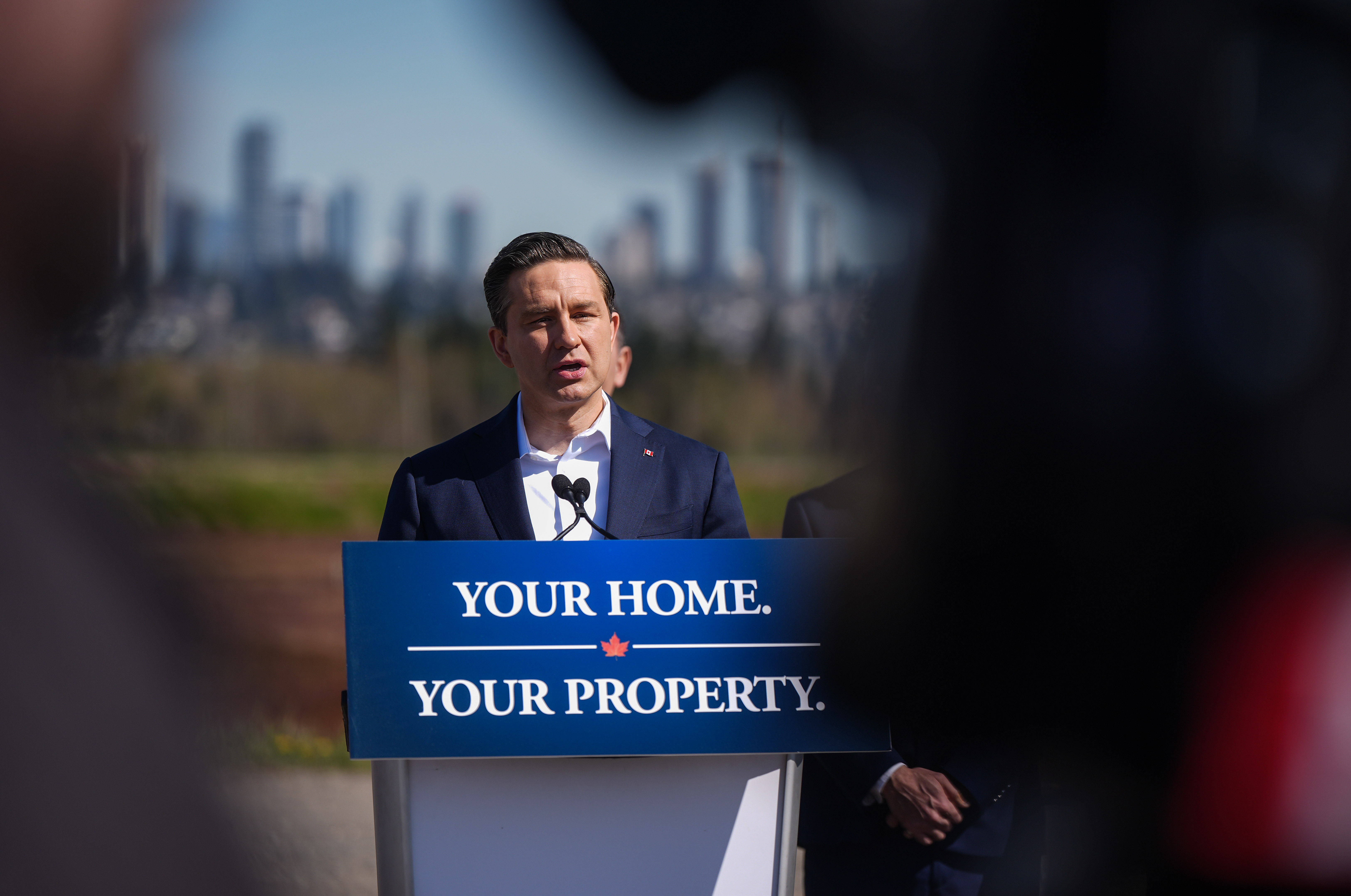

Tory Leader Pierre Poilievre says his party will oppose federal ratification of a treaty approved in B.C. with the K’ómoks First Nation that recognizes self-government, resource, and land rights.
Poilievre said the treaty raises concerns about private property rights and ties into broader issues with B.C. and Canada’s implementation of the United Nations Declaration on the Rights of Indigenous Peoples (UNDRIP).
“The K'ómoks Treaty also refers to itself as a living agreement, meaning that it will never be settled, that it could be renegotiated with more and more demands for decades to come,” Poilievre said June 19 during a press conference in Vancouver. “Enough is enough.”
K'ómoks First Nation is a Vancouver Island First Nation in the Comox Valley near Courtenay and Comox. It has some 350 members, according to the B.C. Treaty Commission.
Negotiations for a treaty started in 1994, leading to an agreement-in-principle in 2012 and a final treaty that was signed in 2024 and ratified by a majority of K’ómoks members in March of last year.
The treaty would establish a constitutionally protected self-government framework for K'ómoks First Nation, replacing aspects of Indian Act governance and providing law-making authority in specified areas.
The B.C. legislature passed Bill 20, the K'ómoks Treaty Act, on May 28 of this year but it is not yet in effect as it still requires federal implementation via legislation passed in Parliament and final ratification between B.C., K’ómoks, and Ottawa.
Poilievre said the treaty’s references to UNDRIP, along with provisions that allow periodic amendment, could impact private property rights in the future.
“UNDRIP threatens Canada’s parliamentary sovereignty, rule of law, resource development, and property rights,” he said, arguing that the treaty does not clearly explain how it will protect fee-simple private-property owners.
In a statement released June 19, the Conservative Party said treaties should provide “long-term certainty and finality,” arguing that the K’ómoks treaty does the opposite.
UNDRIP is a non-binding 2007 U.N. resolution calling for recognition of indigenous self-government, land rights and sovereignty around the world. Parliament passed legislation in 2021 requiring the federal government to work toward aligning federal laws with UNDRIP and to develop an action plan for its implementation.
The Liberal platform states that implementing UNDRIP remains a commitment for the federal government and is part of “long-lasting reconciliation” with indigenous peoples.
Poilievre argued that the K’ómoks treaty creates further uncertainty over private property rights in the wake of last summer’s landmark Cowichan decision as well as this past December’s Gitxaala ruling.
Last August, the B.C. Supreme Court recognized Aboriginal title held by the Cowichan Tribes over approximately 800 acres in Richmond, B.C. The decision held that Aboriginal title claims are not automatically barred because land is held under fee-simple ownership, though the case did not involve residential private property and did not extinguish existing private property interests.
The ruling nevertheless raised concerns among some landowners and property-rights advocates about the potential implications of future Aboriginal title claims involving privately owned land.
In the Gitxaala case, courts found that British Columbia’s mineral claims system didn’t adequately uphold the Crown’s duty to consult indigenous nations before mineral claims were registered. The decision also highlighted the relevance of B.C.’s Declaration on the Rights of Indigenous Peoples Act (DRIPA) and the principles of United Nations Declaration on the Rights of Indigenous Peoples (UNDRIP) in interpreting and developing provincial laws affecting indigenous rights.