On the evening of Aug. 13, 1898, Gustav Witt, the German astronomer and director of the Urania Observatory in Berlin, and his assistant, Felix Linke, planned to locate the asteroid, Eunike. It had been nine years since its last observation. By use of the observatory’s telescope and photographic plates, Witt and Linke scoured the images. They found Eunike, as well as another previously known asteroid, Althrea.

German astronomer Gustav Witt who discovered a new asteroid in 1898. (Public Domain)
“We also found a third faint and indistinct trace,” Linke recalled in Scientific American magazine, “apparently made by a body in very rapid motion, for the length of the mark was about 0.016 inch, twice the length of the other traces.”
The German astronomers wondered if they had found a comet. The next night they pointed the telescope in the direction of the new discovery. Studying the resulting photographic plates, Witt and Linke concluded “the object was evidently not a comet, it was classed as an asteroid.” The asteroid was named 1898 DQ.
At the same time, in France, Auguste H.P. Charlois, working in the Nice Observatory, made the same discovery while studying his plates. The German and French astronomers had hit upon a major astronomical discovery. The 1898 DQ was the first Near-Earth Asteroid (NEA) ever discovered. With this major first, Witt decided to add another first. Instead of giving it a female name, typically after a Greek or Roman deity, he named it Eros, after the Greek god of love.
Eros and NASA
Upon further observation, Eros (433 Eros to be precise) proved to be about twice the size of Manhattan Island, at 21 miles long, 8 miles wide and 8 miles thick. This potato-shaped asteroid with a point farthest from the sun of 1.78 Astronomical Units (AU) and a a point nearest to the sun of 1.13 AU, rotates every 5 hours and 16 minutes. As a point of reference, an AU is approximately 93,000,000 miles—the average distance between the Earth and the Sun. The asteroid, also considered a minor planet, experiences extreme conditions, reaching a temperature of 212 degrees Fahrenheit during the day and -238 degrees Fahrenheit at night.
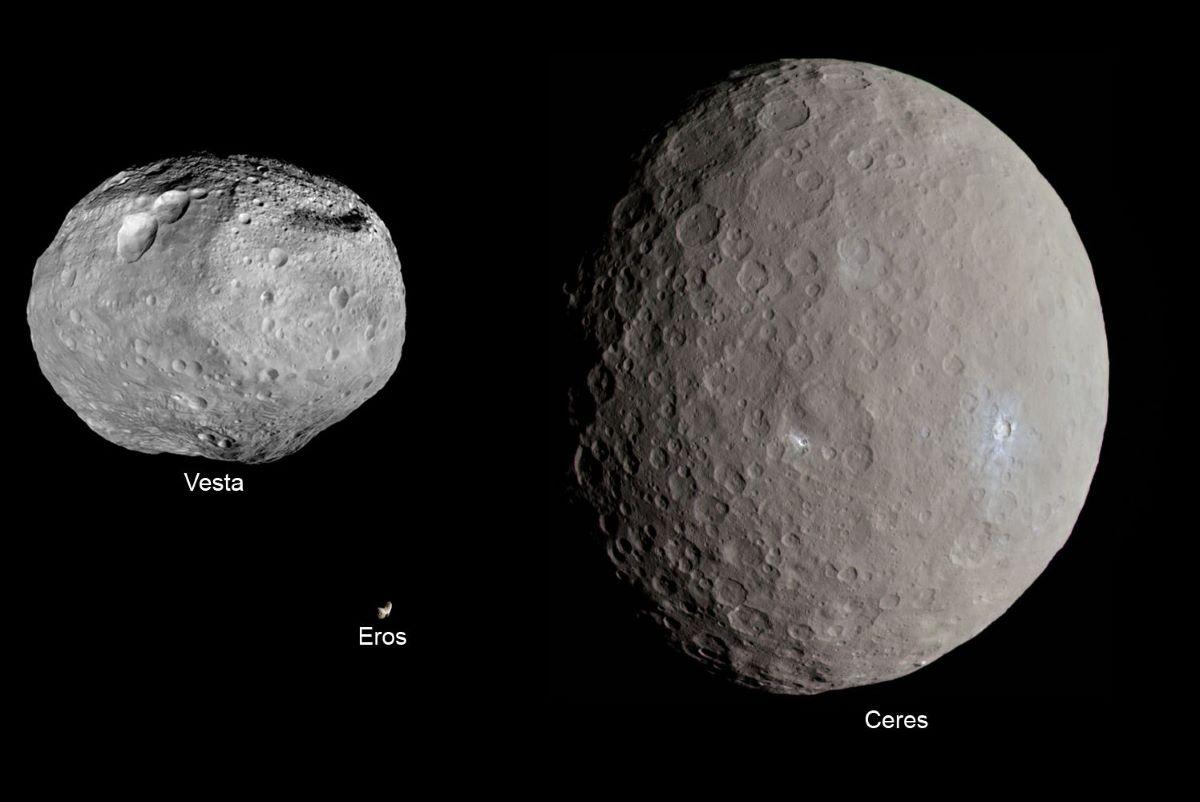
Size comparison of Vesta, Ceres and Eros. Image modified. NASA/JPL. (Public Domain)
Although Eros was the first NEA, it was not the first asteroid to be discovered. The first to be discovered was Ceres in 1801 by the Italian Catholic priest, Giuseppe Piazzi. It could be argued that Ceres was not the first asteroid discovered, as Ceres is now classified as a dwarf planet (one of the Solar System’s five, thus far discovered). In this case, Pallas was the first. Since the 1801 discovery, over a million asteroids have been discovered. Since Eros’s discovery, more than 40,000 NEAs have been located, including nearly 30,000 since 2010.
During the Space Race of the 20th century between America and the USSR, the Soviets became the first to land a spacecraft on a celestial body. In fact, they were the first to land on the moon, Mars, and Venus. The Space Race came to an end (perhaps unofficially) in 1975.
By this time, the last Apollo Mission had been in the books for three years. Soviet and American space competition had thawed somewhat into a collaboration with the Apollo-Soyuz Test Project, which witnessed an American spacecraft dock with a Soviet spacecraft. As the 1970s gave way to the 1980s, NASA found it difficult to obtain congressional funding for its major projects. It needed to adjust and scale down its aspirations.
Getting NEAR
In 1989, a strategic planning session for the Solar System Exploration Division of NASA’s Office of Space Science and Applications was held June 26 to 30 at the University of New Hampshire. The objective was to formulate ways to conduct interplanetary missions at a fraction of the traditional cost. The scientists took some pages out of NASA’s smaller, unmanned missions, like Mariner, Pioneer, and Voyager from the previous decades. Along with planets, the scientists discussed visiting asteroids and dwarf planets as well. During one of the sessions called “Planetary Small Missions Program,” the idea of Near-Earth Asteroid Rendezvous (NEAR) was presented.
It became clear that these missions could be accomplished relatively cheaply (capped at $150 million). Thus began NASA’s Discovery Program. Considering no space program of any country had landed a spacecraft on an asteroid, the Discovery Program’s first effort would be a NEAR mission. The NASA scientists knew exactly which asteroid to choose: Eros.
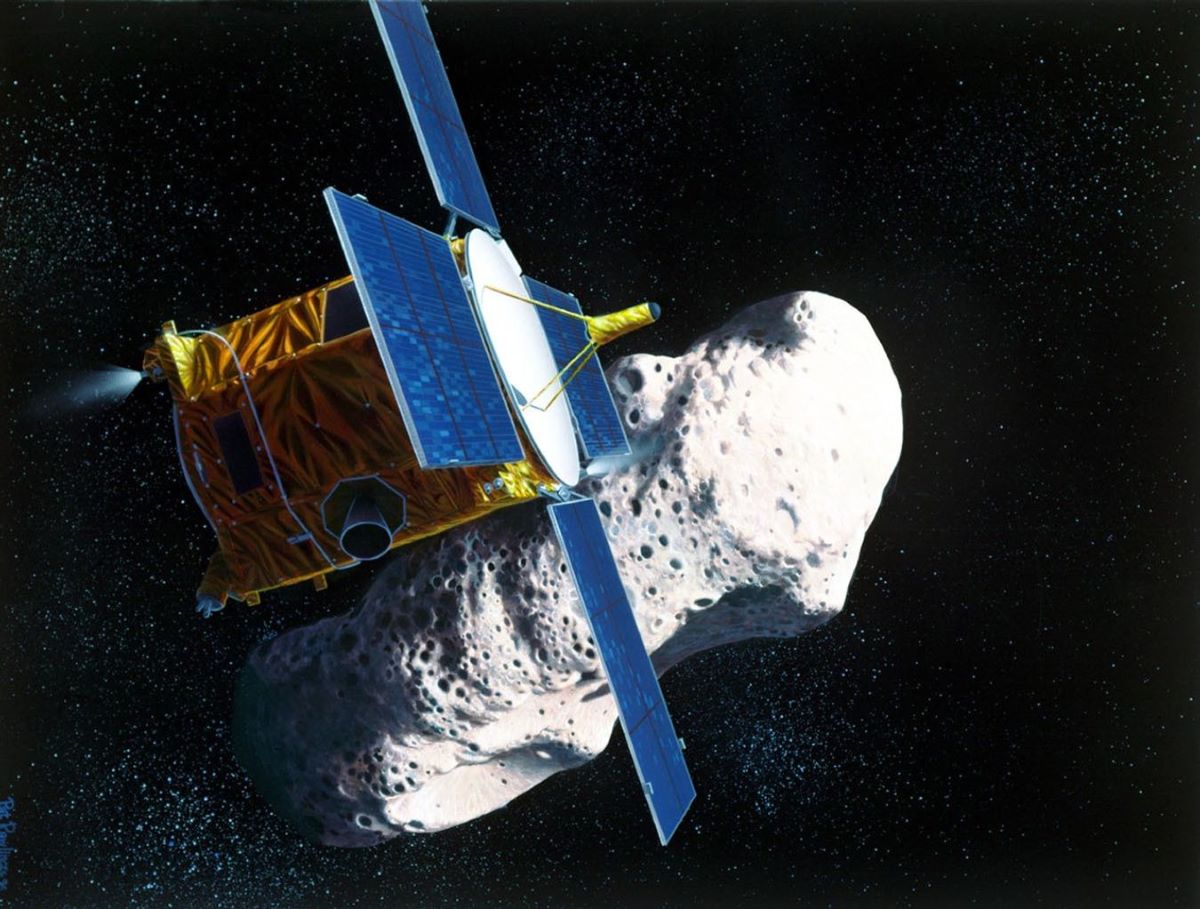
Coordinating with the Applied Physics Laboratory (APL) at Johns Hopkins University, scientists and engineers began constructing the NEAR spacecraft in 1993 with a projection that it would be completed in 29 months (it was completed in 26). The octagonal spacecraft was assembled with visible-light imager; a laser rangefinder; infrared spectrograph to determine temperature, density, chemical composition, and velocity; a three-axis magnetometer to measure the magnetic field; an X-ray/gamma-ray spectrometer to “sense X-ray and gamma-ray emissions … to determine [Eros’s] elemental composition”; and a two-way Doppler telecommunications system.
According to NASA, NEAR’s objectives were “to gather data on its physical properties, mineral components, morphology, internal mass distribution, and magnetic field.”
NEAR Launches
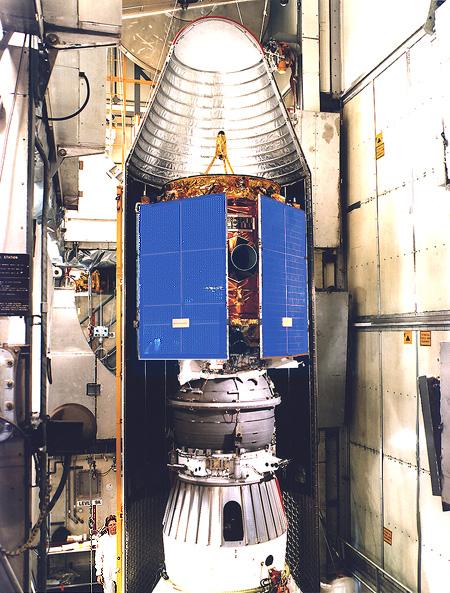
NEAR spacecraft inside its Delta II rocket. NASA. (Public Domain)
The 1,775-pound spacecraft would be thrust out of Earth’s atmosphere by the Delta 7925-8 rocket booster, rushing it toward Eros which orbited the sun approximately 221 million miles away. The journey to Eros was projected to take a few years.
It was during this week in history, on Feb. 17, 1996, that NEAR launched and began its multiyear interplanetary journey toward Eros. About 17 months into its journey, NEAR required a course correction which brought it back toward Earth to conduct a gravity assist. This allowed the spacecraft to use Earth’s gravitational pull to slingshot it toward Eros interplanetary gravity assist had first been conducted in 1974 with the Mariner 10).
NEAR was scheduled to reach Eros in January 1999, but an engine malfunction on Dec. 20, 1998, forced NASA to adjust. NEAR passed Eros on Dec. 23 at a range of about 2,380 miles away, enabling it to observe about 60 percent of the asteroid. The engine malfunction delayed the orbit of the asteroid by about a year, but—fittingly, for the asteroid’s name—on Feb. 14, 2000, NEAR finally began its orbit of Eros.
Orbit and Landing
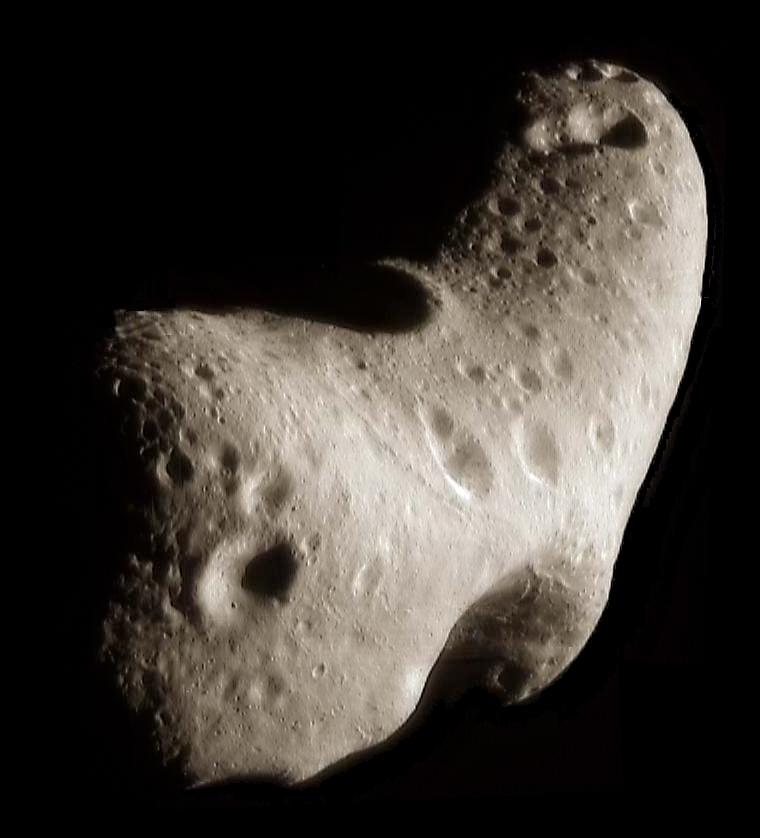
Near-Earth asteroid Eros as seen from the NEAR spacecraft. NASA/JPL/JHUAPL. (Public Domain)
The NEAR spacecraft became the first spacecraft to orbit a minor planet. Its initial orbiting parameters were 200 miles by 225 miles, but, by April 30, it had closed to within 31 miles. Also, by this time, NEAR was renamed NEAR Shoemaker in honor of the renowned American planetary geologist, Eugene Shoemaker, who had died months after NEAR’s launch. By Oct. 26, it had closed to within three miles as NASA scientists began preparations to land NEAR Shoemaker on Eros.
On Feb. 12, 2001, a year after beginning its orbit and five years after its launch from Earth, NEAR Shoemaker slowed to approximately 4 mph, in the hope of avoiding a crash landing. As it slowly settled upon the 4.6 billion-year-old surface, the spacecraft became the first to land safely on an asteroid. Its survival on the minor planet, however, was short lived due to the freezing conditions. By Feb. 28, the spacecraft stopped sending signals. Nonetheless, NEAR Shoemaker far exceeded expectations, sending about 10 times the data anticipated, including approximately 160,000 images.
As the Johns Hopkins APL site aptly asserted, “NEAR Shoemaker now rests silently on Eros, having succumbed to the cold of deep space nearly two decades ago—and setting a high bar for low-cost planetary exploration that guides missions today.”
Never miss a This Week in History story! Sign up for the American History newsletter here.
What arts and culture topics would you like us to cover? Please email ideas or feedback to features@epochtimes.nyc