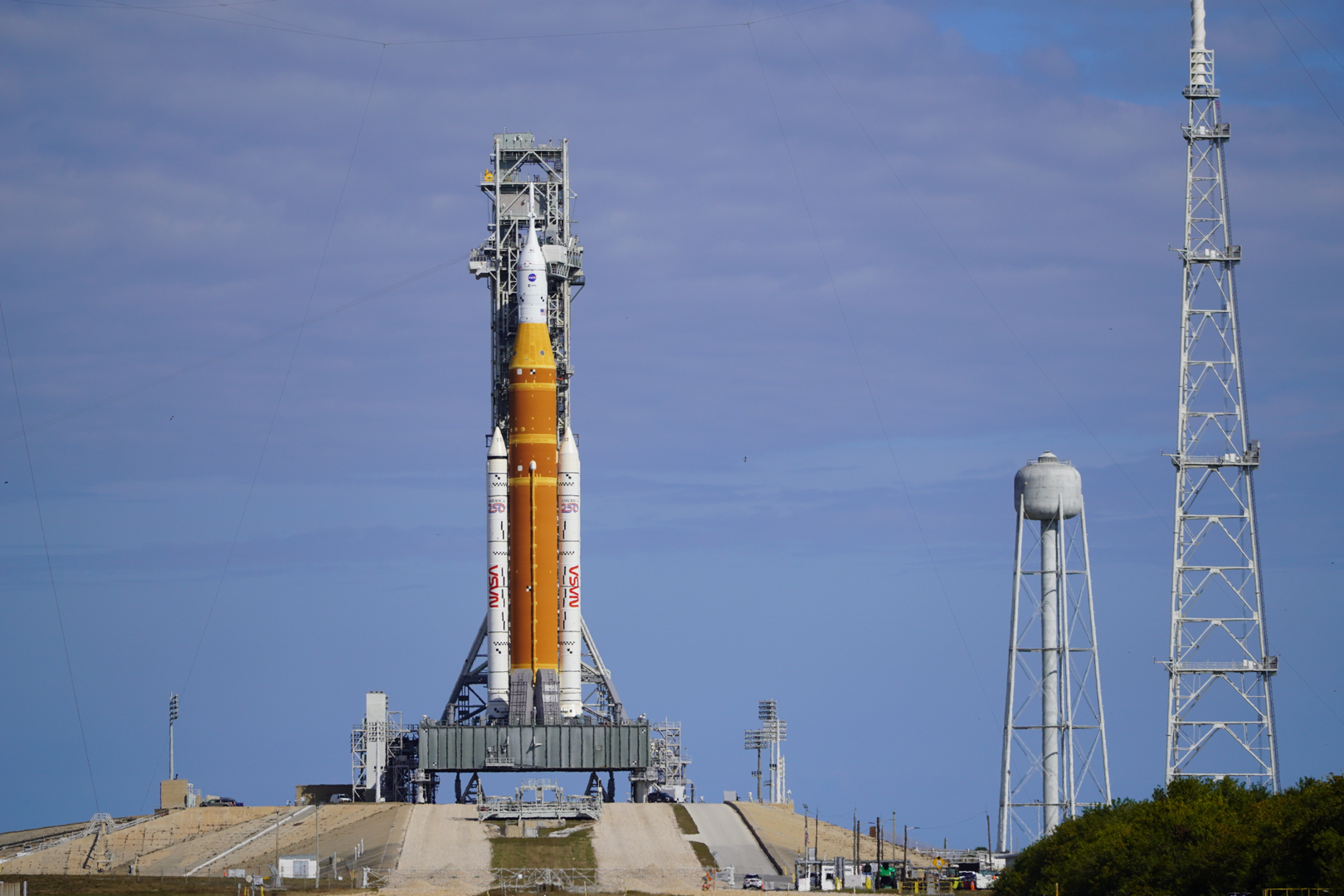

CAPE CANAVERAL, Fla.—The initial results of NASA’s second launch-day dress rehearsal of the Artemis II manned flight around the moon gave mission leaders the confidence to target March 6 as the earliest possible launch date.
The confirmation was given by Lori Glaze, manager of NASA’s Moon to Mars program, at a post-dress-rehearsal press conference at Florida’s Kennedy Space Center. She also confirmed that the Artemis II crew—NASA astronauts Reid Wiseman (commander), Victor Glover (pilot), and Christina Koch (mission specialist), and Canadian Space Agency astronaut Jeremy Hansen—would enter quarantine in Houston, Texas, on Feb. 20, in preparation for launch.
Glaze was joined by Artemis Launch Director Charlie Blackwell-Thompson and Artemis II Mission Management Team Chair John Honeycutt, who shared their excitement at the initial results and praised the work of the entire mission’s workforce for all they did to get the launch vehicle to this point.
However, the three leaders emphasized that the launch date was still pending a multi-day launch readiness review set for next week. The full results of the dress rehearsal operations still need to be analyzed, and more work still needs to be completed at the launch pad.
“I feel like at this point, we have demonstrated a significant amount of improvement to where I am almost happy,” said Honeycutt, whose team is responsible for assessing all mission risks.
Launch controllers reported to their stations on Feb. 17 and over the course of approximately 50 hours put the moon rocket and Orion spacecraft through its pre-launch and launch-day operations.
Officially called a “wet dress rehearsal,” one of the critical milestones involves completely filling the rocket with its propellant. The first attempt to complete the run-through on Feb. 2 were stopped prematurely due to a persistent fuel leak, as well as other challenges that had to be overcome, which caused mission leaders to push any launch attempt past February to early March.
Blackwell-Thompson explained that two fuel line seals at the base of the rocket’s core stage were isolated, replaced, and tested. After the first dress rehearsal, she said that the mission could tolerate some hydrogen leaking so long as the proportion of escaping hydrogen did not account for more than 16 percent of the atmosphere. After the second dress rehearsal, Blackwell-Thompson said that percentage did not exceed 1.6 percent.
Some issues were initially accounted for during the fully integrated checkout test, she said. There was a momentary loss of communications during the fueling process, and an anomaly was detected on one of the two white solid rocket boosters that caused a short pause in the countdown.
These issues were all mitigated, and launch controllers were able to successfully get through all the objectives in the countdown down to the planned stop at T-minus 33 seconds, then recycle the countdown and procedures back up to T-minus 10 minutes, and progress down again to just T-minus 29 seconds, she said. All of this was accomplished within the simulated window of opportunity to launch the rocket.
“Our [Space Launch System] chief engineer, and my friend, John Blevins, often says, ‘You have to earn your right to fly,’” Blackwell-Thompson said. “And I felt like last night was a big step in us earning our right to fly. So [it] felt really good, [I’m] very proud of the team because they continue to work through the challenges.”
Going forward, crews were expected to return to Launch Complex 39B to begin several days of work on the rocket. Temporary platforms will be raised on the launch pad to allow service access to certain parts of the rocket, and the closeout crew will run through their procedures to pressurize and seal the astronauts in the crew capsule in preparation for launch.
While she praised the closeout crew for their work during the dress rehearsal, Blackwell-Thompson told The Epoch Times that there was no full trainer system that allowed them to practice the complete procedure outside of the crew loading area on the launch pad called “the White Room.”
If all goes well, humanity’s first manned flight around the moon in more than 50 years will set off as early as 8:29 p.m. ET on March 6. Glaze said the Artemis II crew will travel to Kennedy Space Center five days before launch and continue the quarantine they started in Texas.
“The excitement for Artemis II is really, really starting to build,” she told members of the press. ”We can really start to feel it. It’s coming, and I really can’t wait to welcome you all back here to Kennedy Space Center when we’re ready to fly.”