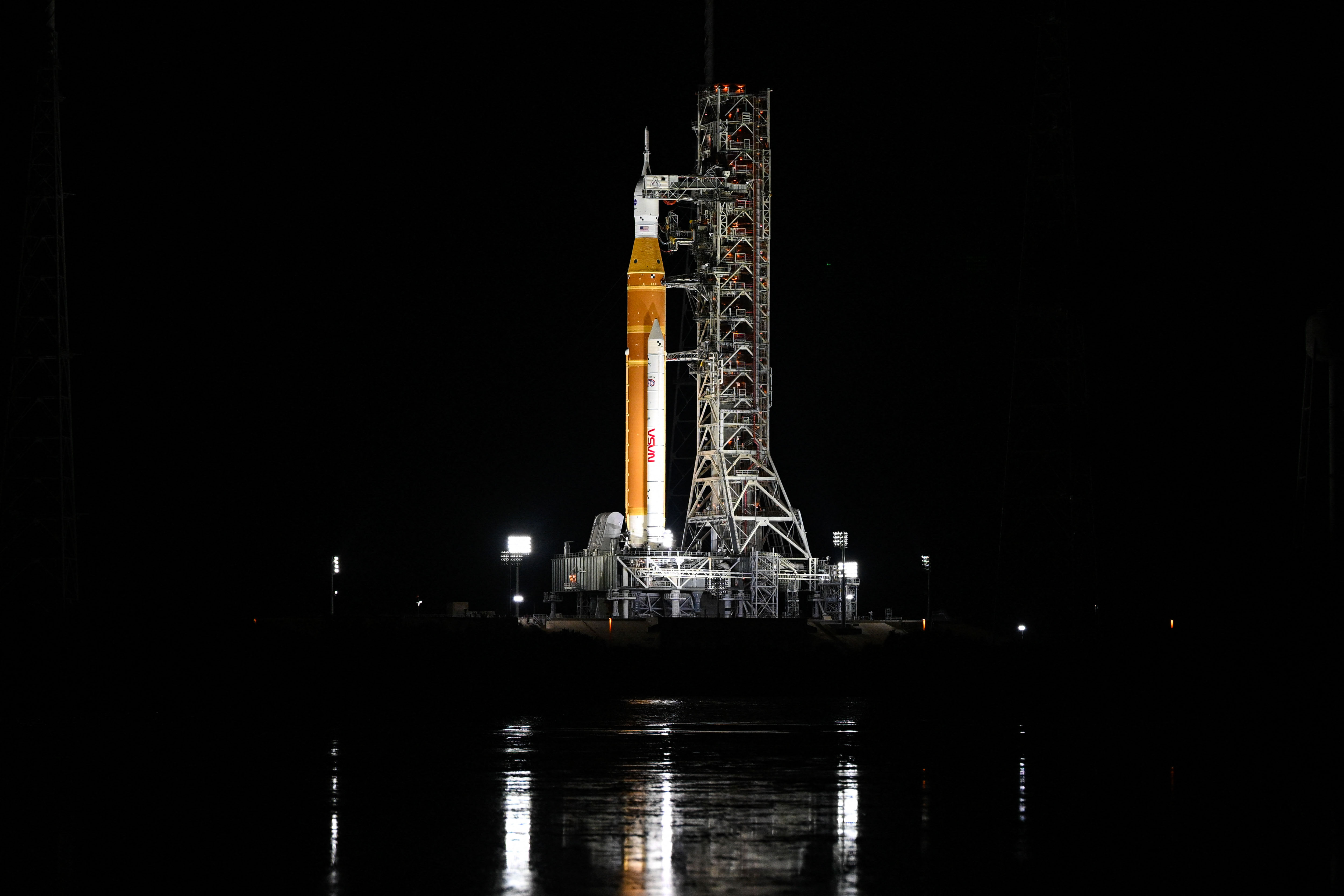

NASA has begun its second dress rehearsal for the launch of Artemis II’s highly anticipated manned flight around the moon.
Launch controllers reported to their stations around 6:40 p.m. ET on Feb. 17. Over the next 50 hours, they will put the behemoth moon rocket, also known as the Space Launch System, through nearly all of its pre-launch operations, proceeding all the way through their checklists to just 33 seconds remaining on the countdown clock.
The climax of their work is slated to come on Feb. 19, within the last 12 hours of the countdown. Officially called the “wet dress rehearsal” due to the inclusion of the moon rocket’s liquid oxygen and liquid hydrogen fuel, ground teams will be required to successfully fill the rocket with its cryogenic propellant before being able to advance further in the countdown.
Launch controllers and ground teams will have to successfully demonstrate an ability to stop and restart their progress at the T-minus 10-minute mark.
They must also complete everything within enough time to make a simulated launch window. That is the time in which NASA would be able to hypothetically launch the rocket and send its crew on a proper course around the moon. That window of opportunity opens at 8:30 p.m. on Feb. 19 and closes at 12:30 a.m. on Feb. 20.
The results of this all-encompassing checkout test must then convince mission leaders that the moon rocket and Orion spacecraft, the crew capsule designed to carry astronauts to the moon and back, are ready to fly.
If all goes well, NASA could attempt a launch as early as the night of March 6. If not, humanity’s first manned flight around the moon in more than 50 years could face yet another delay.
Artemis II’s launch already suffered the loss of its earliest launch window in early February due to the first dress rehearsal ending in failure thanks primarily to a persistent fuel leak.
Liquid hydrogen was discovered to be leaking around a connection point at the base of the rocket, causing it to accumulate in an area inside the spacecraft at dangerous levels, bringing everything to a halt with just five minutes and 15 seconds left in the countdown.
Ground teams were able to make repairs and perform partial tests on the new equipment. However, repairs proved to be complicated. While seals were replaced in the area of the leak, a partial fueling test performed on Feb. 12 exposed a filter as being suspected of reducing the flow of fuel into the tanks. That filter was replaced, and NASA said the partial test gave engineers enough data to begin planning toward a wet dress rehearsal this week.
A similar hydrogen fuel leak caused significant issues with the unmanned Artemis I mission, which launched in 2022. Artemis II will be not only the second mission of NASA’s moon program, but also the second launch ever of the Space Launch System rocket. NASA has faced criticism since the first dress rehearsal over the fact that its rocket had the same problem despite more than three years passing since the prior mission.
Administrator Jared Isaacman addressed those concerns over the weekend. Though the news about the filter was bad, he promised to be transparent about the expensive moonshot program. He also praised the work of NASA’s employees and contractors, and said that work was underway to correct the problem on the next rocket being built for Artemis III.
“Considering the issues observed during the lead-up to Artemis I, and the long duration between missions, we should not be surprised there are challenges entering the Artemis II campaign,” Isaacman said on X. ”That does not excuse the situation, but we understand it.
“There is still a great deal of work ahead to prepare for this historic mission,” he added. ”We will not launch unless we are ready and the safety of our astronauts will remain the highest priority.”