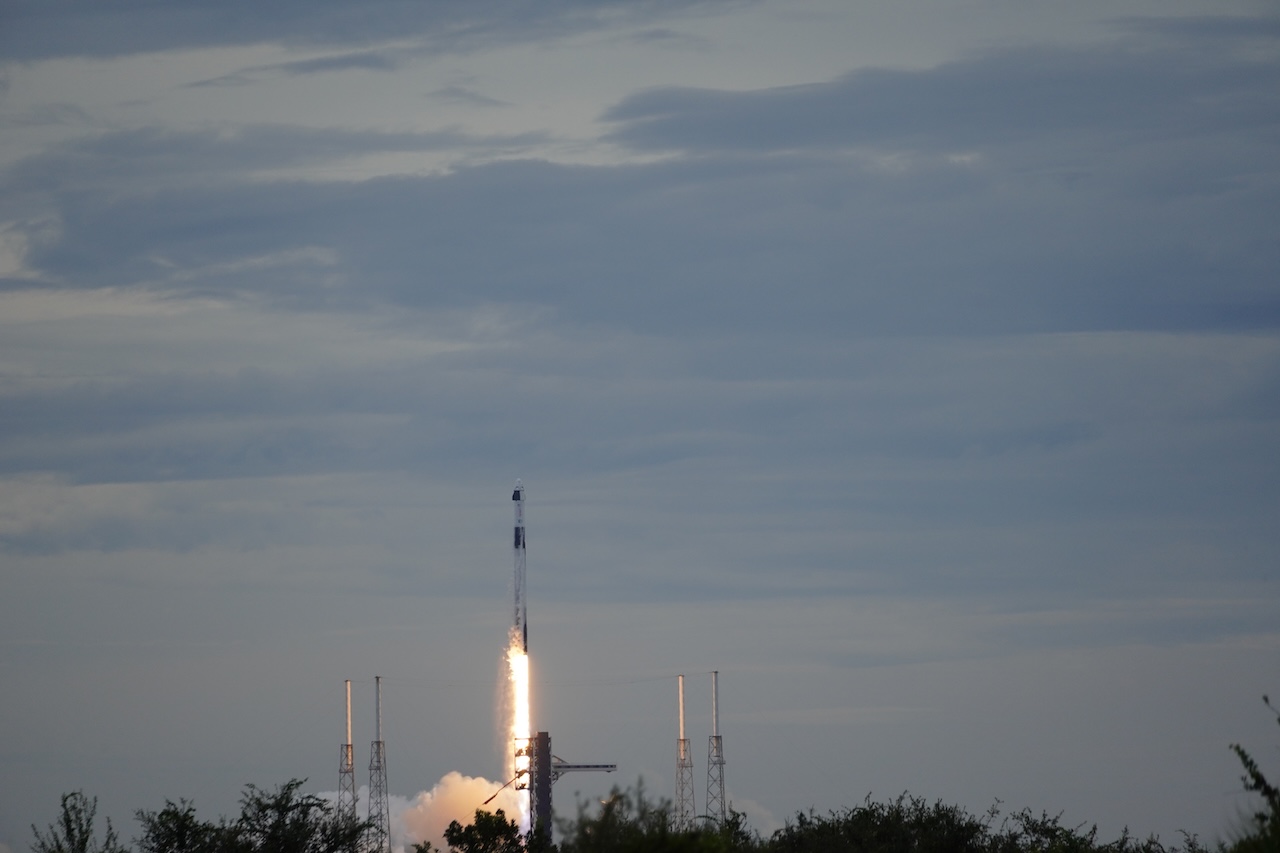

CAPE CANAVERAL, Fla.—A SpaceX Falcon 9 rocket, burning bright, broke through gray, dreary skies over Florida’s Space Coast on Oct. 1.
The launch of the rocket—capped with the reusable Crew Dragon Grace, which contained two Americans, one Canadian, and one Russian—kicked off NASA’s Crew-13 mission bound for the International Space Station.
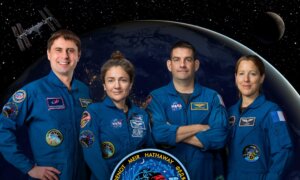
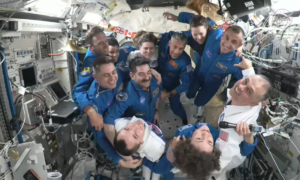
Riding the flight-tested capsule and booster were NASA astronauts Jessica Watkins and Luke Delaney, Canadian Space Agency astronaut Joshua Kutryk, and Roscosmos Cosmonaut Sergey Teteryatnikov. They will call the space station home for the next six months, during which they will continue scientific and technical work to maintain humanity’s 25-year-strong continuing presence in low Earth orbit and further understanding of spaceflight’s effects on the human body that also benefit life on Earth.
The mission was previously set to launch on Sept. 12. However, critical leaks were discovered in the vehicle, and an extended time for troubleshooting and repairs was required.
However, the Oct. 1 window still faced challenges, especially with the weather. As the crew woke up and made their way to their spacecraft, the weather had only a 40 percent chance of meeting NASA’s safety requirements needed for launch. But the weather held out, and the roaring Falcon 9 rocket broke through the clouds just after 11 a.m. ET. Shortly after staging, the booster reemerged below the clouds for a successful soft landing at Landing Zone 40—right next to its launch pad.
“It was spectacular and a real testament to the NASA, SpaceX, Canadian Space Agency, and Roscosmos teams that make all this happen,” Lori Glaze, associate administrator of NASA’s Human Spaceflight Mission Directorate, noted at the post-launch news conference. “It was fantastic.”
Space Station Bound
Watkins, Delaney, Kutryk, and Teteryatnikov had an eight-hour journey to the space station. This is the shortest journey a SpaceX Crew Dragon has flown from Kennedy Space Center to the orbital outpost.
Once there, the crew will join the station’s 75th liveaboard “Expedition” mission. They will conduct spacewalks to install new solar arrays, receive a SpaceX Cargo Dragon spacecraft set for launch on Oct. 13, and produce stem-cell human tissues to help better combat diseases on Earth, including heart disease and Parkinson’s.
They will also study how lengthy exposure to microgravity affects blood flow in the human body. Kutryk, specifically, will be conducting experiments for the Canadian Space Agency studying the mental health of astronauts in long-duration spaceflight, such as looking at stress coping strategies.
Watkins, who is commanding the mission, became the first NASA astronaut to launch aboard a SpaceX Crew Dragon capsule twice. She previously flew on NASA’s SpaceX Crew-4 mission in 2022 and spent 170 days in space.
Delaney sat next to Watkins in the capsule, serving as the mission’s pilot. This is his first trip to space since being selected to be a NASA astronaut in 2021.
Crew-13 is also the first trip to space for Kutryk, and he is expected to be in space when his wife gives birth to their third child. He is the fourth Canadian Astronaut to live aboard the International Space Station, and the first Canadian to fly aboard the SpaceX Crew Dragon.
Teteryatnikov is also a first-time flier. A graduate of Russia’s Naval Academy in St. Petersburg, he served as a test cosmonaut from 2021 to 2023. His presence continues an ongoing seat-swap arrangement between the United States and the Russian Federation. As one Russian cosmonaut flies aboard an American spacecraft, so too does an American astronaut get a seat on the Russian Soyuz spacecraft. This agreement is expected to last at least through the extent of the life of the International Space Station.
Crew-13 marks the second of three consecutive SpaceX Commercial Crew missions that feature three first-time fliers.
While astronaut crew assignments are handled by NASA’s Astronaut Office, Glaze told The Epoch Times that she thought it was fantastic to see so many new astronauts earning their wings.
“We’ve been talking about trying to get as many people into space as possible,” she said. “Getting more experience-based, we’re going to have additional missions with the Artemis missions coming up, additional crew flights to station, and having a larger cadre of individuals that can serve in the various roles that are required for all of those missions is extremely helpful.”
This team of four will be greeted by their peers on NASA’s SpaceX Crew-12 mission. The two crews will undergo a short turnover period where Crew-12 gets Crew-13 caught up and ready to take over ongoing work and experiments.
Dana Weigel, manager of NASA’s Low Earth Orbit Program, said the SpaceX Crew-12 mission was expected to come home as early as Oct. 5 after spending almost eight months in space. Initial checks have shown that Crew Dragon are in great shape, but a final decision will be made over the weekend.
In fact, Weigel said, Crew-12 has to leave so a docking port is available for the Cargo Dragon.
NASA’s SpaceX Crew-13 is the first crewed mission to be numbered 13 since Apollo 13, and the crew added an homage to that famous mission in their mission patch.
No Routine Missions
It is NASA’s 13th Crew Dragon mission to the International Space Station, but Julianna Scheiman, director of Dragon Human Spaceflight and NASA Science at SpaceX, said this marked SpaceX’s 21st human spaceflight with Dragon and the 53rd overall Dragon mission to the International Space Station.
She said that every launch pad built to fly a Falcon rocket was in service on Oct. 1. After the Crew-13 launch, SpaceX’s launch site at Vandenberg Space Force Base was due to launch a Falcon 9 for the Transporter 18 rideshare mission, set to deploy 130 individual payloads. Then, back in Florida, a Falcon Heavy was due to launch a mission for the National Reconnaissance Office.
NASA Administrator Jared Isaacman pointed out that it has only been six years since the SpaceX Demo-2 mission returned human spaceflight to American soil after “a dark period” of nearly a decade after the end of the Space Shuttle program. Since then, SpaceX has proven to be a consistent and reliable launch provider. But Isaacman warns that these missions should never be viewed as “routine.”
“Missions like this have become so reliable that they can almost feel routine, but they are not,” he said. “Putting human beings on top of a rocket and accelerating at 17,500 miles per hour, rendezvousing with a space station, and then bringing them home safely many, many months later will never be routine.
“These are demanding missions. They take dedication, extreme expertise, and confidence across thousands of people from NASA, the Space Force, and again, our industry partners like SpaceX to pull them off very successfully. But building that capability, the experience, and confidence to do it repeatedly to make it look near routine is exactly what we’re collectively striving to achieve now.”