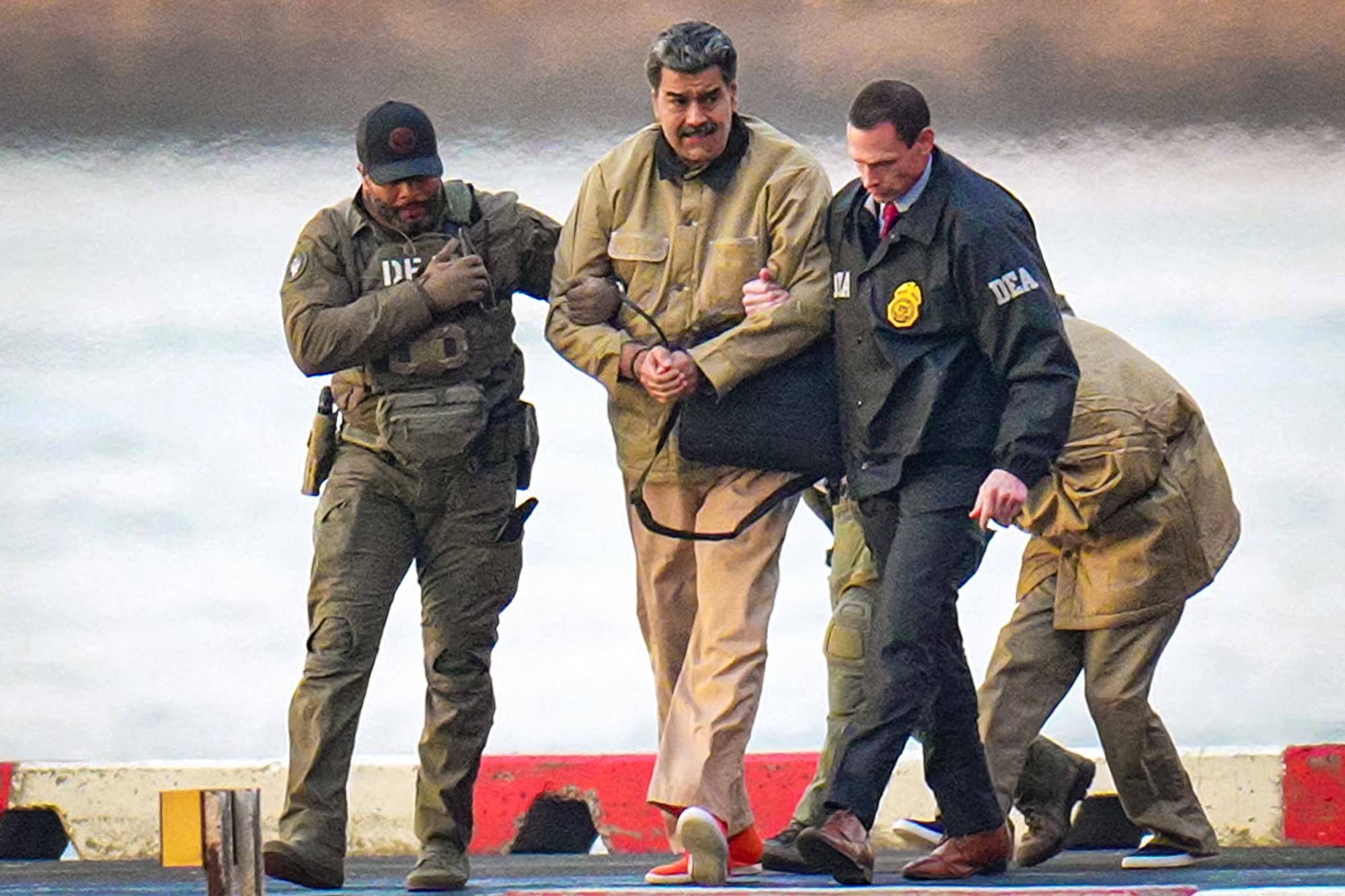
NEW YORK CITY—A federal judge on March 26 declined to dismiss the drug trafficking indictment against Nicolás Maduro after the former Venezuelan leader’s attorney tried to get the case thrown out over an international dispute about legal fees.
Maduro’s lawyer, Barry Pollack, argued that the United States violated the ousted leader’s constitutional rights by preventing the Venezuelan regime from using funds to cover his legal expenses.
U.S. prosecutors contend that Maduro and his wife, Cilia Flores, should instead use personal funds to pay for their legal defense. The former Venezuelan leader claims that he does not have the money for his legal fees. To be granted a public defender, he would need to prove that he cannot afford the fees.
Pollack tried to get the case dismissed over the funding dispute, but Judge Alvin Hellerstein of the U.S. District Court for the Southern District of New York said during the March 26 hearing, “I’m not going to dismiss the case.”
He said he would rule on the funding dispute at a later date. The judge did not set a trial date at the March 26 hearing.
Central to the dispute is the U.S. government’s contention that since it has active sanctions on the Venezuelan regime, there is no legal pathway to order the U.S. Treasury Department’s Office of Foreign Assets Control to grant a license that would release funds for Maduro’s defense. That office is responsible for issuing sanctions on foreign governments.
“Mr. Maduro, as Venezuela’s head of state, has both a right and an expectation to have legal fees associated with these charges funded by the government of Venezuela,” Pollack wrote in papers that he filed in late February.
The filing includes a statement from Maduro in which he suggested that under Venezuela’s laws and practices, he is “entitled to have the government of Venezuela” pay for his legal defense.
“I have relied on this expectation and cannot afford to pay for my own legal defense,” Maduro said, noting that Pollack is his “counsel of choice” and that he has been working with the attorney on his legal defense.
Prosecutor Kyle Wirshba argued on March 26 that there is no legal pathway to release sanctioned funds from the Office of Foreign Assets Control, but Hellerstein pressed him on that position now that relations between the United States and Venezuela are warming.
“We are doing business with Venezuela,” the judge said.
Wirshba responded by saying that even though there are relations with another government, that does not mean that the United States cannot maintain its sanctions.
“If the purpose of the sanctions is because the defendants are plundering the wealth of Venezuela, it would undermine the sanctions to allow them [to] access the same funds now to pay for their defense,” Wirshba said.
Pollack argued that if Maduro is granted public defenders, it would deprive others who cannot afford attorneys of critical legal resources. He told the judge on March 26 that it does not make sense in “a case where you have someone other than the U.S. taxpayer standing ready, willing and able to fund that defense.”
Hellerstein asked prosecutors what they have uncovered regarding whether the ousted Venezuelan leader has the necessary money to fund his legal defense.
Wirshba said the Justice Department is still investigating, but argued that public defenders and court-appointed attorneys in New York state have handled other major cases and could take on this one as well.
Although he said he respects the ability of those lawyers, Hellerstein contended, “This is a case that is beyond the normal and could hamper their ability to do their normal work.”
Maduro Pleads Not Guilty
The March 26 hearing was the first time that Maduro and Flores have appeared in court since their January arraignment. At the time, Maduro pleaded not guilty and claimed that he was a “decent man, the constitutional president of [Venezuela].” His wife also pleaded not guilty.
Since their capture by U.S. forces, both Maduro and Flores have been incarcerated at a detention center in the New York City borough of Brooklyn, and neither has requested to be released on bail.
Murals and billboards demanding the return of Maduro, 63, and Flores, 69, have been seen throughout the Venezuelan capital of Caracas, since their U.S. capture in early January.
Even though the ousted leader’s ruling party is still in power, Venezuelan acting President Delcy Rodríguez has since consolidated control of the regime.
Rodríguez has reorganized agencies and the nation’s ruling structure—appointing ambassadors, replacing senior officials—including the Maduro-aligned defense minister and attorney general—and discarding tenets of the socialist regime that has ruled Venezuela for more than two decades.
The shift has seen Venezuela reestablish diplomatic ties with the United States for the first time since 2019. Washington has also moved to ease economic sanctions on the nation’s critical oil industry and sent a chargé d’affaires, or diplomatic official, to Caracas.
The U.S. Treasury Department’s Office of Foreign Assets Control failed to uphold its initial decision to allow the Venezuelan regime to pay Maduro’s legal fees, Pollack wrote in his court filing last month.
Pollack argued that the office approved the arrangement on Jan. 9, but then denied it less than three hours later without an explanation.
The Department of Justice filed a 25-page indictment earlier this year accusing Maduro and other Venezuelan regime officials of working with drug cartels and the military to traffic thousands of tons of cocaine into the United States.
Both Maduro and Flores are also accused of ordering kidnappings, assaults, and murders of those who owed drug money or subverted their trafficking enterprise. The indictment claims that Maduro also ordered the killing of a drug boss in Caracas.
Maduro and Flores face life in prison if convicted.
The Associated Press contributed to this report.