
A Chinese national was arrested at Kenya’s largest airport while attempting to leave the country with more than 2,200 live queen garden ants hidden in his luggage, authorities said.
Zhang Kequn, 27, was arrested on March 10 at Jomo Kenyatta International Airport in Kenya’s capital, Nairobi, according to court filings. Kenyan immigration authorities flagged a “stop order” on Zhang’s passport last year following his escape from arrest in Kenya.
He was arraigned before Magistrate Njeri Thuku at a local court, according to The Kenya Times. Thuku agreed to the prosecutors’ request to detain Zhang for five days while Kenya Wildlife Service investigators conducted a forensic analysis of his phone and laptop computer.
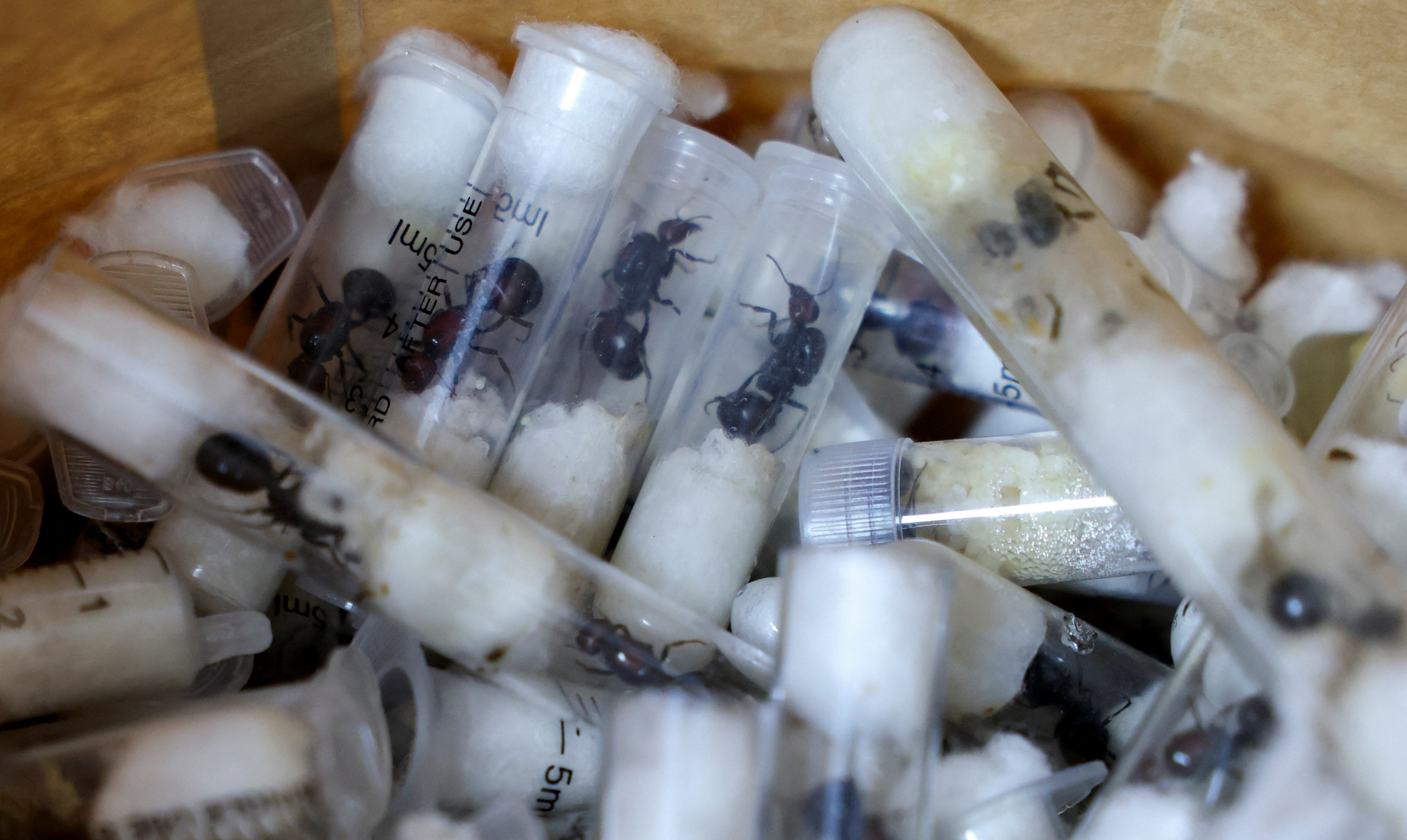
“Personal luggage was searched, and within that luggage, there were found 1,948 garden ants. They were packed in special test tubes,” prosecutor Allan Mulama told the court, according to the outlet.
Some of the ants were hidden in tissue paper, according to investigators.
Thuku also warned the court that Zhang could flee, if he were allowed to be released on a bond, according to Kenya’s television channel TV47.
Ant enthusiasts often invest significant amounts of money to keep colonies in large transparent vessels called formicariums. These containers offer clear views into the ants’ complex social structures and behaviors.
Investigators believe Zhang may be linked to two cases from last year that also involved trafficking garden ants, according to the news outlets.
In May 2025, Thuku sentenced four men to a fine of KSh 1 million ($7,740) each, or 12 months in prison if they failed to pay, according to two sentencing documents. They were charged under Kenya’s Wildlife Conservation and Management Act for unlawfully dealing with wildlife species.
Two of the four men, Lornoy David and Seppe Lodewijckx, both 19-year-old Belgian nationals, were found to have in their possession about 5,000 garden ant queens packed in 2,244 tubes, according to court documents.
David and Lodewijckx claimed in court that they “acted out of naivety,” Thuku said in her ruling.
Thuku wrote that there was “no justification” that David and Lodewijckx should be found with such a large quantity of queen garden ants, which are scientifically known as Messor cephalotes.
“This is beyond a hobby,” Thuku wrote. “Indeed, there is a biting shortage of messor [cephalotes] online; and if sold at an average price as posted online of €169.90 [$194] then the value of the 5,000 queen ants is in excess of €800,000 [$914,660] or $900,000 [$1 million].”
The remaining two men, Duh Hung Nguyen, from Vietnam, and Dennis Nganga, from Kenya, were found to possess garden ants “packaged in 140 syringes and about 300 unpackaged garden ants in two containers,” according to court documents.
Thuku stated that Nguyen was sent to Nairobi to meet Nganga to collect ants in an “elaborate scheme” that had “all the hallmarks of illegal wildlife trade and possibly bio-piracy.”
At the time of Thuku’s May 2025 sentencing, Kenya Wildlife Service described the messor cephalotes as critical species for maintaining soil health and ecosystem balance.
The ants “were destined for the European and Asian exotic pet trade, where colonies of rare and ecologically unique species can command prices of up to 1,200 euros each,” the wildlife service said in a statement.
Also on May 10, the wildlife service said a similar shipment of ants, traced back to Kenya, had been seized in Bangkok, indicating the existence of an extensive and organized ant-smuggling network.
Reuters contributed to this report.