
SAN DIEGO—As the flood of illegal immigrants at America’s southern border slowed to a trickle, agents shifted gears. Now they’re focused on security—and that has led to record drug seizures, with the most secure border in American history, officials told The Epoch Times.
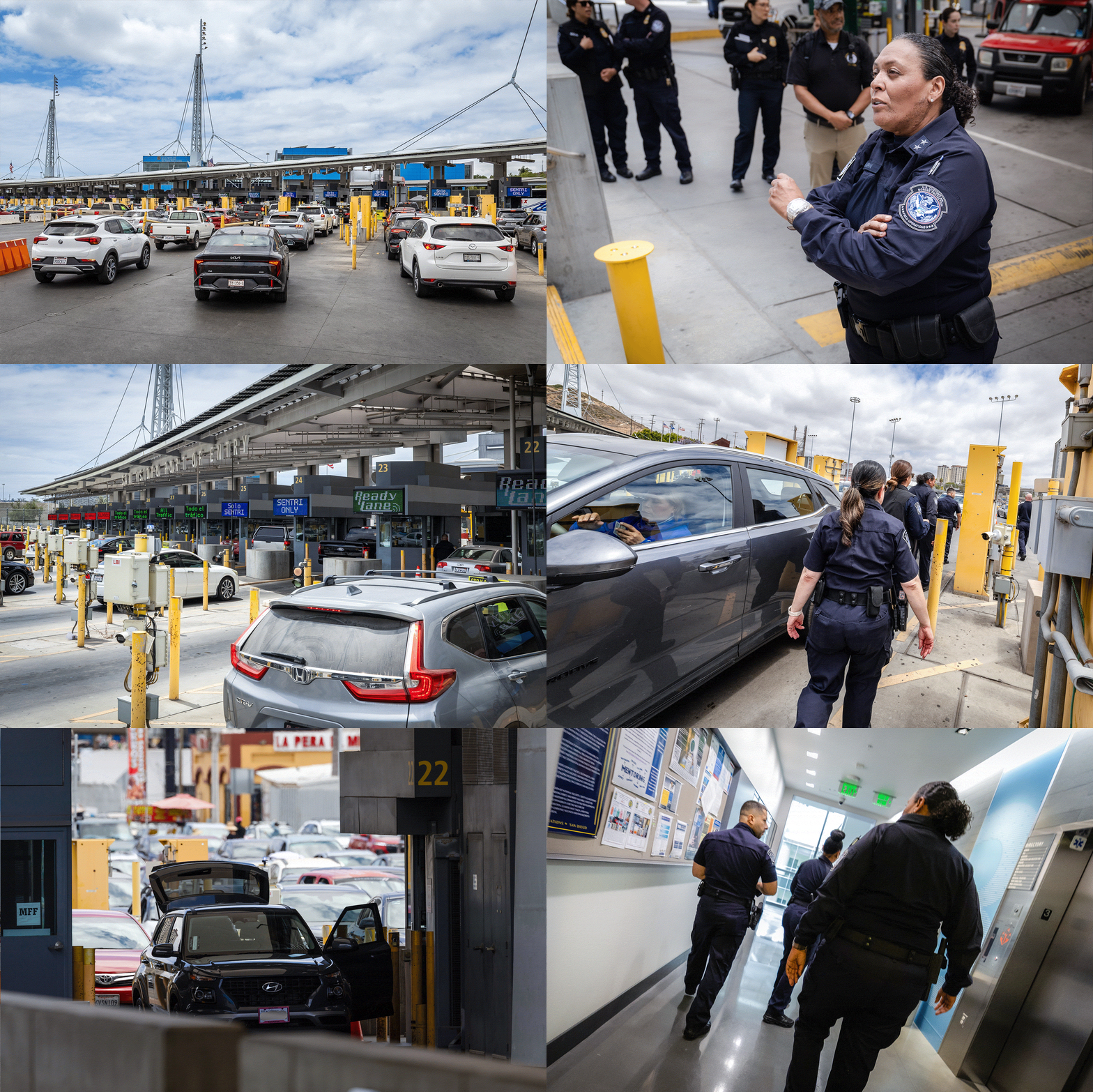
U.S. Customs and Border Protection (CBP) took The Epoch Times behind the scenes at the border between San Diego and Mexico—home to the San Ysidro Port of Entry, the busiest land border crossing in the Western Hemisphere.
The San Diego sector, patrolled by thousands of federal officers, encompasses more than 56,000 square miles. That includes 60 linear miles of international boundary between the United States and Mexico, and an additional 931 miles of coastal border stretching from the California–Mexico line north to Oregon.
Officers said the success they’re experiencing—not just in drug seizures, but also in fewer illegal immigrants entering the country—stems from the Trump administration’s tough border policies.
“Without having four or five hundred people in detention making an asylum claim, I’m going to take those officers and say, ‘I don’t need you to process asylum claims, I need you out there looking for dope, looking for people smuggling, looking for those agriculture violations,’” Mariza Marin, port director at the San Ysidro Port of Entry, told The Epoch Times.
Marin said she was able to move about 180 officers from handling administrative work processing illegal immigrants to enforcement and inspection.
“That’s huge; 180 individuals is huge,” said Sidney Aki, San Diego director of field operations.
The Evidence
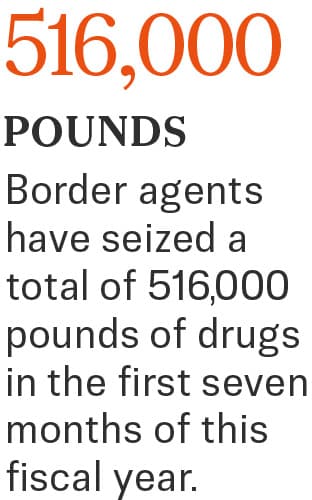
Under the Biden administration, total drug seizure amounts for fiscal years 2024 and 2023 were 573,000 and 549,000, respectively.
In 2025, the first year of the Trump administration, drug seizures were slightly more, at 583,000.
But border agents seized 516,000 pounds of drugs from October 2025 through April 2026 alone. That’s the first seven months of the current fiscal year for CBP, meaning five months remain for the agency to extend those numbers. And historically, summer months tend to yield higher seizure amounts, according to Department of Homeland Security data.
In April, agents seized 185,000 pounds of illegal narcotics, the biggest monthly seizure since officials began to track totals.
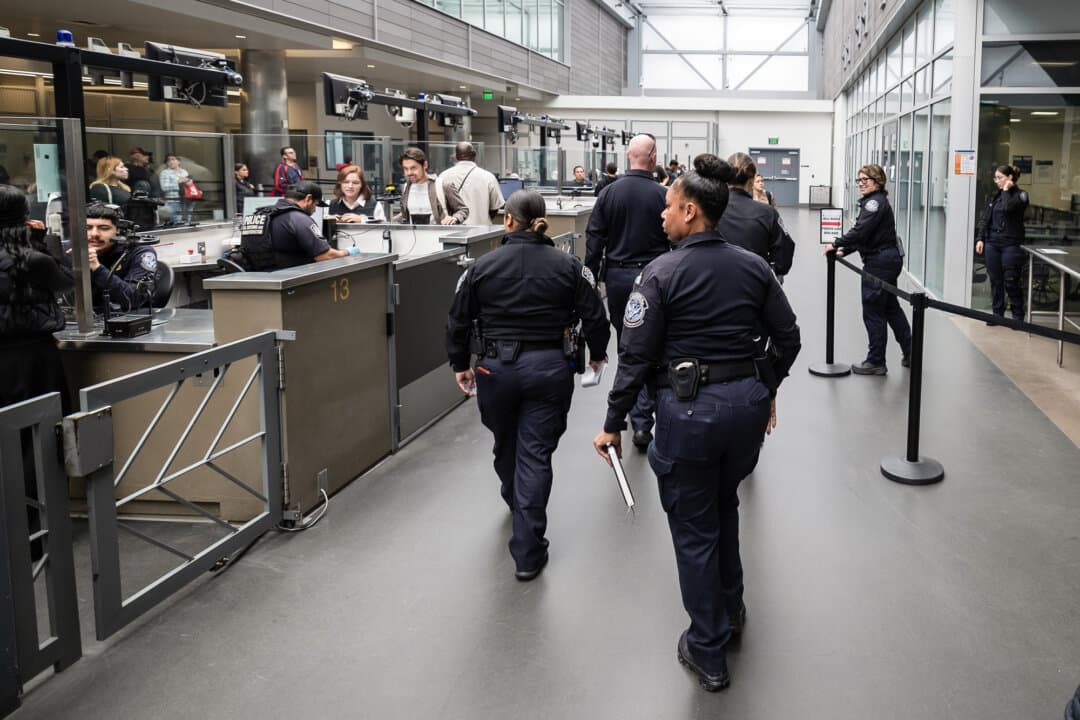
U.S Customs and Border Protection agents monitor border traffic outside of San Diego on May 26, 2026. Agents who had previously been tied up processing a flood of illegal immigrants under the Biden administration are seizing significant amounts of illegal narcotics compared to years prior. (John Fredricks/The Epoch Times)
Last month, CBP announced its Office of Field Operations had seized a historic amount of fentanyl: about 100 million lethal doses from October 2025 through May this year. According to the U.S. Drug Enforcement Administration, a lethal dose of fentanyl is about two milligrams.
“When you look at the point of where we are now compared to the course we were on previously, we are increasing our numbers and seizures,” Aki said.
Methamphetamine and cocaine seizures are also surpassing previous numbers.
This fiscal year, CBP officers have seized more than 152,000 pounds of methamphetamine, eclipsing seizures for all of fiscal year 2025. They’ve seized more than 28,000 pounds of cocaine, surpassing fiscal year 2025 to date by about 6,000 pounds.
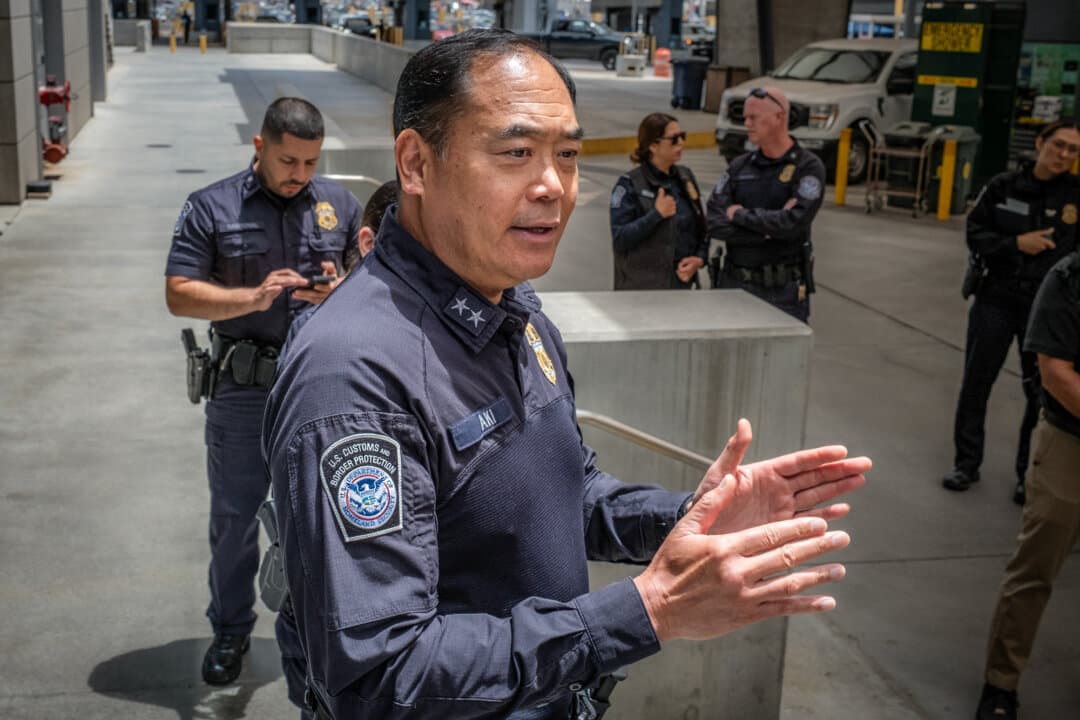
Sidney Aki, director of field operations for U.S. Customs and Border Protection’s San Diego Field Office, monitors border crossings at the San Ysidro Port of Entry on May 26, 2026. Aki and other officials told The Epoch Times the border is more secure now than at any point in their careers, and in U.S. history. (John Fredricks/The Epoch Times)
Federal Backing
While policy changes on immigration and the border have led to the refocusing of personnel, a top-to-bottom support system from the Trump administration has also created high morale and motivation for federal officers, they said.
Border enforcement and security, which is “emphasized significantly with this administration,” continues to increase, Aki said.
Since Trump returned to the White House, he has signed executive actions designating cartels as terrorist organizations and fentanyl as a weapon of mass destruction.
The One Big Beautiful Bill Act, signed nearly a year ago, allocated $170 billion for border security and immigration enforcement initiatives.
On June 10, Trump signed a roughly $70 billion bill to fund Immigration and Customs Enforcement (ICE) and Border Patrol. The Secure America Act ended a 116-day dispute over immigration funding.
The measure will fund ICE and Border Patrol through Sept. 30, 2029, going beyond the end of Trump’s term.
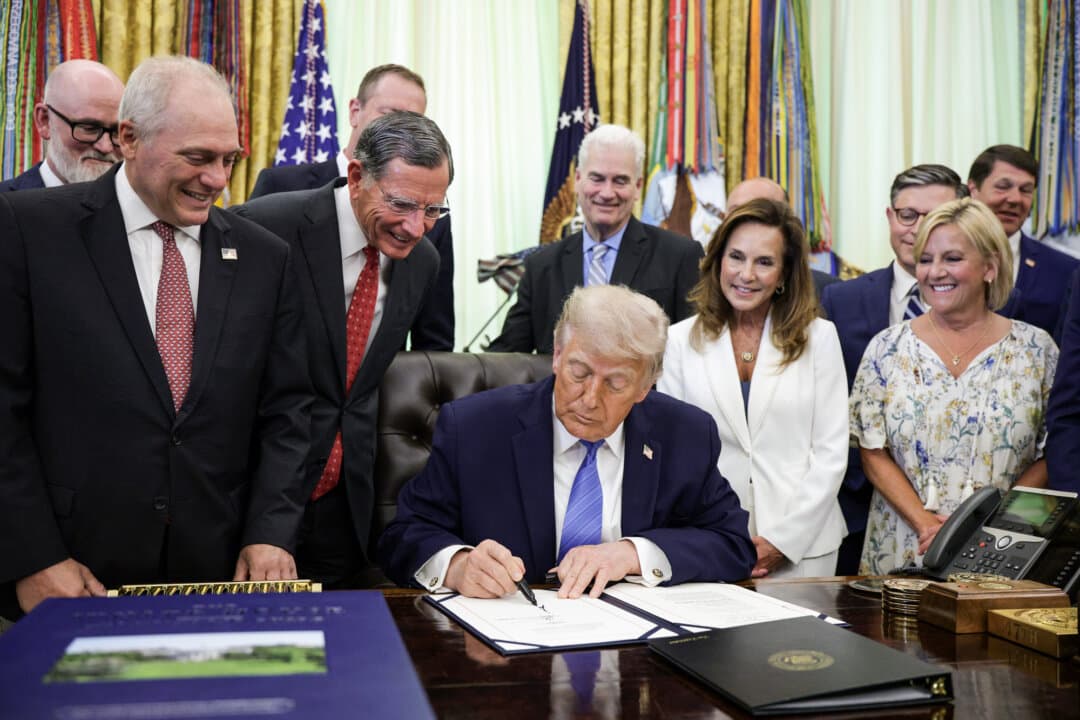
Members of Congress look on as President Donald Trump signs the Secure America Act in the Oval Office on June 10, 2026. The $72 billion package funds Border Patrol and Immigration and Customs Enforcement (ICE) operations through the end of Trump’s term in office in fiscal year 2029. (Alex Wong/Getty Images)
Enforcement at an Entry Point
The Epoch Times witnessed how agents at a port of entry carry out their tasks.
The massive San Ysidro Port of Entry has a total of 34 lanes, which are funneled into seven upon entry, and two separate pedestrian walkways that allow travelers to cross the international boundary by foot.
About 42,000 to 47,000 vehicles cross per day, Marin said.
Taking into account the number of passengers in each vehicle, commercial trucks, and pedestrians, the total number of individuals entering the United States through the crossing each day likely eclipses 100,000.
The vetting process to ensure each of these travelers is abiding by U.S. law starts with what federal agents call the “primary” or “technology zone,” immediately adjacent to the international boundary.
But, with the help of Mexican authorities, intelligence gathering and enforcement can extend beyond that.
Coordination with Mexico is the best it’s ever been, the officials said. Sometimes, their Mexican law enforcement counterparts intercept bad actors before they even reach the U.S. border, said Justin De La Torre, chief patrol agent for the San Diego Sector.
However, with so many thousands of vehicles and individuals seeking to enter the United States each day, things can slip by Mexican authorities.
That’s when the primary or technology zone comes into play. The zone is where an intelligence package begins to be built on travelers.
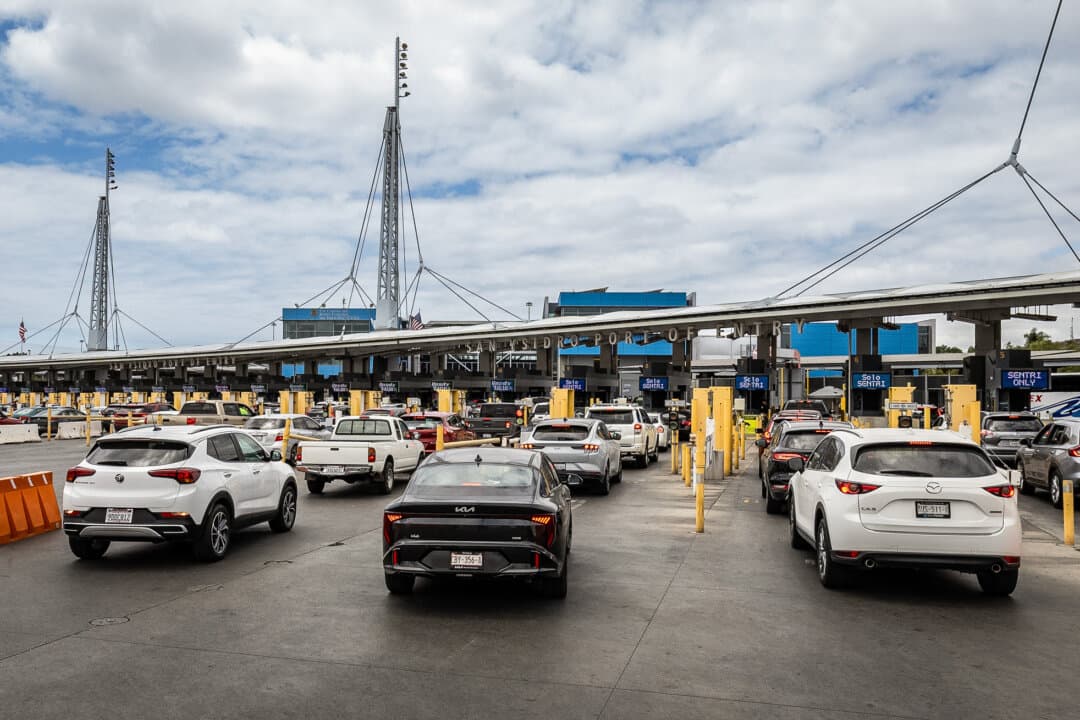
Vehicles cross from Mexico through the San Ysidro Port of Entry outside San Diego on May 26, 2026. Between 42,000 to 47,000 vehicles pass through the “world’s busiest border crossing” each day, according to Port Director Mariza Marin. (John Fredricks/The Epoch Times)
Automatic cameras take pictures of each car, its driver, and any passengers. Radiation portal monitors scan vehicles to ensure there are no radiological threats. This technology, Marin said, has a very low alarm threshold—for good reason.
By the time a traveler reaches a primary officer for what the agents call an “interview” before entering the country, they already know who the traveler is, their crossing history, potential criminal history, vehicles they’ve driven across the border, people they’ve crossed with, and more.
“It could be a driver that nine times we saw him in a Versa, and then we see him in a Fiat,” Marin said. “‘Where’d you get this car?' So the officers are trying to build that picture, and that’s part of the interview.”
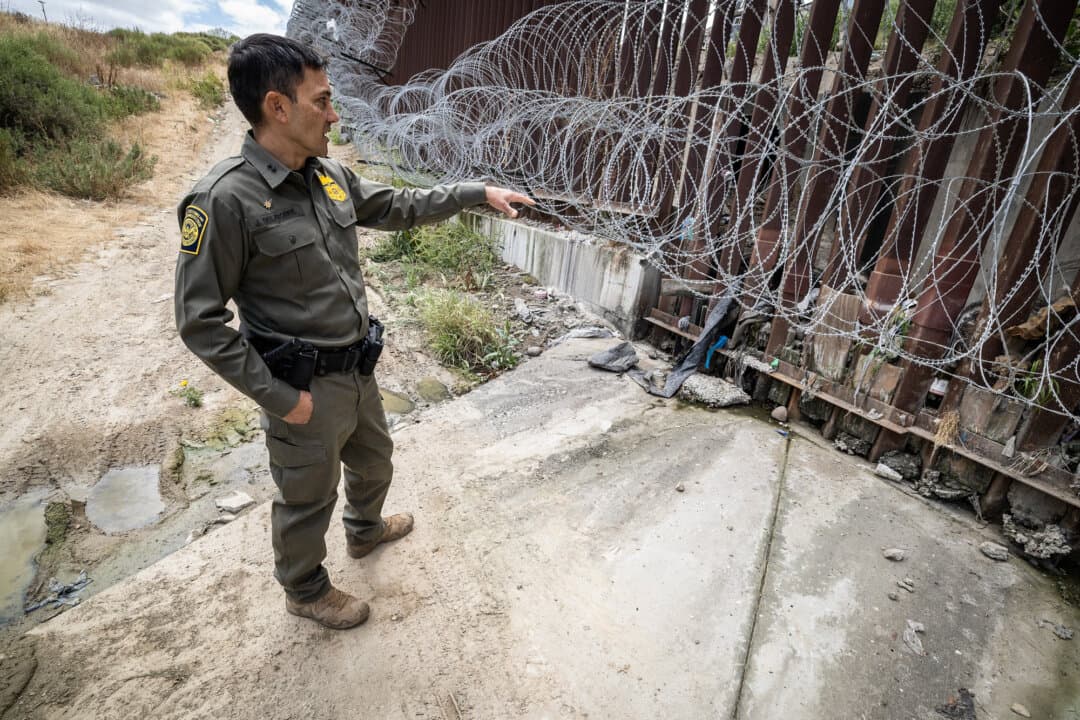
Chief Patrol Agent Justin M. De La Torre of the U.S. Border Patrol’s San Diego Sector checks the southern border wall outside San Diego on May 27, 2026. De La Torre highlighted increased coordination with Mexican law enforcement to intercept bad actors before they reach the U.S. border. (John Fredricks/The Epoch Times)
An officer’s instinct plays a major role during the interview process in catching violators.
What might appear to be innocent questions or small talk, Aki said, is actually agents trying “to poke holes” into your story. “Why did you go to Mexico? Why are you coming to the United States? Whose car is this? Why are you bringing that?”
Meanwhile, officers are looking for physical signs that could point to nefarious activity: indicators of nervousness such as fidgeting, white knuckling, and avoiding eye contact.
Intelligence packages are also used for commercial trucks entering the United States.
Intelligence plays a massive role in intercepting large drug smuggling attempts and preventing further ones, Aki said. It can point to previous loads a truck has carried, where it came from, who loaded it, who has operated it, and whether it has ever had any compliance violations.
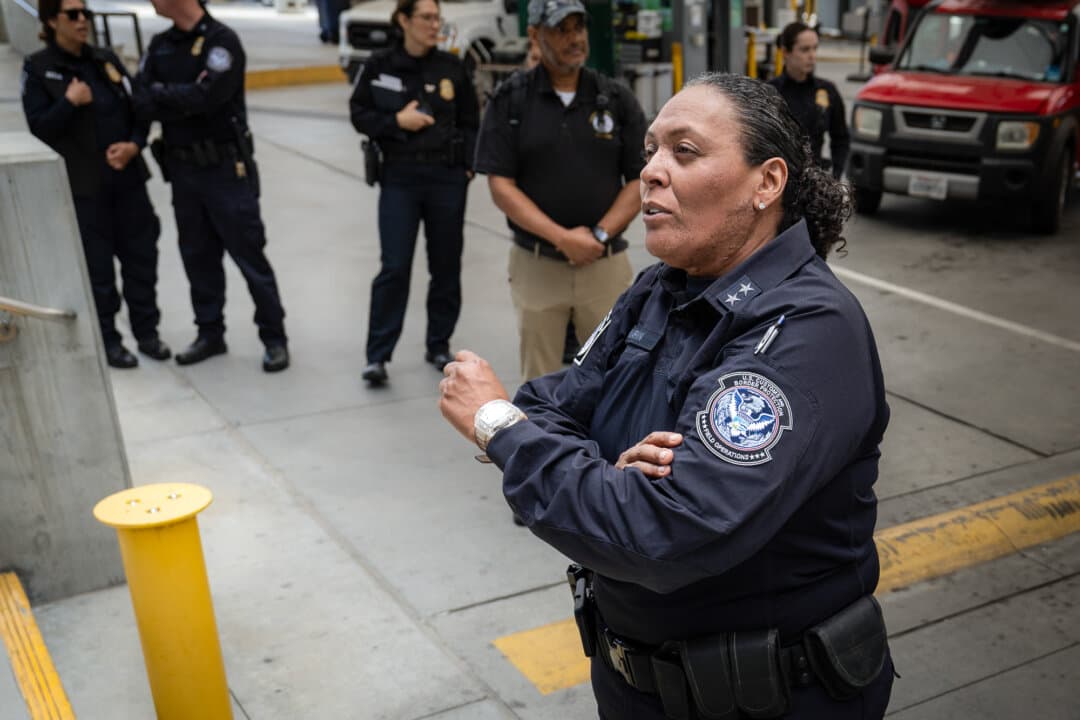
San Ysidro Port Director Mariza Marin works with colleagues at the San Ysidro Port of Entry near San Diego on May 26, 2026. Marin said the agency uses technology to compile traveler profiles, including travel history, travel methods, and other information, before a traveler reaches a primary officer. (John Fredricks/The Epoch Times)
Marin and Aki credited intelligence with a massive methamphetamine seizure from three separate trucks over the span of a week.
“It was basically in flower pots, cement, as well as flat-screen televisions,” Aki said. The seizure was based on intelligence gathering that suggested a nefarious connection and prompted further inspection. Ultimately, officers intercepted nearly 9,000 pounds of methamphetamine, Aki said.
In an example at the Texas border, officers discovered 307 hidden packages in a tractor-trailer hauling lettuce from Mexico.
According to CBP, the packages contained 1,645 pounds of methamphetamine worth $14.7 million.
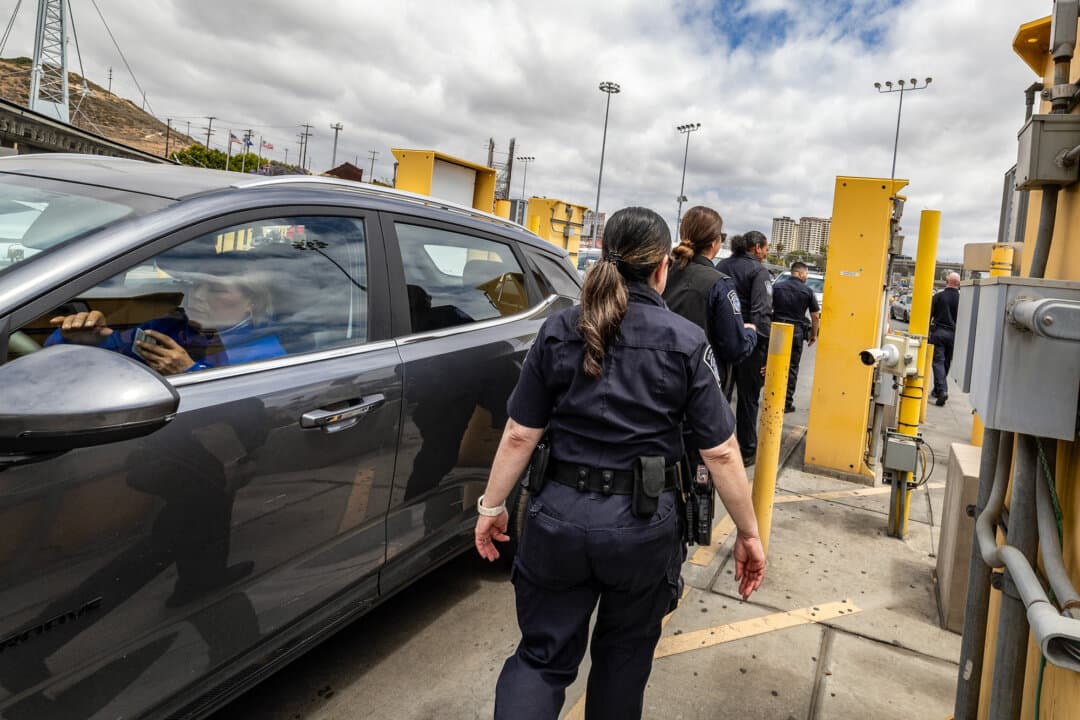
U.S. Customs and Border Protection agents walk through the vehicular entry of the San Ysidro Port of Entry near San Diego on May 26, 2026. (John Fredricks/The Epoch Times)
“We can then go back, based on our information, technology, and intelligence, and say, ‘Well, what broker was responsible for that?'” Aki said.
“What freight forwarder was responsible? What shipper? Who produced the lettuce? Who placed the lettuce into that trailer? What trailer was used? What cargo truck? What cargo company? What trucking company was used?”
CBP intelligence teams track all that information. They can vet entities involved in a violation to better understand who they are connected to and how to predict or prevent future drug smuggling attempts, based on associations to the truck in question.
In addition to these security measures, there are roving K-9 teams and density readers checking drivers and vehicles before they get to an officer for their “interview.”
Density readers can detect areas within vehicles that do not conform to the typical make-up of a car. That could point to hidden compartments or packages containing narcotics.
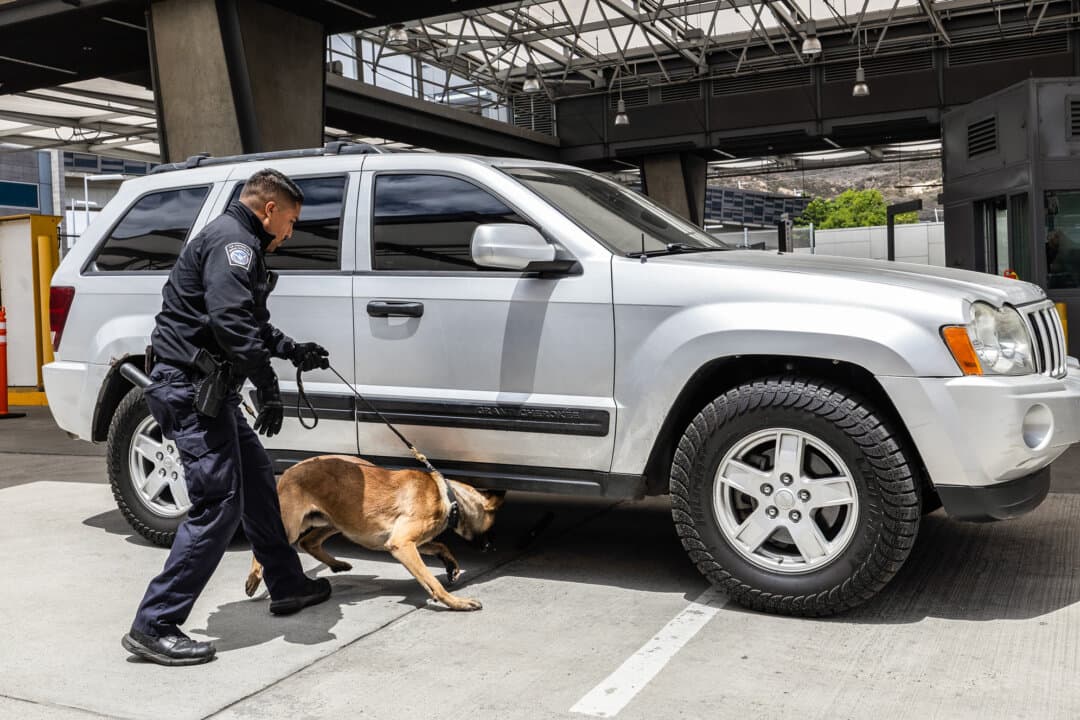
A U.S. Customs and Border Protection K9 unit checks a vehicle at the U.S.–Mexico port of entry outside San Diego on May 26, 2026. Before reaching an officer for inspection, drivers and vehicles are screened by roving K9 teams and density readers. (John Fredricks/The Epoch Times)
Secondary Inspections
Out of the roughly 42,000 to 47,000 vehicles that cross per day at San Ysidro, about 3 percent are referred for secondary inspections. That involves more K-9 teams and another layer of sophisticated technology, complimenting the arsenal travelers have already passed through.
“[The cartels] are gambling, hoping that they don’t come into secondary,” Marin said.
X-ray technology, integrated with artificial intelligence, lends a clear view of exactly who and what is inside each vehicle.
X-rays have been used by border agents for almost two decades, but AI has significantly improved their use, Marin said. Most recently, technology using AI has been developed to provide clear scans of a vehicle’s undercarriage.
At the San Ysidro entry, cartels try to beat the technology by hiding drugs or humans using what federal officers call “hard concealment”—fabricated compartments in the oil tanks, gas tanks, or the engine compartments of vehicles.
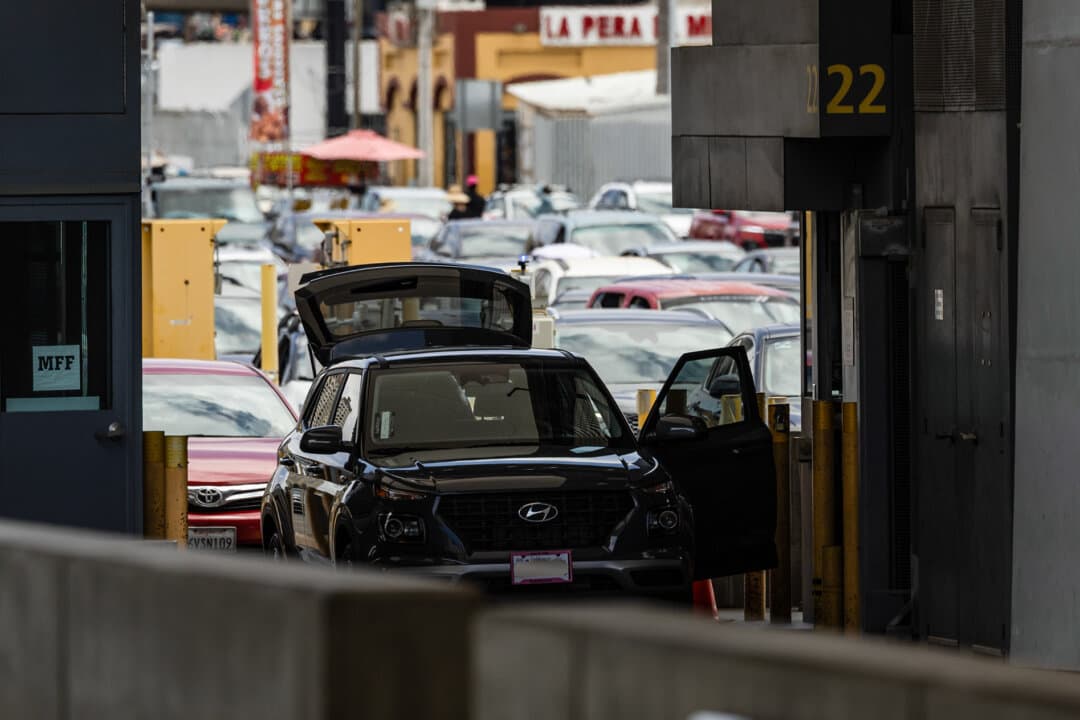
A vehicle undergoes inspection at the San Ysidro Port of Entry outside San Diego on May 26, 2026. Of the roughly 42,000 to 47,000 vehicles that cross daily, about 3 percent are referred for secondary inspections, where AI-assisted X-ray technology helps officers identify who and what is inside each vehicle. (John Fredricks/The Epoch Times)
This can be highly dangerous when dealing with concealed humans.
“What does the compartment look like?” Marin said. “Can they breathe? How long was the wait? How long were they in line? And then, probably, do we need to render CPR right away to get them out? So that’s top of mind, and then prosecution comes next.”
In February, officers at the San Ysidro Port of Entry discovered a Mexican national in a fabricated compartment in a vehicle’s gas tank. The individual was transported to a local hospital for burn injuries sustained during the smuggling attempt.
Officials said preservation of life is the first priority, and collecting evidence for prosecution is second.
Agents took The Epoch Times into an X-ray booth to watch scans in real time.
The technology instantaneously provides clear images of a vehicle. Officers stationed in the booths spend about five to 10 seconds—that’s all it takes, one agent said—looking at each X-ray, searching for anomalies.
“We wouldn’t see [anomalies] normally, but that’s where these guys are key in being able to hone in on it,” Marin said.
“If there’s something there, he’ll see it. But that’s really where training and experience come in.”
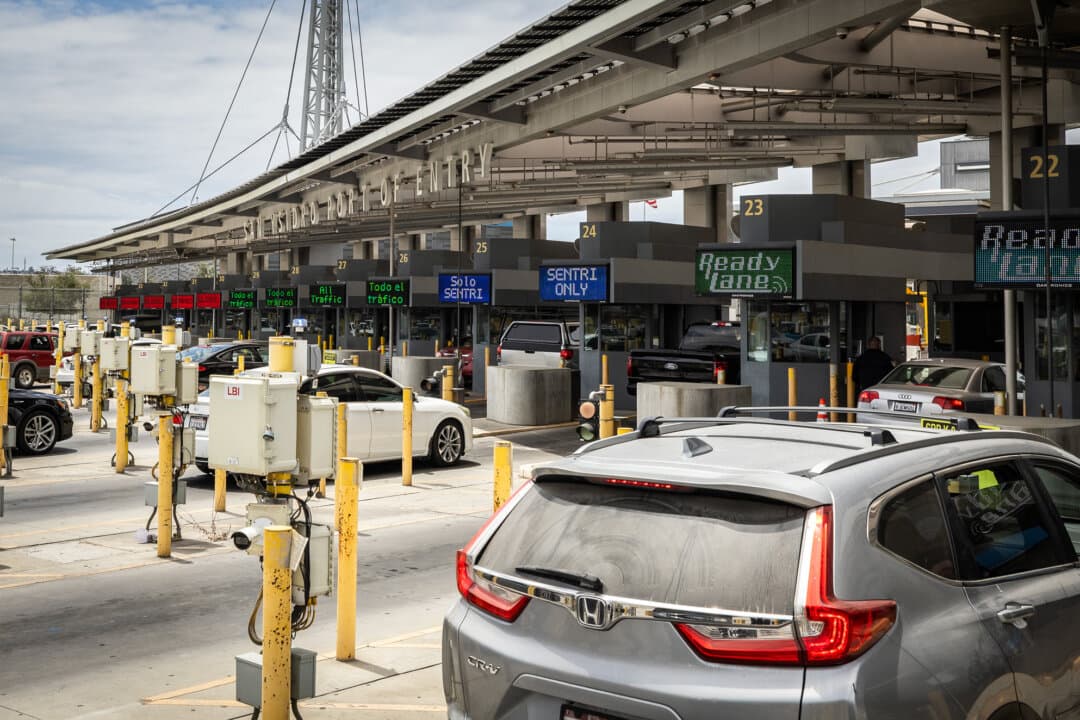
Vehicles pass through the San Ysidro Port of Entry from Mexico into San Diego on May 26, 2026. (John Fredricks/The Epoch Times)
In addition to real-time scans, officers showed The Epoch Times images from prior encounters, showing drugs smuggled in spare tires, floorboards, doors, dashboards, and seats.
The difference between a “clean” vehicle and one carrying drugs is nearly impossible to see with an untrained eye. But officers in the X-ray booths are so adept at detecting anomalies, they can determine what a hidden package might contain even before it’s removed from the vehicle, inspected, and tested.
The shift of border priorities under Trump allowed the San Diego leaders to put more agents in X-ray booths and send more agents out roving with K-9s.
But criminal organizations keep trying to game the system.
“If K-9s are out there, my roving teams are out there, computer systems and AI are all firing, the intelligence system is firing the way it should, hopefully we’re catching a lot of this stuff,” Marin said.
“[But] when you’re talking 42,000 to 47,000 vehicles a day, they’re gambling that something could get through.”
And as technology improves, cartels modify their techniques, the San Diego officials said.
When X-rays were first implemented about 15 years ago, they provided grainy imagery compared to today’s technology. Cartels would send an individual across the border with hidden packages of sand or dog food to see if it would be caught.
“They’re utilizing the best technology and best expertise to try to play that cat-and-mouse game with us,” Aki said.