
WASHINGTON—Congressional Democrats will try to place guardrails on the Iran war when the floor is briefly open during a two-week break for Easter.
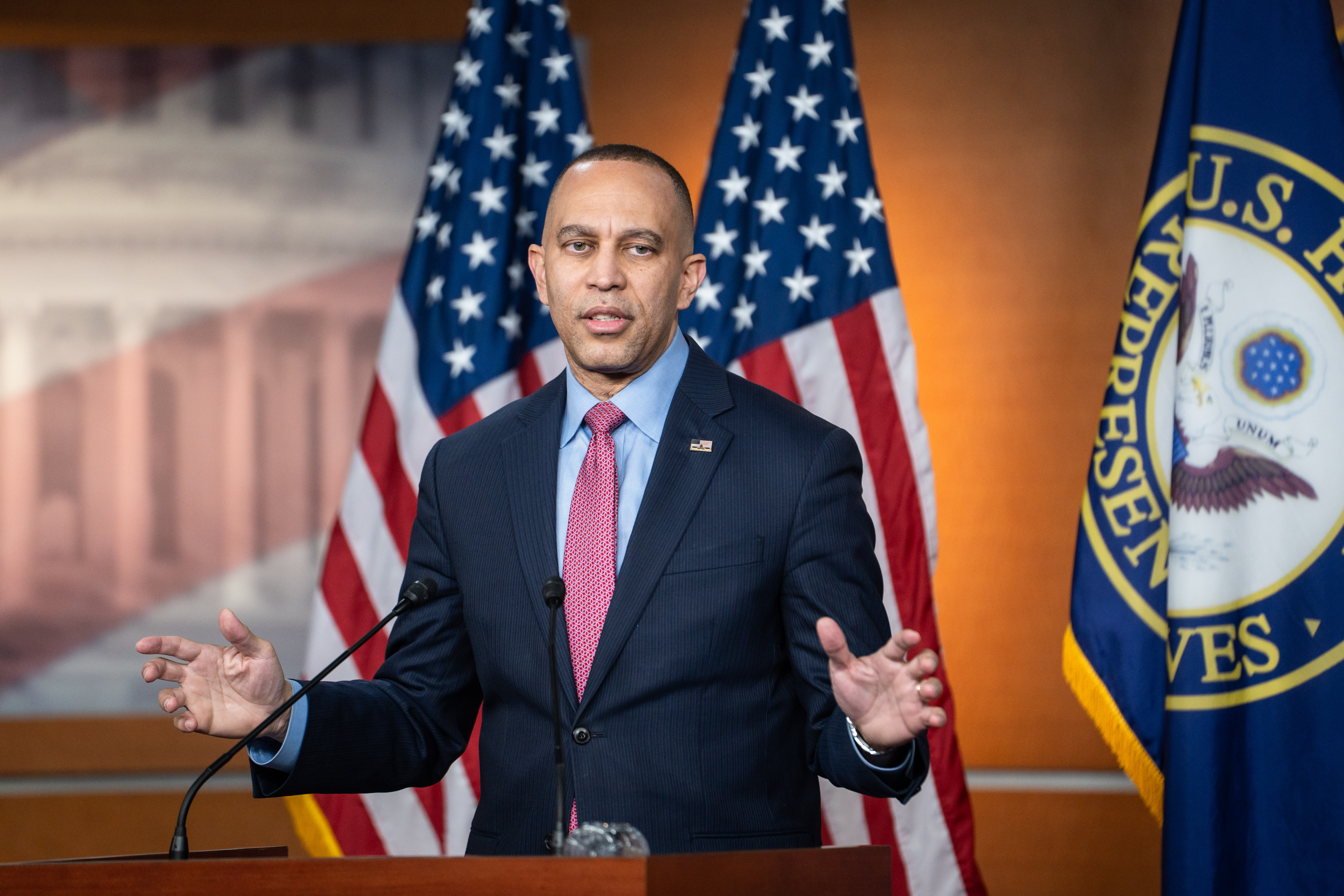
House Minority Leader Hakeem Jeffries (D-N.Y.) detailed his intentions in an April 8 letter to colleagues.
During an April 9 session that would normally be a formality, Democrats will seek to advance a War Powers Resolution on Iran through unanimous consent. It’s a maneuver that House Republicans can easily block.
Senate Minority Leader Chuck Schumer (D-N.Y.) also announced that the Senate would take a vote on a War Powers Resolution related to Iran.
“The War Powers Act will cease hostilities and require the administration to get an AUMF before going to war after the hostilities cease,” Schumer said of the proposal.
The Democrats’ calls to pursue votes for restricting the president’s war powers come a day after President Donald Trump announced he was suspending attacks in Operation Epic Fury, on the condition that Iran reopens the Hormuz Strait to unimpeded maritime traffic.
Multiple parties have accused one another of violating the two-week ceasefire. Pakistani Prime Minister Shehbaz Sharif, whose country helped mediate the brief interruption in fighting, has called on the combatant nations “to exercise restraint and respect the ceasefire for two weeks.”
In his April 8 letter, Jeffries described the present ceasefire as “woefully insufficient.”
“We have demanded that the House come back into session immediately in order to vote on our resolution to permanently end the war in the Middle East,” he wrote.
A War Powers Resolution would mandate congressional authorization of U.S. involvement in the war.
A previous attempt to constrain the president’s actions failed in the House on March 5.
Almost all Republicans opposed that resolution, which drew the support of all but four Democrats in the lower chamber.
The Senate equivalent was shot down on March 4. That vote also mostly fell along party lines. Sen. Rand Paul (R-Ky.) broke with his party to support the measure, while Sen. John Fetterman (D-Pa.) crossed the aisle to oppose it.
Ongoing two-week breaks in the House and Senate have been punctuated by pro-forma sessions. Those brief assemblies of only a few members are held as a formality so the chambers technically remain in session.
On the Senate side, the meetings keep the individual breaks short enough that the president cannot make recess appointments.
The sessions are also how lawmakers avoid adjourning for longer than three days. Under Article I of the Constitution, anything longer would take an agreement between the House and Senate.
The Easter break of 2026 has already witnessed some minor drama during sessions where little is typically expected to happen.
Earlier in April, the House did not take up a Senate-passed bill that would partly fund the Department of Homeland Security (DHS).
Some Republicans have resisted the DHS deal, which excludes immigration enforcement and border funding.
House and Senate Republican leaders have vowed to fund those areas for multiple years through a separate, party-line budget vote.
Joseph Lord contributed to this report.