
This Presidents’ Day weekend, it behooves Americans to think on some of the great executives who have led this country. Indeed, it is beneficial to think about the earliest presidents: George Washington, John Adams, and Thomas Jefferson. The three didn’t simply set standards for the traditions and expectations of what a president should be, they ensured that an American presidency was even possible.
The Raab Collection, a Pennsylvania-based business that specializes in the discovery, purchase, and selling of rare historical documents and artifacts, has acquired a collection of five letters written by five of America’s most famous and consequential presidents. Along with Washington, Adams, and Jefferson, are letters written by Abraham Lincoln and Theodore Roosevelt.
“Our objective was to celebrate the presidency in and around Presidents’ Day by showcasing a collection of five important and original pieces of presidential history,” Nathan Raab, principal of the Raab Collection, told The Epoch Times.
Washington’s Letter
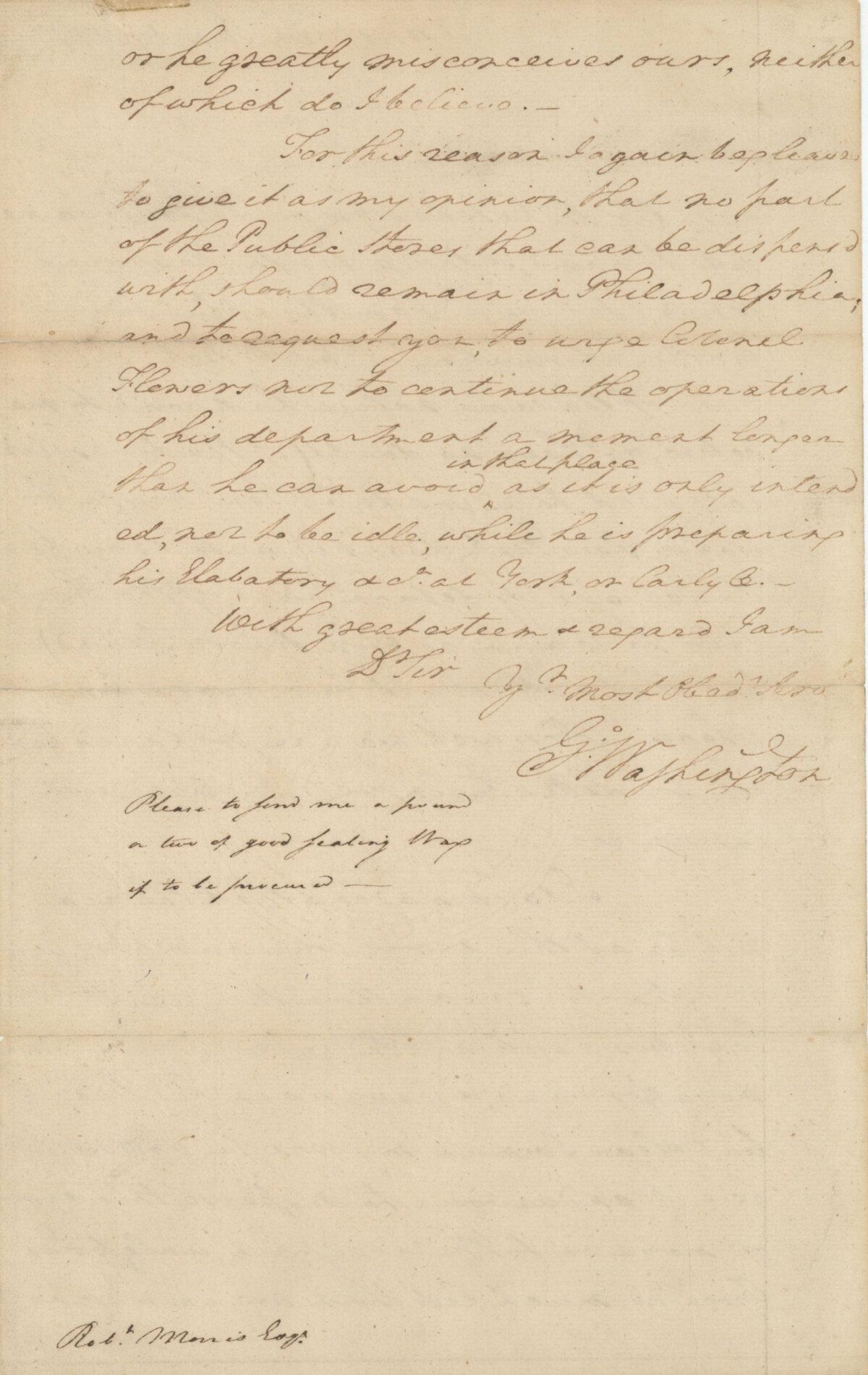
George Washington's 1777 letter to Robert Morris, voicing his concerns over Gen. Howe's advance to Philadelphia. (Courtesy of The Raab Collection)
Washington’s letter comes during the most pivotal period of the American Revolution. Penned from Morristown, New Jersey, on Jan. 19, 1777, this letter was issued shortly after the battles of Trenton and Princeton, which breathed new life into the rebellion. As Washington eyed Gen. William Howe and the British Army, he expressed his concern to Robert Morris, considered the financier of the Revolution, for the safety of the Continental Congress. He stated that Howe “will endeavour to disperse this army, or move on to Philadelphia, unless his force is much less than we imagine or he greatly misconceives ours, neither of which do I believe.”
Washington’s fear of Philadelphia being attacked, was not solely about the safety of Congress, but also war materiel. Morris summarized Washington’s concern, which recommended that “all military stores should be removed from Philadelphia before its possible occupation.”
The French Connection
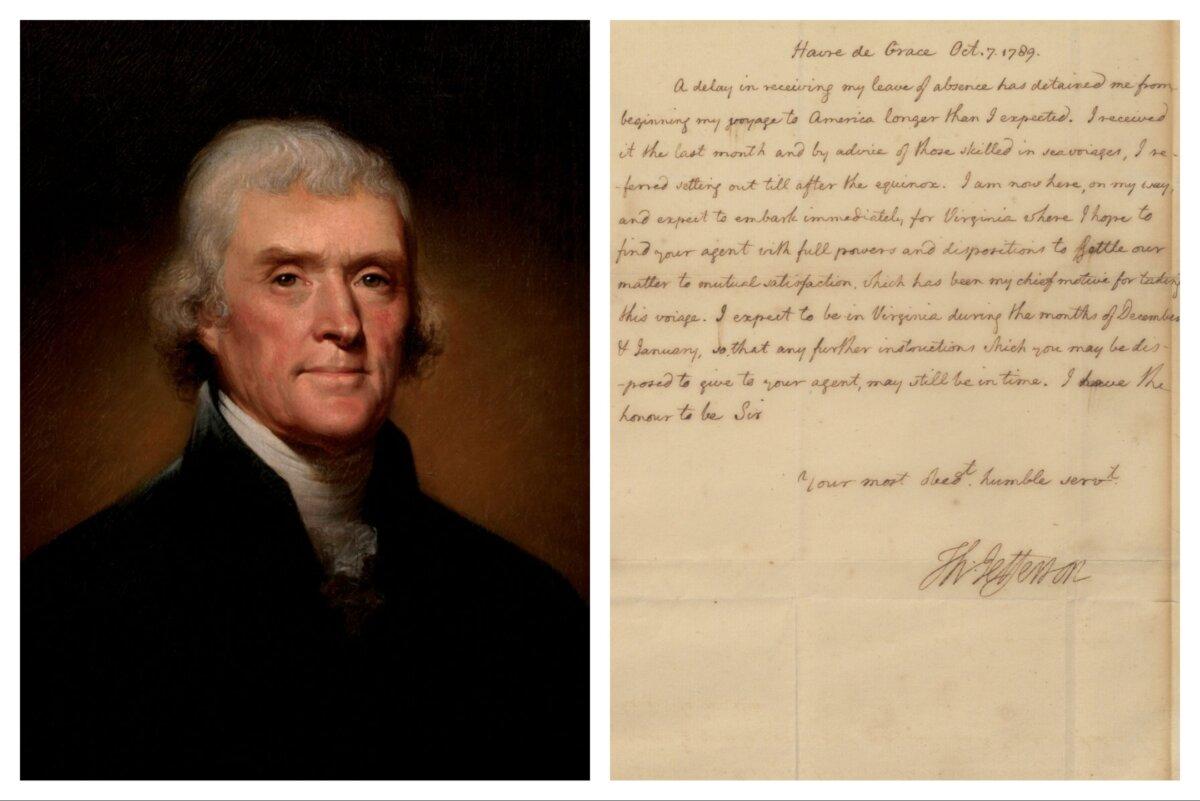
Thomas Jefferson wrote his farewell letter to France to William Jones in 1789. (Courtesy of The Raab Collection)
By the time Jefferson’s letter was written Oct. 7, 1789, the War for Independence had been over for six years. He had been the minister plenipotentiary to France for five years where his affection for French culture had grown immensely. He was present in Paris during the storming of the Bastille, which began the French Revolution. Jefferson’s relationship with the Marquis de Lafayette, the French hero of the American Revolution, enabled him to consult the Frenchman on his Declaration of the Rights of Man. Jefferson’s letter was the last letter he would write in France, or Europe for that matter, as it was the last time he would see the continent. Upon his arrival in America on Nov. 23, he was informed that he had been appointed Washington’s secretary of state.
There is also a French connection with Adams’s letter. He wrote to James Le Ray de Chaumont, the son of Jacques Donatien Leray de Chaumont, who was known as the French Father of the American Revolution. In 1785, during a visit to America, Chaumont, the son, became a naturalized United States citizen, married an American, and invested in extensive landholdings with a group of exiled French nobility. He returned in 1816 to live in his New York mansion in Jefferson County. It began his longest stay in America—16 years. During that time, he held the positions of first president of the Jefferson County Agricultural Society (JCAS) and president of the New York State Agricultural Society.
In 1818, he sent a copy of his JCAS speech to Adams, and, after reading it, Adams wrote back glowingly:
“Thirty nine years ago, I little thought I should live to see the Heir apparent to the Princely Palaces and Gardens of Passy my Fellow Citizen in the Republican Wilderness of America laying the Foundation of more ample domains and perhaps more splendid Palaces.”
Lincoln and Roosevelt
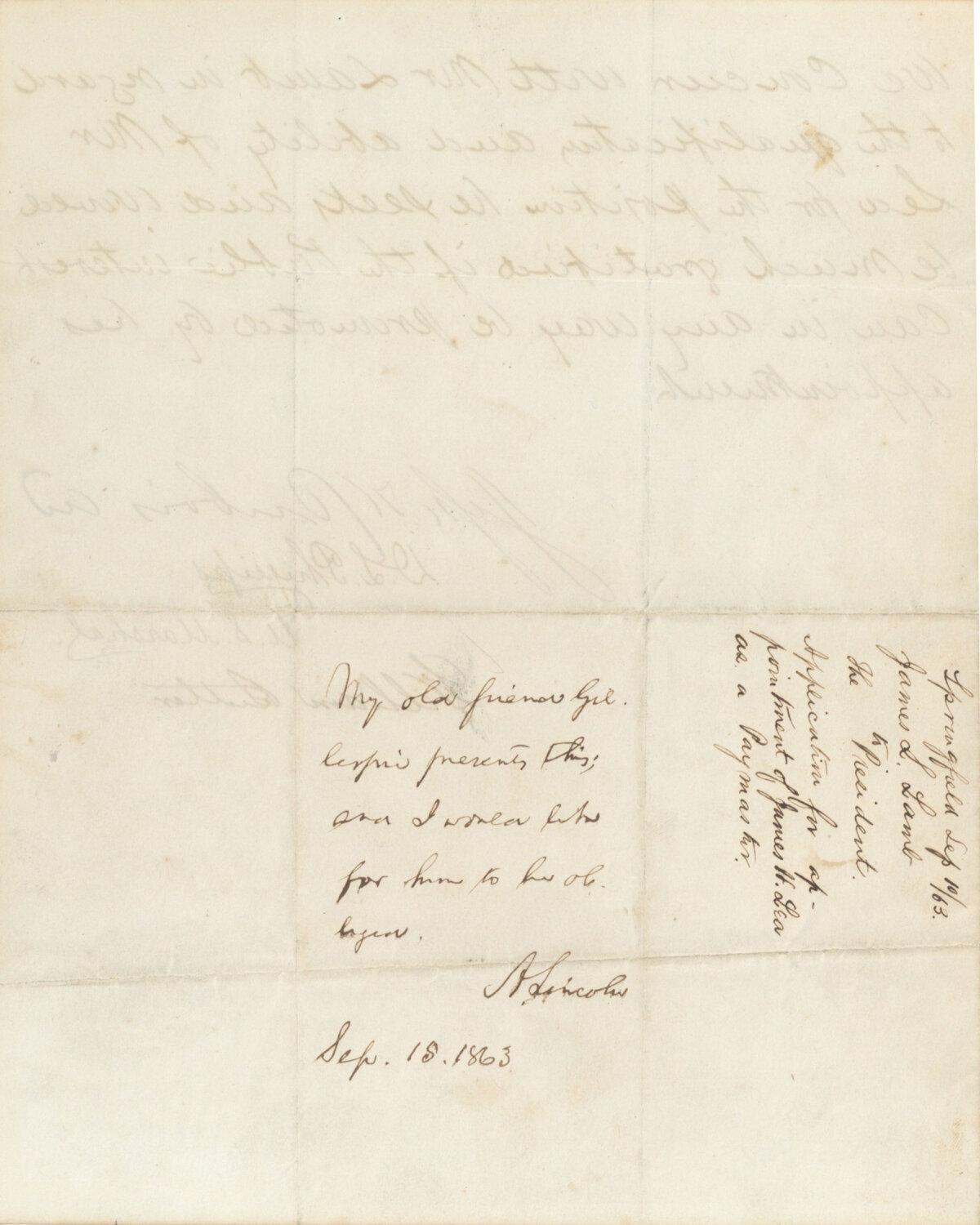
Abraham Lincoln's letter of recommendation for James H. Lea as paymaster for the Union Army, dated Sept. 15, 1863. (Courtesy of The Raab Collection)
Lincoln’s writing on Sept. 15, 1863, is a brief aside referencing the potential appointment of “James H. Lea as a Paymaster” for the Union Army. It demonstrates Lincoln’s willingness to help his friends in ways that were appropriate. Lea’s letter of recommendation identified him “as a reliable, competent businessman and one whose integrity could be fully relied upon. His moral character is without blemish,” which proved enough to obtain him the position.
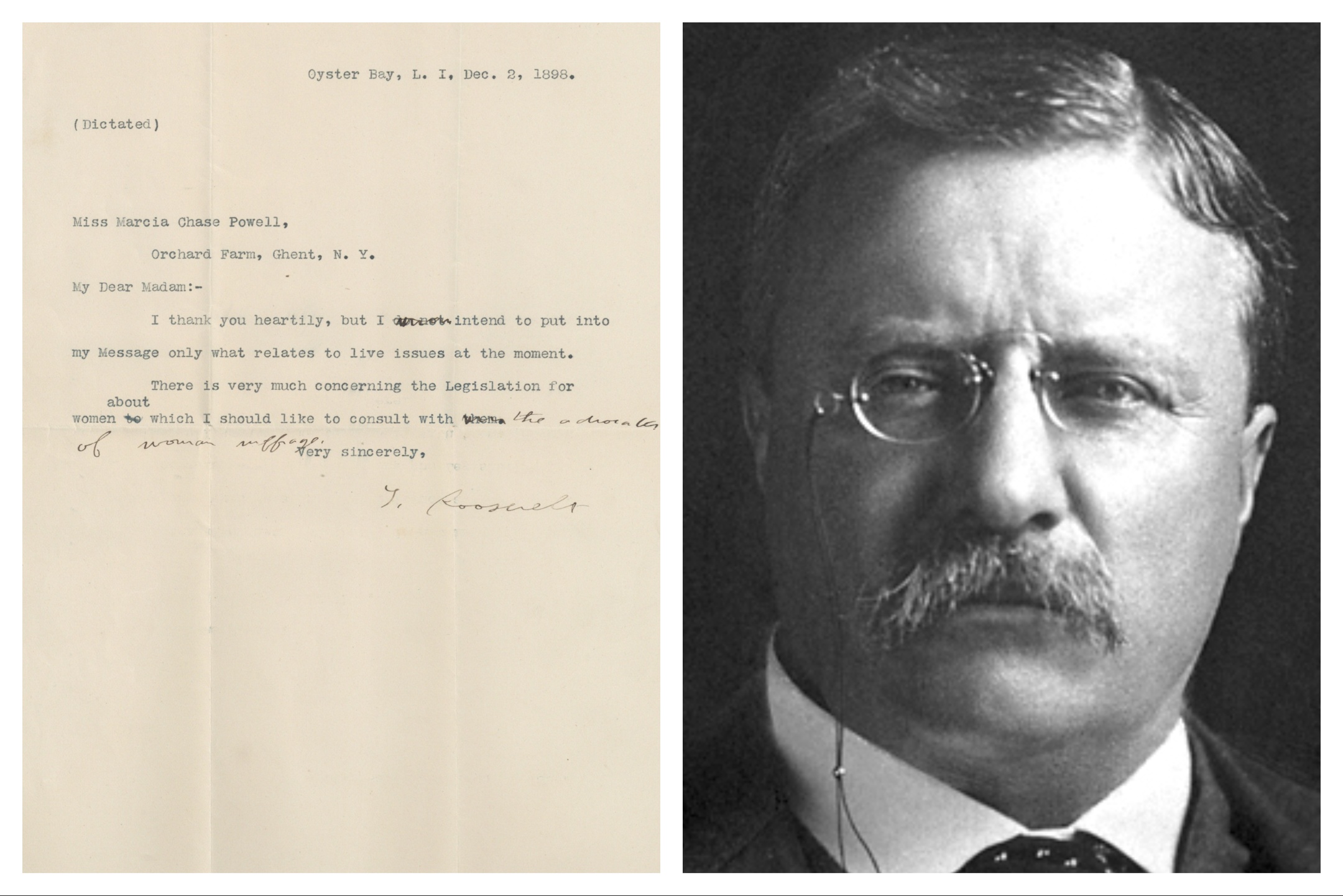
Roosevelt’s letter was written on Dec. 2, 1898, to Marcia Chase Powell shortly after his inauguration as governor of New York, in which he references women’s suffrage. According to the Raab Collection website, “This is the only letter of Theodore Rosevelt we have ever seen on the topic of women’s rights. We obtained it directly from the family of the recipient and it has never before been offered for sale.”
A Princely Sum
These newly acquired letters, heralded as The Presidential Collection, are being sold collectively for the princely sum of $300,000. Nathan Raab noted that although they are being promoted together, each letter can be purchased separately. The most expensive letter is understandably Washington’s, at $185,000. For those with a tighter budget, yet still looking to obtain at least a piece of presidential history, there is Roosevelt’s letter for $5,000.
For Raab, simply having these letters, especially during this special year, is a cause célèbre.
“Presidential documents like these are always exciting to acquire and to sell. That never gets old for us,” he said. “And as America 250 kicks off this spring and summer, yes, there will be a great national spotlight on history and historical documents. It’s rewarding to be a part of that.”
What arts and culture topics would you like us to cover? Please email ideas or feedback to features@epochtimes.nyc