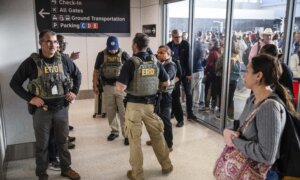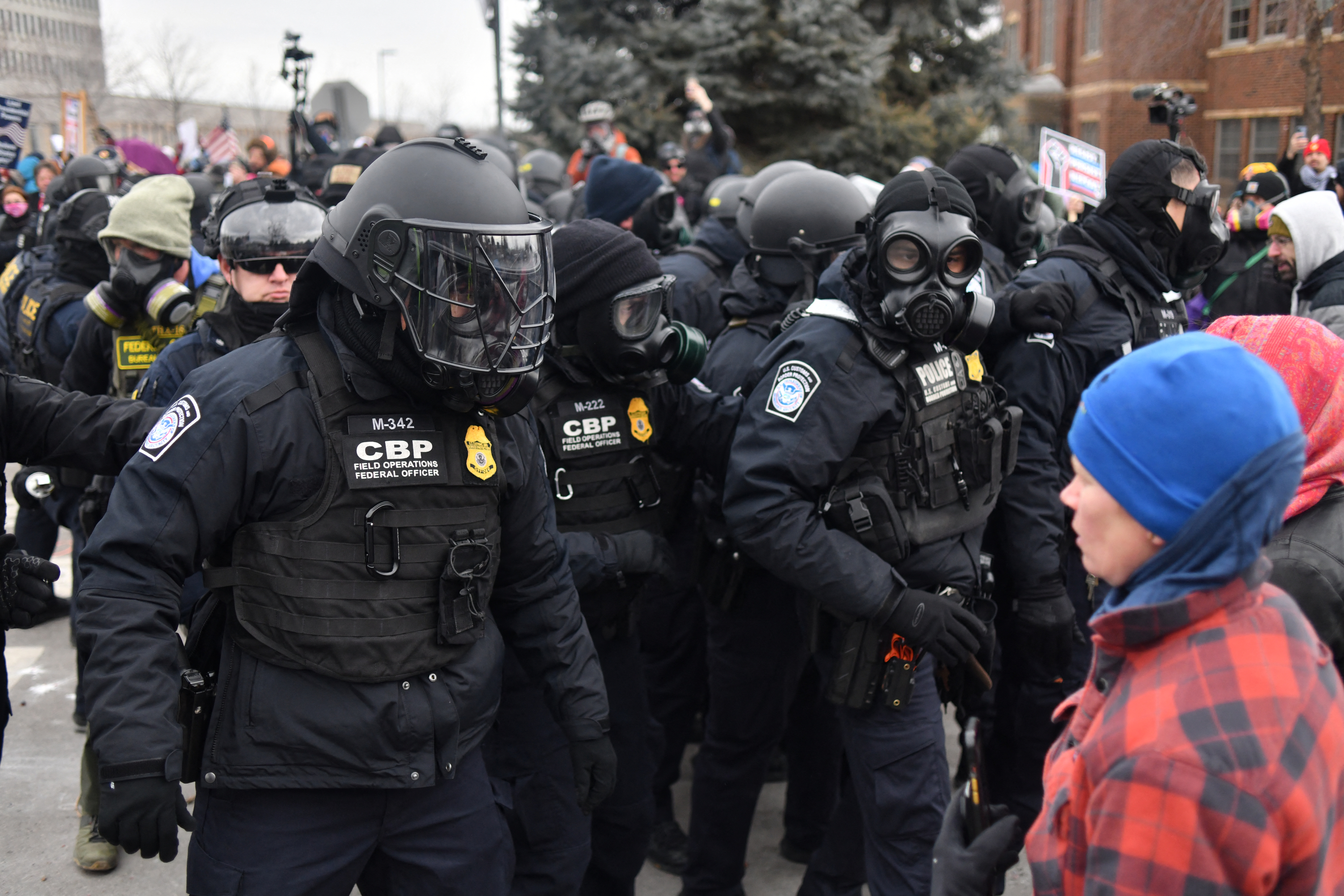


A federal judge on Jan. 31 denied Minnesota’s emergency request to block the Trump administration’s deployment of thousands of federal agents to the Twin Cities in a large-scale immigration enforcement operation.
In her ruling on Jan. 31, U.S. District Judge Katherine Menendez wrote that the “court must view Plaintiffs’ claims through the lens of the specific legal framework they invoke, and, having done so, finds that Plaintiffs have not met their burden ... the motion is denied.”
Menendez addressed in her decision that attorneys representing Minnesota and its Twin Cities focused on what they claim are costs and consequences from excessive law enforcement operations that also harm citizens. Department of Justice (DOJ) attorneys did not submit evidence directly contradicting this but rather highlighted the importance of immigration enforcement and public safety, she wrote.
Defendants also presented evidence about how federal agents have been met by resistance, threats, and violence in some cases.
“The outcome in this case depends more on the relevant law than the granular facts,” Menendez’s ruling states.
The judge delved into a high-level summary of events in Minnesota from both the plaintiff and defendants’ points of view before reaching her analysis of the case and whether Minnesota’s emergency request should be granted.
Menendez decided that Minnesota did not meet its burden of proof.
“Though Plaintiffs’ position is not without merit, for several reasons the Court finds that Plaintiffs have not shown the likelihood of success required for preliminary injunctive relief,” the judge wrote.
Menendez heard arguments earlier this week from both the DOJ and attorneys representing Minnesota, St. Paul, and Minneapolis, appearing somewhat skeptical of the district court’s authority over the separation of powers arguments the plaintiffs were advancing.
Plaintiffs had argued a temporary restraining order blocking President Donald Trump’s Operation Metro Surge was necessary to calm tensions in the streets between residents and federal agents, which reached an inflection point on Jan. 24 after a Border Patrol officer fatally shot a protester just weeks after a driver was shot and killed. Federal authorities have said that the officers acted in self-defense.
The judge also probed the DOJ’s intentions with Operation Metro Surge, the federal government’s deployment of more than 4,000 federal agents to Minnesota’s Twin Cities, and whether the Trump administration violated the 10th Amendment’s “anti-commandeering doctrine.”
That aspect of the 10th Amendment blocks the federal government from forcing state legislatures to pass laws or requiring state officials to administer a federal regulatory program.
Plaintiffs argued that the Trump administration’s actions amounted to a violation of Minnesota’s state sovereignty.
Minneapolis city attorney Brian Carter suggested that a letter Attorney General Pam Bondi sent to Gov. Tim Walz, a Democrat, was meant to coerce the state into ending its so-called sanctuary policies at the threat of continued deployment of federal agents.
In her letter, Bondi said that Minnesota has “refused to enforce the law” and demanded that Walz “restore the rule of law, support ICE officers, and bring an end to the chaos in Minnesota,” share state data on Medicaid and food stamps programs, repeal state sanctuary policies, and hand over state voter rolls to the DOJ.
The DOJ stated in court that the state laws in question, which the Trump administration argues shield illegal immigrants from detention and deportation, violate federal law.
In Menendez’s Jan. 31 ruling, she appeared to agree with this argument of coercion brought forward by the Minneapolis city attorney, while citing White House border czar Tom Homan’s recent comments in addition to Bondi’s letter as more evidence to support the plaintiffs’ coercion theory.
Homan, who was placed in charge of immigration enforcement in Minnesota earlier this week, said on Jan. 29 that the Trump administration will begin drawing down agents when local authorities make good on the commitments to cooperate more with federal authorities.
“We are not surrendering our mission at all, we’re just doing [it] smarter,” he said.
The border czar also reaffirmed that he would not be leaving the state until the problem is gone.
“Using a surge of executive force against a ’sanctuary' jurisdiction to accomplish the same ends is arguably no less coercive than withholding funds, and the Court does not dismiss Plaintiffs’ position as ‘legally frivolous,’ as Defendants suggest it should,” Menendez wrote. “However, there is also support that cuts the other way.”
Based on evidence presented at court, Menendez said Minnesota’s sanctuary policies require a greater presence of federal agents to achieve immigration enforcement initiatives than in other places that actively support Immigration and Customs Enforcement.
Menendez said attorneys for Minnesota and its Twin Cities did not provide enough evidence to support their claim that federal law enforcement agents are committing unlawful actions.
“A proclamation that Operation Metro Surge has simply gone ’so far on the other side of the line' is a thin reed on which to base a preliminary injunction,” the judge said.