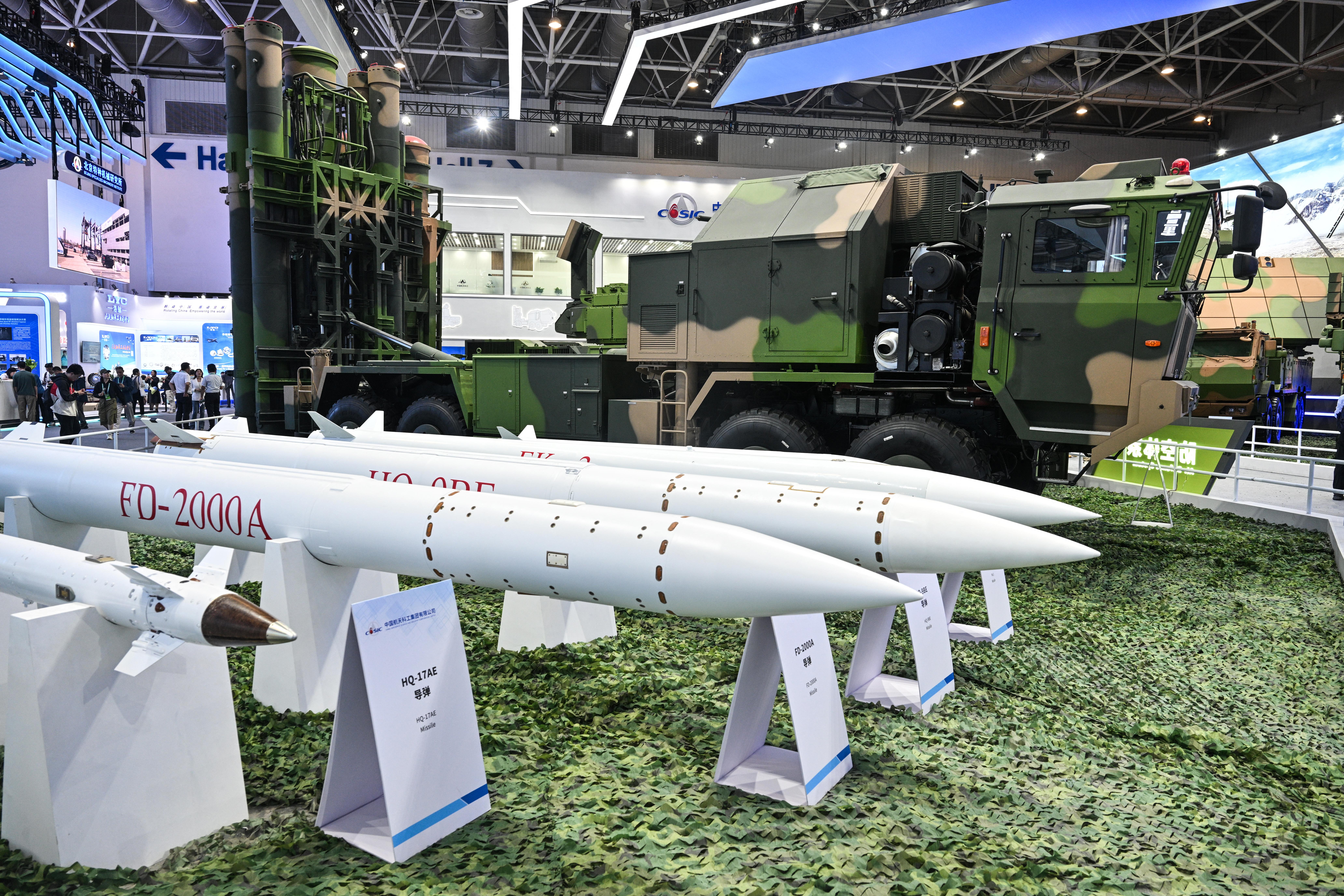
Taking photos of missile models and warplanes at public exhibitions could help foreign intelligence services uncover “core secrets,” China’s top spy agency warns. But military experts say the claim defies logic—and that its real effect is to accuse ordinary people of espionage.
The Ministry of State Security (MSS) said in a June 7 article that foreign spy agencies are using offers of “part-time photography” and “paid research” to recruit people inside China online. According to the ministry, the recruits are sent to military and technology exhibitions to take photos or measurements, which are then passed abroad and analyzed to extract sensitive military information.
Experts interviewed by The Epoch Times said the technical claims don’t hold up, because the hardware shown at such exhibitions is built for display, not accuracy. They also said the article reflects a broader push by the Chinese regime to fold everyday activities—taking photos, working part-time, attending trade shows—into its national security campaign, leaving ordinary citizens exposed to being branded as spies.
The MSS article cited examples of foreign actors allegedly asking people in China to photograph aircraft landing gear at air shows, record video of rotating radar systems at naval exhibitions, or measure the length and diameter of missile models. Such details may seem harmless taken separately, the ministry said, but once compiled, integrated, and professionally analyzed, they could be used to deduce “core secrets.”
The article claimed that at air shows, the seams in a plane’s outer skin, the arrangement of its rivets, and even how its coating reflects light could expose the state of China’s stealth materials and manufacturing. At electronics exhibitions, it said, circuit board layouts and chip model numbers could be analyzed to reverse-engineer electronic warfare capabilities.
It further claimed that while a single piece of information may be of limited value, collecting data on the same family of equipment—radar vehicles, command vehicles, loading vehicles—across different exhibitions over time could allow foreign agencies to piece together a weapon system’s complete combat configuration.
The ministry urged the public to turn down high-paying offers that involve photographing military equipment or facilities with professional gear such as telephoto lenses, 3D scanners, or signal analyzers.
‘Even Aliens Couldn’t Do It’
China-based weapons expert Tian Ru, who spoke to The Epoch Times using a pseudonym out of fear of reprisal, said the ministry draws a straight line from photographing missile models to uncovering core secrets—an obvious leap in logic.
Missile models shown at military exhibitions are not built to the dimensions of real weapons, he said. They are polished and modified for display, and the true measurements are never made public.
“Even if you handed the model itself to a foreign spy, they couldn’t figure anything out from it,” he said. “If core secrets could be deduced from a few photos, I don’t think even aliens could pull that off.”
Tian said the ministry’s logic collapses when applied in reverse. Detailed photos of real American missiles, F-35 fighter jets, and astronaut spacesuits are freely available online, he said, so by the MSS’s reasoning, Beijing should have been able to extract core secrets from those images long ago.
“If that were really possible, China’s rockets would have long since matched the performance of SpaceX’s Falcon 9,” he said. “The MSS article is shoddy work—it’s hoodwinking ordinary people.”
Chinese military scholar Li Xiangqun made a similar point. The regime’s weapons models are usually not built to scale, he told The Epoch Times, and many are promotional or display items rather than miniature versions of actual weapons.
The features that matter—key structures, materials, guidance systems, engine parameters, and combat performance—are not necessarily real, even when put on display, he said.
“It’s like the food models outside Japanese restaurants,” he said. “They let you judge a dish’s appearance, plating, and rough portion size, but not the freshness of the ingredients or how it tastes.”
Turning Exhibition Visitors Into Suspects
Li said the article’s real significance lies elsewhere. Beyond warning people not to take assignments from abroad, he said, it pulls “information gathering in public settings” into the regime’s national security narrative. Taking photos at an exhibition used to be ordinary visitor behavior. Under the ministry’s framing, photos, videos, measurements, and online side gigs can all be cast as links in an intelligence chain.
“It’s quite clear—in the future, if you take photos at a military exhibition, you could become a ‘walking 500,000 yuan,’ and they'll treat you as a foreign spy,” Li said. “It sounds absurd, but they really do have that intention.”
The phrase “walking 500,000 yuan” comes from the cash rewards China’s state security system pays for tip-offs. In 2017, the Beijing Municipal State Security Bureau announced that verified tips on espionage could earn up to 500,000 yuan (about $70,000), a policy reported by the regime’s state-run outlets, including People’s Daily Online and Xinhua.
Chinese internet users have since turned the phrase into a label that carries mockery as well as menace: anyone tagged as a “spy,” a “foreign force,” or a threat to national security becomes a potential payday for whoever reports them. The term is often aimed at people who hold dissenting views, those with foreign ties, journalists, scholars, and rights activists.
The June 7 article fits a pattern. In recent years, the MSS has published a steady stream of counterespionage cases that recast everyday activities—photography, part-time jobs, tourism, research, thesis data, and exhibition visits—as national security risks.
In May 2025, Xinhua circulated an MSS case claiming that foreign accounts offered university students 300 yuan a day to photograph naval ports, bridges, and airports. In April 2025, the website of the Supreme People’s Procuratorate published a case claiming that “casual snapshots” had caused leaks of state secrets.
Sun Chen contributed to this report.