LOS ANGELES–The U.S. Department of Justice on Monday announced a spate of new arrests as part of its ongoing, multi-pronged investigation into alleged voter fraud in California, the latest escalation in a tense standoff over access to the state’s voter rolls as November elections near.
US. attorneys announced they had charged 28 legal immigrants with election-related crimes, including registration fraud and illegal voting, with 11 arrested so far.
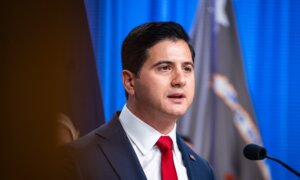
“This Department of Justice will not look the other way while noncitizens vote in federal elections. Unfortunately, the same can’t be said for California and L.A. County,” acting Deputy Attorney General Trent McCotter said at a press conference Monday.
Less than a week prior, the department sued California and L.A. County officials for refusing to set aside mail-in ballots associated with more than 20,000 suspected noncitizen voters, including the 28 individuals named Monday.
California officials sought to downplay the cases, dismissing the crackdown as voter intimidation, while federal prosecutors said they were proof the state’s election system is riddled with structural vulnerabilities that have led to rampant fraud.
The state’s Democratic leadership and election officials have so far successfully fought off federal attempts to inspect its voter rolls, citing civil rights concerns and lack of legal authority.
In May, California Gov. Gavin Newsom signed a law prohibiting any individual from allowing federal law enforcement to seize voter data without a court order. Federal prosecutors, meanwhile, recently suggested rank and file election workers could be liable for “aiding and abetting” fraud.
The Justice Department has sued 30 states plus the District of Columbia seeking copies of voter data; most of the lawsuits have been dismissed by District Court judges.
The List: ‘Questionable Circumstances’
Los Angeles County said it was given less than 48 hours to respond to DOJ demands to review the list of suspected noncitizen voters, which were delivered in “questionable circumstances” in the middle of an election cycle, unsupported by statutory or legal authority.
“The Department of Justice has not provided the underlying evidence, source, or methodology supporting its assertions that individuals identified in its records are ineligible to vote,” L.A. County Registrar Dean Logan said in a statement Oct. 15.
The county said it received DOJ’s letter, along with a USB flash drive and a handwritten password on a sticky note, at around 2:55 p.m. on Oct. 13, followed by an Excel version of the same data the next day. A deadline of 9 a.m. on Oct. 15 made the task of reviewing and responding to a list of 20,000 individuals with addresses throughout the state an “impossibility,” it argued.
But McCotter noted Monday that the Departments of Justice and Homeland Security had repeatedly tried to engage the state in the months leading up to Oct. 13.
When California began mailing ballots to every person on their voter roll in October, as required by state law, Justice officials sent the list of 20,000 people, for whom it has “high confidence” to believe are not citizens but remain on the rolls.
“After we provided that information, California and L.A. didn’t come back to us and say, ‘No, you’re wrong. These folks are citizens.’ They didn’t say, ‘Actually, let’s work together to try and figure out whether they’re citizens.’ Instead L.A. County in particular said they would not even attempt to open the list because of concerns about [information technology] integrity,” McCotter said.
“It’s a little bit ironic when a county has more concern about the integrity of their IT system than the integrity of their voter roll,” he added. “Unfortunately, the only recourse is a lawsuit.”
Logan in his statement last week said the county could not withhold or refuse to count ballots based “solely on unverified allegations,” and that it had no authority to act on records outside its jurisdiction.
Secretary of State Shirley Weber in an Oct. 14 statement reported her office had “immediately requested written information about [DOJ] methodology and data sources to back up their claims. They refused and provided California with nothing.”
‘They’re Lying’
First Assistant U.S. Attorney Bill Essayli on Monday fired back: “They’re lying,” he said during the press conference.
The DOJ explained the process, detailed in an infographic later posted to social media, he claimed, but election officials refused to engage.
“They want to look inside our systems. … It’s a two-way road. We’re happy to show a lot of our work—most of our work—but California has to come to the table, and they have to be willing to open their books as well,” Essayli said.
Federal officials said they cross-referenced and “enriched” information from a limited, public version of California’s voter roll with other government databases and public information, then subtracted individuals for whom they could find any evidence of citizenship, including from State Department, passport, Social Security, alien files, derivative citizenship and other records, and then “manually verified” the results.
Essayli previously told The Epoch Times, state officials are “stonewalling” the federal government’s attempts to review its records, while Weber has argued such attempts are unlawful and would give “unprecedented” access to sensitive voter information such as Social Security numbers and voting history.
“The USDOJ’s relentless efforts to unlawfully gain access to states’ protected voter data and purge voter rolls serve only to cause chaos and fuel public distrust in our elections,” Weber said in her statement.
A Drop in the Bucket
Essayli noted the Justice Department had charged 113 noncitizens in 20 states with illegal voting and registration offenses in the past seven weeks, which he compared to only 13 such cases prosecuted during the Biden administration.
“These are not isolated incidents,” he said, pointing to thousands of similar cases across the country, and to 6,600 noncitizens who were accidentally registered to vote in New Jersey. In North Carolina, federal officials on Oct. 15 announced a grand jury had indicted 10 noncitizens for illegally voting.
While state officials maintain California law ensures only U.S. citizens can register to vote and that non-eligible registrants are removed from voter rolls, critics say the state’s loose approach to voter identification—which is not required in most cases to cast a ballot—and the increasing share of mail-in ballots, have allowed rampant fraud to take root.
Vote-by-mail in California accounted for more than 80 percent of ballots in the 2024 general election, a sharp increase from around 24 percent in 2000 and previous decades in which vote-by-mail was nearly non-existent.
While 20,000 represents a tiny fraction of the 16.1 million ballots cast in California in 2024, elections are often decided by a razor-thin margin, McCotter pointed out, recalling the 2024 race for the state’s 13th Congressional District in which Democrat Adam Gray defeated Republican incumbent John Duarte by less than 200 votes.
Most media coverage of the DOJ investigation noted such cases of voter fraud were “exceedingly rare.” The 28 cases in question, California Attorney General Rob Bonta pointed out, represent 0.0001 percent of the state’s 23 million registered voters.
Essayli noted in a social media post that California can’t confirm whether voter fraud is a rare occurence because it does not verify voters’ citizenship status and refused to review the DOJ list.
“What are they hiding?” he asked on Monday, alleging the state is well-aware it is sending ballots to noncitizens. “They’ve never disproven a single one of our records because they have no proof of citizenship.”
Responding to Bonta on X, U.S. Assistant Attorney General for Civil Rights Harmeet Dhillon on Tuesday pointed to a 2017 finding that Los Angeles County alone had more than 1 million illegitimate entries on its voter rolls, which was revealed in a lawsuit settlement.
“You can stop gaslighting the public, and start admitting that California has a grossly flawed system of election administration,” Dhillon wrote.
‘We’re Not Perfect’
Responding to DOJ’s lawsuit against state and county election officials last week, Gov. Gavin Newsom called it a “sad, desperate attempt by [President Donald] Trump to use his politicized Justice Department to try to suppress California voters just three weeks before Election Day.”
That sentiment was echoed by advocacy groups including Campaign Legal Center and the National Association for the Advancement of Colored People (NAACP), in an Oct. 16 motion to intervene as defendants in the case.
“Once again, this Justice Department is resorting to unlawful and unprecedented tactics in order to hijack the midterm election,” Kristen Clarke, NAACP’s general counsel, said in a statement.
Essayli suggested Newsom and others were intentionally creating false narratives to distract from systemic fraud.
“There’s a lot of misinformation and disinformation being spread by the deceivers up there in Sacramento—the governor and the secretary of state and the attorney general. They’re lying.”
Newsom’s office directed inquiries to the secretary of State, who did not respond in time for publication; nor did the L.A. County registrar.
Federal officials on Monday said they have explained their methodology well enough to elicit a good faith response from state and county officials, and were willing to work together despite the pending legal battle.
“We want California to work with us. There may be some names on there who it turns out ultimately are citizens. We’re not perfect, and that’s why we’ve asked California to cooperate with us,” McCotter said.
“We could knock through most of these names pretty quickly, probably in a day or two, if California were to work with us.”
The Justice Department on Monday filed an emergency motion asking the court to grant a temporary restraining order to set aside the ballots pertaining to the 20,000 people on its list.
In a motion filed Tuesday, Los Angeles County Assistant Registrar-Recorder Aman Bhullar said he did not believe it would be technically possible to comply with the DOJ’s demand without violating state and federal law.
Bhullar also recounted a preliminary analysis his team conducted of a sample of 200 records from the list of 20,000. They found 112 of the individuals were not sent ballots for the upcoming election due to canceled or inactive records; 71.2 percent had never voted in past elections; nearly 39 percent reported they were born in the United States.
Only 7,035 of the 20,000 or so total on the list, Bhular said, had addresses located in Los Angeles County.