

Republicans are projected to lose their majority in the U.S. House of Representatives, putting Democrats on track for majorities in both chambers of Congress.
In the early hours of Wednesday morning, at 1:26 am ET, The Associated Press projected that Democrats had cleared the 218-seat threshold to take control of the House. The party had already reclaimed control of the Senate on Tuesday evening.
The latest projection from The Associated Press has Democrats winning 228 seats in the House to the Republicans’ 139, with 68 races yet to be called. In the Senate, Democrats are poised to control 54 seats compared to the GOP’s 46, although two races are yet to be called.
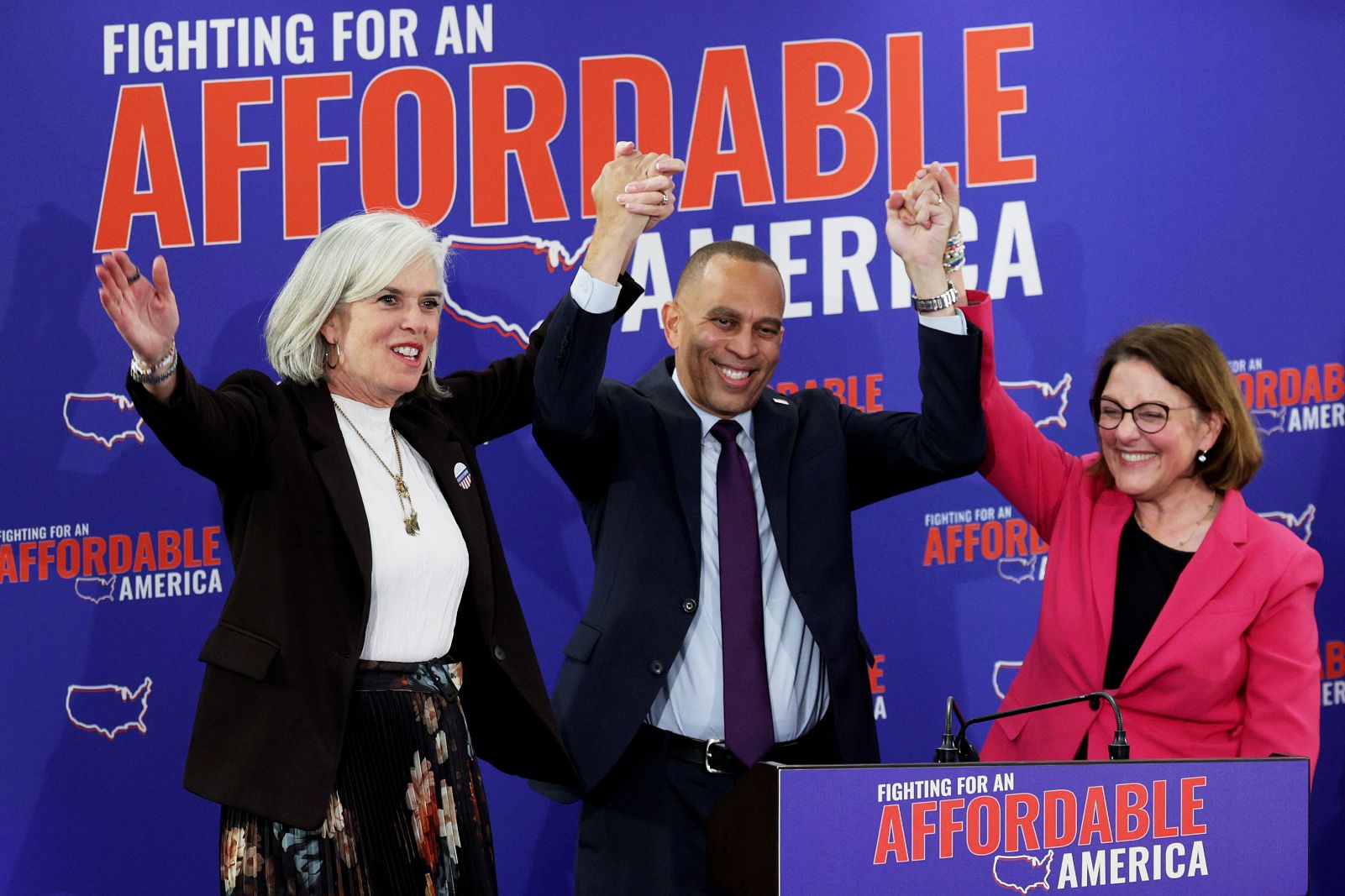
“Today begins the great American comeback,” said House Minority Leader Hakeem Jeffries (D-N.Y.), the heir apparent to the speaker’s gavel, with Democrats’ victory in the House.
“The American people … have had enough of the corruption. They want a Congress that’s going to deliver for the American people and that’s exactly what House Democrats will do as soon as we get into office in January.”
President Donald Trump, speaking to Fox News after Democrats won Senate control, congratulated Democrats on their win. “You worked very hard,” he said.
The president also said he would work with Democrats on certain issues, but not others like the border or transgender issues.
With a majority, Democrats will gain control of the House and Senate congressional committees—including the all-important subpoena power, which will allow the party to carry out sweeping investigations into the Trump administration. Democrats have vowed to carry out such investigations, though the party is divided about the prospect of pursuing another impeachment.
The Democratic victory also sets the stage for protracted showdowns with the White House over government spending and other key areas of federal policy, as was the case when Democrats swept the House midway through Trump’s first term.
Senate Flips Blue
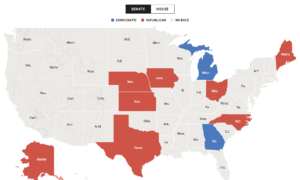
Democrats have already won key victories in the Senate, becoming the winners in critical battlegrounds such as South Carolina, North Carolina, Georgia, New Hampshire, Texas, Kansas, Iowa, and Ohio.
The first flip was in North Carolina, where former Gov. Roy Cooper, a Democrat, defeated former Republican National Committee Chairman Michael Whatley.
Down south in South Carolina, pediatrician Annie Andrews, a Democrat, defeated incumbent Republican Sen. Darline Graham, who took the seat after her brother, former Sen. Lindsey Graham (R-S.C.), died earlier this year.
In Kansas, pastor Adam Hamilton, a Democrat, defeated incumbent Republican Sen. Roger Marshall. Hamilton will be the first Democrat from Kansas in the Senate in 94 years.
The biggest upset was in Texas, where Democratic state Rep. James Talarico defeated Republican Texas Attorney General Ken Paxton. This is the first time a Democrat will be sent to the Senate from Texas since Lloyd Bentsen, who served between 1971 and 1993.
In Ohio, former Sen. Sherrod Brown will return to the Senate, defeating incumbent Sen. Jon Husted (R-Ohio). Brown will serve the remaining two years of Vice President JD Vance’s term.
Over in Iowa, Democratic state Rep. Josh Turek defeated Republican Rep. Ashley Hinson for Sen. Joni Ernst’s (R-Iowa) seat. The last Iowa Democrat in the Senate was Tom Harkin, who retired from the Senate in 2015.
In Maine, former state Senate President Troy Jackson defeated longtime Republican Sen. Susan Collins.
Samara Klar, a political science professor at the University of Arizona, told The Epoch Times that one issue has defined the past two elections.
“The Republicans had an incredibly strong election in 2024 largely based on their promises of affordability. And affordability remains as big of an issue, if not bigger, for Americans today than it was then,” she said.
Klar said the American electorate has sent a message to the president and the GOP.
“Voters are sending a message that the policies Trump and his Republican government have brought in over the last 2 years are not working for them,” she said.
In Michigan, progressive Democrat Abdul El-Sayed won the seat, defeating former Republican Rep. Mike Rogers with just over 52 percent of the vote.
While the incumbent in the seat is a Democrat—Sen. Gary Peters—it’s still seen as a big win for the progressive movement. El-Sayed is also the first Muslim in U.S. history to be elected to the Senate.
Senate seats in Mississippi and Alaska are still undecided, with the former coming down to the wire in vote counts.
House Gains
As of Wednesday morning, Democrats had picked up an extra 25 House seats.
Critical wins for Democrats included North Carolina’s 11th Congressional District and New Jersey’s Seventh Congressional District.
So far, Democrats have a 228–139 advantage in the House, with 68 seats yet to be called.
House Minority Leader Hakeem Jeffries (D-N.Y.), the heir apparent to the speaker’s gavel, faces a divided party between progressive and moderate Democrats.
Changes to Governorships
Some gubernatorial races resulted in surprising changes.
Texans will have its first Latina governor—and first Democrat to hold the office—in more than 30 years.
Underdog candidate Gina Hinojosa, 52, took the seat from incumbent Republican Gov. Greg Abbott to run the executive branch of the nation’s most populous red state.
In Georgia, Democrat Keisha Lance Bottoms, the former mayor of Atlanta, was elected governor, becoming the first black woman elected governor in U.S. history. Bottoms defeated Republican businessman Rick Jackson, flipping the top job in the swing state.
Wisconsin and Florida also got their first black governors, with Democrat David Crowley and Republican Byron Donalds taking the positions in their respective states.
Crowley will replace Gov. Tony Evers, who chose to retire. His win also marks the first time in Wisconsin’s 178-year history that Democrats will hold the governor’s office for more than eight consecutive years.
In Florida, Donalds succeeds outgoing Republican Gov. Ron DeSantis.
Savannah Hulsey Pointer contributed to this report.