

WASHINGTON—Congress on Feb. 5 will continue to work on a bill to fund the Department of Homeland Security (DHS) as members in both chambers remain at odds on the path forward.
Democrats in the Senate are demanding reforms to DHS and its subsidiary Immigration and Customs Enforcement (ICE). Republicans in the House are demanding the passage of a law to require voter ID nationwide, which Senate Democrats have described as a nonstarter.
With both sides digging in, senators are indicating that a deal before the Feb. 13 funding deadline appears unlikely.
Currently, 96 percent of the federal government is fully funded through Sept. 30, the end of the fiscal year, after President Donald Trump on Feb. 3 signed legislation to end the partial government shutdown.
That legislation contained funding for five departments, while punting the deadline for DHS funding to Feb. 13.
Senate Democrats have demanded changes to the DHS bill to reform ICE as a condition of their support to pass the bill through the upper chamber.
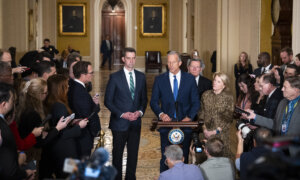
“Our caucus is united, is unified over three main legislative objectives,” Senate Minority Leader Chuck Schumer (D-N.Y.) said on Jan. 28.
Schumer said that these included “an end to roving patrols” of ICE agents in U.S. cities, including strengthened judicial warrant requirements, measures to “enforce accountability,” and changes to ICE attire, including an end to masking, prominent presentation of badges, and body cameras.
Senate Democrats’ support will be required for any measure to overcome the 60-vote filibuster threshold.
Negotiations
On Feb. 4, Senate lawmakers were skeptical about the prospects of reaching a deal before the deadline. Sen. Katie Britt (R-Ala.), who is one of the GOP leaders in the negotiations on the funding bill, had little to say about how negotiations currently stand as she left an initial meeting with Senate Democrats.
She told reporters that lawmakers would “need a little bit more time” to “figure out a pathway forward.”
Britt added that Republicans, including Trump, were working in good faith, noting the administration’s decision to deploy body cameras on immigration agents in Minneapolis, with plans to expand the policy nationwide.
Britt said that Democratic lawmakers were negotiating in good faith as well.
Sen. Lisa Murkowski (R-Alaska), representing a crucial swing vote, was pessimistic when asked about the prospects of a deal being reached before the Feb. 13 deadline.
“It’s really hard, because the time that we’ve given ourselves, this window, it’s so short,” Murkowski told The Epoch Times.
She added that a deal being reached before the deadline is “not impossible, but you’ve got to have willingness on both sides, and you’ve got to have the president really leaning in on these negotiations.”
SAVE Act
Originally introduced by Rep. Chip Roy (R-Texas), the Safeguarding American Voter Eligibility (SAVE) Act is intended “to require proof of United States citizenship to register an individual to vote in elections for Federal office,” including requiring voter ID to vote across the United States.
Roy and other backers of the bill have argued that it’s necessary to override a 2013 Supreme Court decision that effectively banned states from imposing proof of citizenship requirements to register voters.
Now, many House Republicans are indicating that passage of the legislation by the Senate—whether as a standalone package or as part of the DHS bill—will be necessary for their support of any reforms negotiated by the Senate.
The Republican Study Committee (RSC) in the House has called for the bill’s passage.
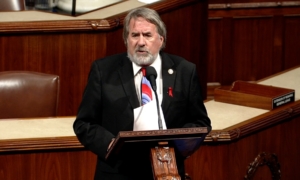
“American elections should be fair and free, not subject to foreign influence. Illegal aliens have no right to be in America, and they certainly shouldn’t be voting,” said Rep. Brandon Gill (R-Texas), who’s leading the RSC’s push to pass the bill.
“House Republicans are united behind the SAVE Act. I urge my Senate colleagues to pass this legislation and get it to President Trump’s desk for his signature.”
Rep. Anna Paulina Luna (R-Fla.) has been tying her support of the measure to the SAVE Act’s passage.
Many conservative Republicans, including Reps. Tim Burchett (R-Tenn.), Ralph Norman (R-S.C.), Thomas Massie (R-Ky.), John Rose (R-Tenn.), and Keith Self (R-Texas), have given indications that they won’t back the DHS bill without passage of the SAVE Act.
Democrats have indicated that the measure is a nonstarter in the upper chamber.
“The SAVE Act ... is dead on arrival in the Senate,” Senate Minority Leader Chuck Schumer (D-N.Y.) said in a statement. “It is a poison pill that will kill any legislation that it is attached to.”
Schumer said the legislation would “suppress voters,” and that it “seeks to disenfranchise millions of American citizens, seize control of our elections, and fan the flames of election skepticism and denialism.”
The New York lawmaker vowed that Democrats would “go all out to defeat the SAVE Act.”
He has stated that lawmakers from the Democratic Party are entirely united on the issue.