More than three years after China ended its draconian COVID-19 pandemic controls, some Chinese citizens say they are still suffering from serious health problems that they believe began after receiving domestically produced COVID-19 vaccines.
Several individuals also say they have seen a rise in deaths among younger people from sudden heart attacks or strokes. Chinese authorities have not acknowledged a broader vaccine injury issue. But an analyst who recently spoke to The Epoch Times said the lack of answers—and lack of support—has turned fear into anger.
Most requested anonymity or used only their surnames, citing fear of reprisal.
Yang, who runs a funeral paper shop in Jiaozhou, Shandong Province, said he has noticed that more young people are dying.
“In the past, it was rare for people in their 30s or 40s to die from heart attacks or strokes,” Yang told The Epoch Times.
Deaths among people in their 50s have also increased, he said.
“Most people already understand the reason—the vaccine,” Yang said. “There are more heart attacks and strokes. People’s immunity has generally declined. Now, things like hair loss, forgetfulness, and skin allergies are considered minor problems.”
He described the COVID-19 pandemic years as overwhelming.
“Many people died. We could barely keep up,” he said. “My wife and I do this work ourselves. We don’t have employees.”
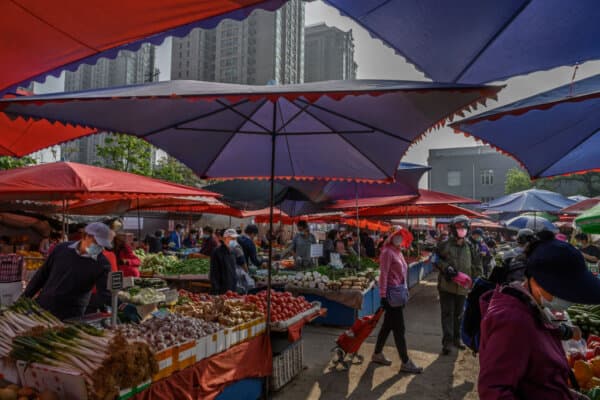
Chinese fruit and vegetable vendors and customers wear protective masks at a local outdoor market in Beijing on April 30, 2020. (Kevin Frayer/Getty Images)
Lingering Illness, No Clear Diagnosis
Wang, a resident of Liaocheng, Shandong Province, said her uncle died of a heart attack in late April without warning.
“He had no symptoms at all. He just suddenly passed away,” she told The Epoch Times. “My uncle had always been very healthy. We all believe it was due to the vaccine.”
She said similar sudden deaths have become common in her area, and most of them were in their 40s and 50s.
Wang also said she began experiencing symptoms after receiving a single-dose COVID-19 vaccination that was counted as two shots.
“After I got the vaccine, I sometimes felt sharp pain in my chest,” she said. “I became forgetful, weak, and sleepy, and I often had low fevers. I also experienced hair loss.”
For Dong, a man in his 30s from Hechi, Guangxi Province, the symptoms have been more severe. He said his health began deteriorating after three COVID-19 vaccine doses.
“The symptoms feel like a heart attack and a stroke tormenting me,” he told The Epoch Times. “My heart feels uncomfortable every day. Last year, I nearly died suddenly on several occasions.”
He described chest tightness, shortness of breath, palpitations, and severe headaches. At times, he said, he could hear his heartbeat and struggled to walk steadily.
“It felt like heart failure,” he said. “I’ve gone to the emergency room several times.”
Despite repeated hospital visits—including scans, ultrasounds, and more than a dozen electrocardiograms—doctors found no clear cause.
“They said it was a nervous system disorder and that there was no treatment available,” he said.
Dong said he tried medication for more than a year, losing about 50 pounds, but eventually stopped. He said he can no longer work, even though he was once able to handle long hours of physical labor.
“I’m ruined,” he said. “My vision is blurry, and my body feels weak.”
Dong said his condition worsened after receiving a vaccine produced by Shenzhen Kangtai Biological Products.
“After the second shot, I couldn’t get out of bed,” he said. “I asked if I could skip the third, but they said it had nothing to do with the vaccine and gave me another shot.”
Dong also said his child has developed a range of health issues that he believes are linked to vaccination.
“My child is also ruined,” he said.
Dong added that as many as six people he personally knew had died suddenly after receiving COVID-19 vaccinations, although he did not provide details on the vaccine brands and exact timing of their deaths.
The Epoch Times reached out to Shenzhen Kangtai Biological Products for comment but did not receive a response by publication time.
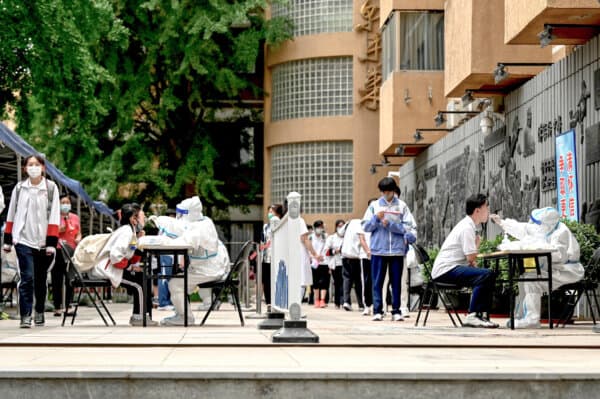
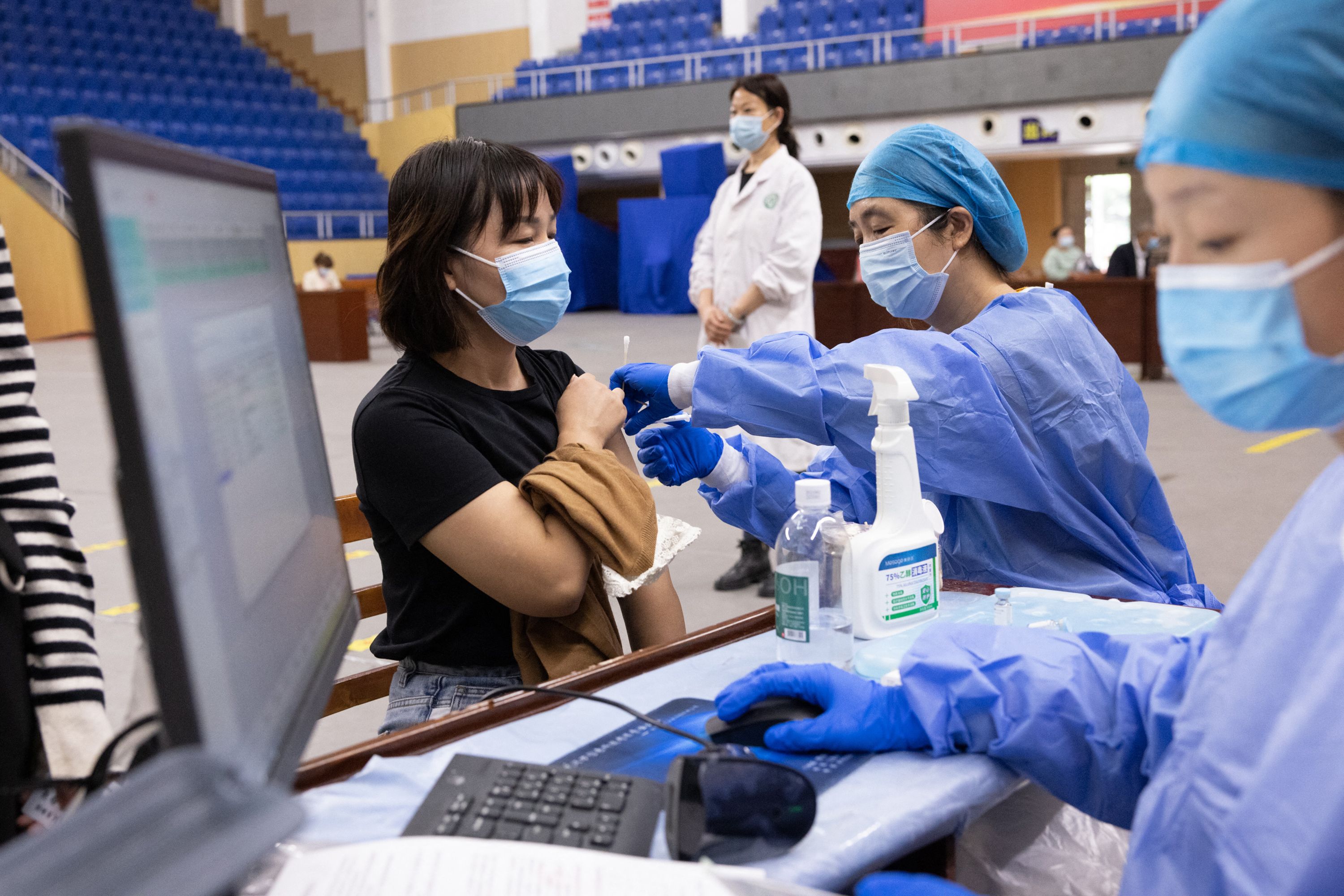
Health workers take swab samples from students to be tested for COVID-19 in Beijing on June 7, 2022. (Jade Gao/AFP via Getty Images)
Complaints Met With Silence
Both Wang and Dong said that seeking help from authorities felt pointless.
“The government doesn’t care about these things,” Wang said. “It’s a dead end.”
“I didn’t go to the government,” Dong said. “There’s no way to get through to the authorities.”
Some who have tried to publicly raise concerns say they were blocked.
On June 18, 2025, Guangdong resident Wang Haiyan and several others who said they were disabled by COVID-19 vaccines went to provincial health authorities to seek compensation. They were not received. That evening, they livestreamed from a reception room to describe their experiences, but the stream was quickly shut down.
In another case, Shanxi resident Zhao Yajing received two doses of the Sinovac COVID-19 vaccine in May and June 2021, respectively. She was diagnosed with acute myeloid leukemia in January 2022, according to Radio Free Asia.
Zhao and her husband, Wang Hongyi, suspected a link and repeatedly petitioned Beijing authorities for compensation, they told the media outlet. Wang was later sentenced to six months in prison for “picking quarrels and provoking trouble,” a charge often used against petitioners. Zhao was sentenced to two years and nine months on the same charge.
The Epoch Times reached out to Sinovac for comment but did not receive a response by publication time.
Rising Sudden Deaths, Restricted Discussion
In recent years, reports of sudden deaths among middle-aged and younger individuals have circulated in China. Public discussion of possible links to vaccines is tightly controlled, and related posts are often removed.
Several recent deaths among officials and public figures have drawn attention online, although the causes are typically reported in vague terms such as “sudden illness” or “treatment failure.”
On April 20, Mao Xinyu, 45, chief of the Longba police station under the Zhuxi County Public Security Bureau in Shiyan, Hubei Province, died suddenly while working, according to state-owned outlet Legal Daily.
On April 18, Ye Jun, 43, a director known for the Chinese-language documentary series “Masters in the Forbidden City,” died after medical treatment for an illness failed, according to state-run China Internet Information Center.
On April 15, Yi Lian, 38, an artist and alumnus of the China Academy of Art, also died after medical treatment for an illness failed, state-censored Jimu News reported.
On April 10, Yu Hongli, 45, deputy director of the Yongren County Public Security Bureau in Chuxiong Prefecture, Yunnan Province, died after suddenly falling ill during a meeting, according to state-run People’s Public Security News.
Other recent cases reported by Chinese media outlets include Wang Zhiwen, Party secretary and director of the Shuocheng branch of the Shuozhou Ecology and Environment Bureau in Shanxi Province, who on April 1 died from a sudden illness while working at age 49; Tang Jian, Party secretary and chairman of Guotong Trust, who on March 25 died of a sudden heart attack at age 55; and Wei Hua, an investigative reporter with Henan Radio and Television, who on March 19 died of a sudden heart attack at age 45.
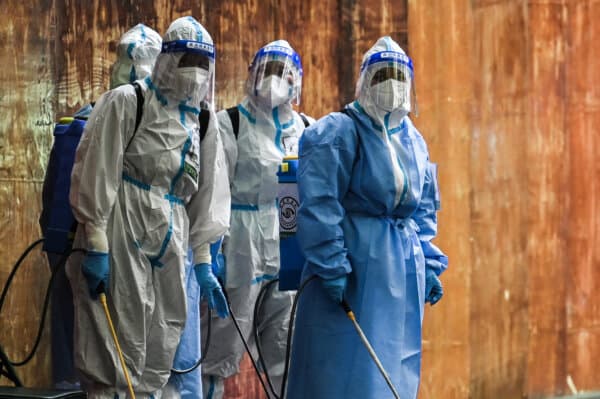
Workers who handle disinfectant look on next to a residential area under a COVID-19 lockdown in the Huangpu district of Shanghai on June 4, 2022. (Hector Retamal/AFP via Getty Images)
Tang Jingyuan, a U.S.-based China affairs commentator with a medical background, told The Epoch Times that the Chinese Communist Party (CCP) treats vaccine safety as a political issue rather than a medical one.
“The CCP does not even allow people to mention whether these sudden deaths are related to the vaccines,” Tang said. “It does not allow reporters to cover such cases or medical experts to study them.”
He said the vaccines—developed domestically and heavily promoted—are closely tied to the regime’s political credibility.
“In the CCP’s view, this is no longer a medical issue; it has become a political one,” Tang said.
He said that China’s COVID-19 vaccine development was rushed under political pressure.
“COVID-19 is caused by an RNA virus that mutates easily, making effective vaccine development difficult and requiring major investment, robust research capacity, and time,” Tang said.
“But at the time, global attention was focused on whether the virus originated in a CCP-linked laboratory, while Chinese leader Xi Jinping was eager to produce a vaccine and seize control of the narrative.
“After pushing out large quantities of inactivated vaccines through what it called ‘overtaking on a curve,’ the CCP used the vaccines as bargaining chips in political deals around the world.
“Before there was reliable and systematic proof of vaccine safety, it began enforcing vaccination at home.”
In 2021, after rapidly rolling out and expanding exports of Chinese-made COVID-19 vaccines, Beijing used vaccine access as a tool of foreign policy. In some cases, officials and diplomats said Chinese vaccines were tied to political concessions. In March 2021, Taiwan accused Beijing of offering Paraguay access to millions of Chinese vaccine doses if it cut diplomatic ties with Taipei. In June 2021, Ukrainian officials said China threatened to withhold access to Sinovac vaccines unless Kyiv withdrew support for a U.N. statement on Xinjiang.
The regime placed its own interests above public health, Tang said.
Growing Distrust Among Younger Chinese
A university student from Liaoning, using the alias Xiaopeng, said the COVID-19 pandemic changed his view of the CCP.
“I never used to care about national affairs,” he told The Epoch Times. “But after they forced us to take what I call a toxic vaccine, I have hated the regime.”
Despite being fully vaccinated, he said, he fell seriously ill and was diagnosed with another viral infection earlier this year.
“It was the same as during the pandemic,” he said. “I had a fever of over 39 degrees Celsius (102 degrees Fahrenheit) and felt terrible for a long time.”
Tang said such anger may be more widespread than it appears because of strict information controls.
“Many young people didn’t understand how the regime operates,” he said. “But after being forced to get vaccinated and then experiencing health problems, their views changed.”
Tang said the most serious concern is the sharp decline in immunity reported by some alleged victims.
“This kind of damage could be irreversible,” he said. “For many, it feels as if their lives have been derailed before they even began.”
Ting Bing and Gu Xiaohua contributed to this report.