
News Analysis
Several Chinese government websites have recently become inaccessible from many locations outside China, prompting questions among analysts and researchers who rely on official sources to track developments inside the country.
The issue came to wider attention after reports emerged that Cai Qi, one of Chinese leader Xi Jinping’s closest allies, had been appointed president of the Central Party School. Researchers and overseas observers seeking additional information on the appointment found that the school’s official website could not be accessed from many foreign locations.
Further testing suggested that the restrictions extended to several government ministries, including Civil Affairs, Natural Resources, and Housing and Urban-Rural Development.
Technical specialists who examined the issue say the websites do not appear to be suffering from routine outages. Instead, they point to evidence suggesting that access requests from overseas IP addresses are being deliberately blocked through web-application firewall systems. Users connecting from within mainland China can still access the sites normally.
Some tests suggest the restrictions do not appear to apply to visitors accessing the sites from Taiwan, although the reason remains unclear.
The findings are notable because they come at a time when Beijing is emphasizing openness to foreign investment and international engagement. Yet the apparent restrictions suggest that in some areas, the flow of information is moving in the opposite direction.
Party School Website Offers Clues
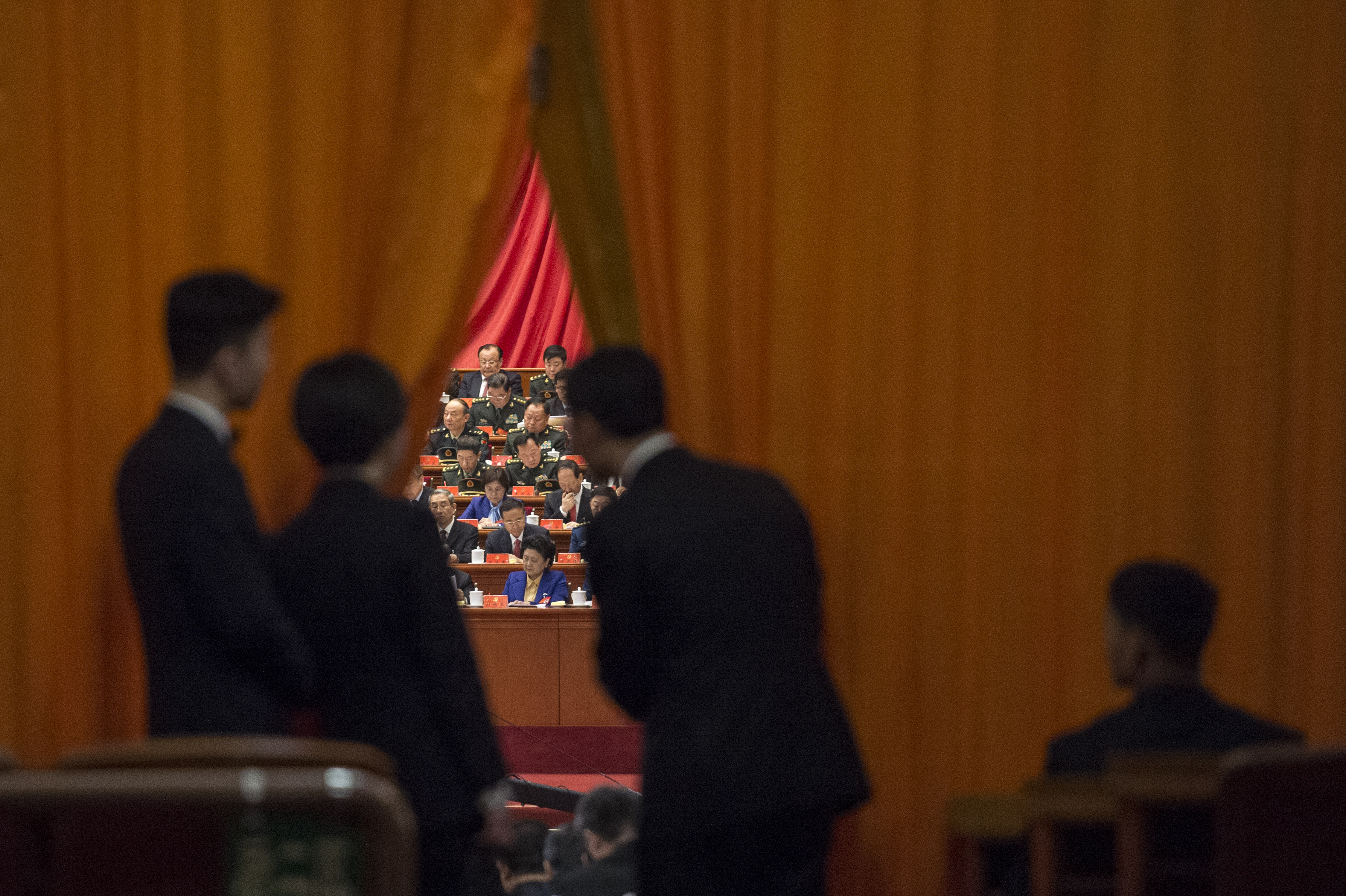
The Central Party School is a particularly revealing case. Although largely unknown outside China, the institution occupies a central place in the Communist Party’s political system. It trains senior officials, develops ideological doctrine, and often provides clues about the leadership’s priorities through speeches, research projects, and internal policy discussions that later appear on its website.
Sheng Xue, a prominent Chinese-Canadian author and democracy activist, told The Epoch Times that the Central Party School’s website serves as a repository of raw material reflecting the thinking and intellectual trends of China’s senior-level officials. For decades, China watchers have mined Party School publications for clues to the regime’s shifts in official thinking, paying close attention to changes in terminology, research priorities, and the prominence of particular themes.
What makes the current restrictions particularly striking is that, in September 2022, Xie Chuntao, then executive vice president of the Central Party School, announced plans to accelerate the construction of an international communications discourse system and enhance China’s global influence in shaping narratives. The move signaled that the Party School—long a key incubator of the Communist Party’s domestic propaganda apparatus—was stepping more prominently onto the international stage. The institution was expected to help tell the Party’s “China story” to foreign audiences. Yet today, overseas users are increasingly finding themselves locked out of its website.
Sheng said the Party’s effort to “tell China’s story well” amounts to external propaganda: “lying to the outside world,” presenting a false image of stability and prosperity, and exporting “brainwashing products” tailored for foreign audiences.
She said that Chinese authorities fear that overseas China specialists may be able to decode policy shifts, emerging problems, or internal crises by interpreting subtle changes in the language and research priorities published on the Party School website. In her view, the authorities would rather restrict international access than risk the exposure of information that could be independently interpreted.
She said other Party and government policy websites that remain accessible overseas generally present processed and curated information rather than raw source material.
“The Party wants foreign audiences to see only what it wants them to see,” she said.
Access Restrictions
Restrictions on overseas access to the Ministry of Civil Affairs website have raised additional questions.
The ministry has traditionally published quarterly statistics on marriages, divorces, cremations, and other social indicators within roughly three months after the end of each quarter. That practice changed following China’s explosive COVID-19 outbreak in late 2022. Statistics for the fourth quarter of 2022 were not released until June 9, 2023, and notably omitted funeral and cremation data, fueling speculation that authorities were seeking to obscure the true death toll from the pandemic.
Sheng said that the three ministries affected by the apparent website restrictions—the Civil Affairs, Natural Resources, and Housing and Urban-Rural Development—sit at the center of three major challenges facing China today: social pressures, economic stress, and geopolitical security concerns. Restricting overseas access, she said, effectively places sensitive information behind a curtain and makes independent scrutiny more difficult.
The Ministry of Civil Affairs, she noted, oversees not only funeral statistics but also key indicators such as falling marriage rates, a rapidly aging population, and the number of people living in poverty who receive government assistance.
These indicators offer valuable insights into living conditions and social stability. Sheng noted that if foreign media outlets and research institutions were able to systematically track and study these figures, they could challenge official narratives portraying sustained prosperity and social confidence.
The Ministry of Natural Resources, meanwhile, manages information related to land use, geographic surveying and mapping, strategic mineral resources, and other data with potential geopolitical significance.
Amid intensifying international competition, Sheng believes the authorities may be trying to prevent foreign analysts from using publicly available information to conduct big data assessments of China’s strategic geography and resource distribution.
The Ministry of Housing and Urban-Rural Development maintains data that can shed light on China’s prolonged property downturn and local-government fiscal pressures, both of which are closely tied to the country’s real estate sector. Restricting access to primary-source information, Sheng said, may help limit the circulation of information that concerns foreign investors and reduce the risk of further capital flight.
‘Reverse Firewall’
A study released in February suggested that what some researchers describe as a Chinese “reverse firewall” is increasingly taking shape.
According to the report, more than half of Chinese government websites are no longer accessible from overseas locations. Roughly 10 percent appear to employ explicit server-side or domain-name-based blocking measures, while an additional 40 percent fail through connection timeouts. Researchers attributed many of those failures to infrastructure-level bottlenecks and restrictions on cross-border internet traffic.
The pattern suggests an increasingly selective information strategy. Some official narratives are intended for foreign audiences but not domestic ones, while other information is reserved for domestic consumption and shielded from international scrutiny.
Chen Pokong, a U.S.-based commentator and China expert, told The Epoch Times that while Beijing often struggles to improve its international image, it devotes considerable effort to maintaining political control. He compared the phenomenon to WeChat’s separate domestic and overseas versions, which operate under different rules and content regulations.
According to Chen, Chinese authorities are increasingly worried that foreign media outlets and independent researchers can extract valuable political signals from official websites by closely analyzing personnel changes, policy documents, and government statistics. Restricting overseas access, he said, reduces opportunities for such analysis.
As the challenges facing the Chinese political system intensify, Chen believes greater secrecy will follow. He predicted that delayed data releases, reduced transparency, and even outright website inaccessibility could become commonplace.
In recent years, Beijing has simultaneously promoted a message of openness while tightening controls on passports, cross-border mobility, and internet access. The apparent restriction of public-sector websites to overseas visitors adds another layer to that trend.
As Chen noted, “The Communist Party’s practice of saying one thing and doing another is nothing new.” During the Mao era, the authorities invoked slogans about “the people” and “the republic,” yet there was neither a genuine republican government nor meaningful popular participation, he said. In his view, the further the Party moves away from reform, and the more it revives practices reminiscent of the Cultural Revolution, the more it feels compelled to invoke the banner of reform.
Sheng offered a similar assessment.
She said Beijing’s ideal version of openness welcomes foreign capital, investment, technology, and equipment, but not the outward flow of information, data, or inconvenient facts. The emergence of a reverse firewall, she said, is particularly revealing because it now appears to extend even to administrative and public-service agencies. That development, she said, reflects a level of political insecurity that suggests the regime is increasingly incapable of facing international media scrutiny.
Tang Bing and Gu Xiaohua contributed to this report.