Two veteran educators from mainland China have drawn considerable attention online after recently sharing candid reflections on their visits to Taiwan.
Their accounts contrasted the island’s open classroom discussions and everyday civic courtesy with what they described as the ideological constraints of mainland China’s education system.
The accounts, shared by a secondary-school history teacher and a university lecturer, both with more than two decades of teaching experience, offered a critical perspective from within China’s own educational establishment.
Both educators came to question whether educational success should be measured by ideological conformity and material progress or by the ability to think independently and show empathy for others.
A 40-Minute Lesson in Democracy
The discussion began when a veteran history teacher from mainland China recounted observing an exchange class at a Taiwanese junior high school the previous year.
The teacher acknowledged that she entered the classroom with a sense of superiority. But 40 minutes spent observing from the back of the room challenged assumptions she had held throughout her teaching career.
Rather than delivering a set of approved answers or asking students to memorize historical dates and officially sanctioned narratives, the Taiwanese teacher posed an open-ended question on the blackboard.
Students were invited to discuss conflicts, grievances, and historical traumas involving different communities in Taiwan’s past.
These divisions have deep historical roots.
After the Kuomintang (KMT) government retreated to Taiwan in 1949 following its defeat in the Chinese Civil War, tensions grew between the new ruling authorities and many residents.
The Feb. 28 Incident of 1947, in which an uprising against the KMT administration was followed by a violent crackdown, became a defining episode in Taiwan’s modern history.
Subsequent decades of martial law, which lasted until 1987, further shaped debates over political identity, historical memory, and relations between different communities.
In the classroom, the mainland teacher observed the students as they explored complex historical experiences from the perspectives of indigenous peoples, early Han Chinese settlers, and later waves of migration.
Despite their drastically differing views, the students listened to one another.
Throughout the debate, no student was reprimanded or politically stigmatized for expressing an unconventional view, and the instructor did not impose a single, authoritative interpretation of the past.
“Seeing the light and confidence in those children’s eyes—an atmosphere of free expression where no one feared saying the wrong thing—was something I had never witnessed in my own classroom,” the teacher recalled.
Crisis of Conscience: ‘What Did I Teach Them?’
The contrast left the educator shaken. As she left the classroom, she recalled feeling a chill down her spine and a profound sense of shame.
“Looking back at my 20-year teaching career, what on earth did I actually teach my students?” she reflected.
She realized that for two decades, she had compelled generations of students to memorize emotionally charged narratives, reducing complex historical events to rigid black-and-white dualities of “us versus them.”
In doing so, she had unwittingly suppressed their ability to think for themselves.
“At that moment, I painfully saw the truth,” she wrote. “What I had been passing on was not a love for one’s country or for life, but rather, a whole generation’s paranoia and hatred toward the outside world.”
She added: “For 20 years, I believed I was lighting up children’s eyes. But until that moment, I realized the one whose eyes were truly blindfolded—the one who most needed to see the world clearly—was me all along.”
Indoctrination and the Politics of Hatred
The teacher’s reflections point to a defining characteristic of China’s state-run education system.
In Chinese textbooks and state media, history is routinely presented through an uncompromising, black-and-white lens that strips events of nuance, human complexity, and dissenting viewpoints.
Figures are strictly categorized as flawless proletarian heroes or irredeemable class enemies, while modern historical accounts are tailored to legitimize the rule of the Chinese Communist Party (CCP).
Under the banner of “patriotic education,” classroom curricula have long been weaponized to foster collective grievance and instill hostility toward state-designated adversaries—ranging from Western democracies and Japan to domestic dissidents and traditional spiritual groups.
From primary school onward, students are trained to repeat uniform political slogans and adopt pre-packaged historical enmities, leaving little room to question official orthodoxy or develop empathy for differing perspectives.
In contrast, the educational approach observed in Taiwan emphasizes historical empathy and multiperspectivity.
Rather than treating history as a tool to engineer nationalistic fervor, the curriculum seeks to help students understand how historical trauma shapes contemporary society and how diverse civic groups can build consensus despite past divisions.
Beyond Skyscrapers: A Lecturer’s Realization
A similar reassessment emerged in the account of a university lecturer from Wuhan in central China’s Hubei Province, who had spent more than two decades teaching in higher education.
In a recently shared video, she described how a visit to Taiwan changed her understanding of the differences between the two sides of the Taiwan Strait.
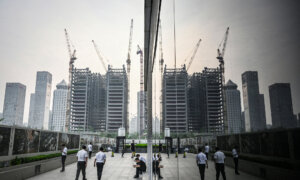
Having watched mainland Chinese cities expand with skyscrapers, modern transport networks and large-scale infrastructure, the university lecturer noted that she had long assumed China had outpaced its democratic neighbor.
Her travels across Taiwan altered that view.
“I finally understood what the real gap is,” she said. “It is not about how tall your buildings are, but about how warm the human heart is.”
She recounted observing passengers on the Taipei Metro consistently leaving priority seating open for those in need, and watching commuters naturally stand on the right side of escalators to let hurried travelers pass on the left—all without police supervision or loud public propaganda banners.
One evening in Taipei’s Ximending shopping district, she became lost while looking for a pastry shop known for its pineapple cakes.
A young bubble tea vendor noticed her difficulty, closed his stall, and walked alongside her for about 20 minutes to help her find the shop.
When she offered to buy him a drink in gratitude, he declined with a smile, saying, “It was nothing at all—welcome to Taiwan!”
On another occasion, she boarded the wrong high-speed train. Passengers nearby quickly came to her aid. Someone checked her ticket, another looked up the timetable on his phone, and others reassured her not to worry. They helped her find the correct platform before going their separate ways.
Living Legacy of Traditional Virtues
The Wuhan educator interpreted these experiences as evidence of the continuing influence of traditional Chinese civic values, including the Confucian virtues often summarized as gentleness, benevolence, respectfulness, moderation and deference.
“We are always talking about overtaking others, always competing over who has a higher GDP or more skyscrapers,” she reflected. “In Taiwan, I saw that these traditional virtues exist as living, unprompted habits woven into daily social interactions.”
Both educators concluded that educational success cannot be measured solely by standardized test scores or a nation’s material expansion.
“Instead, the genuine kindness and courtesy of the Taiwanese people, their consideration and respect for strangers, their voluntary respect for public rules, and their regard for the dignity of others, are what we should learn from,” the Wuhan lecturer said.
Li Jing contributed to this report.