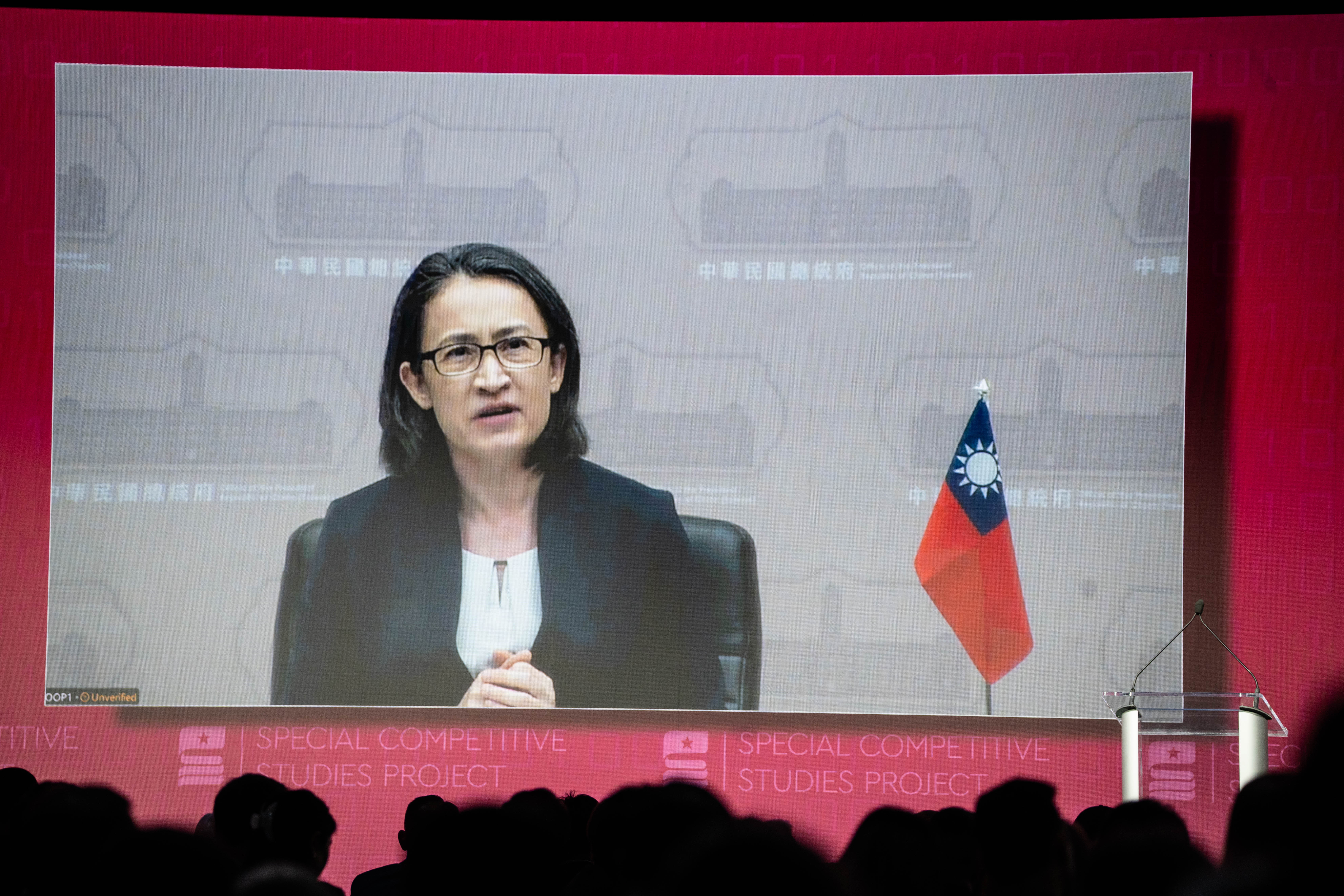

China is spreading disinformation about Taiwan in the United States, Taiwanese Vice President Hsiao Bi-khim said in an interview aired on Dec. 1, telling Americans not to be misled about the self-governing island.
Hsiao, who was Taiwan’s top envoy to the United States from July 2020 to November 2023, made remarks in an interview with Natalie Winters, the co-host of Steven Bannon’s “War Room” podcast. Hsiao has been in her current role since May 2024, after securing victory as Lai Ching-te’s running mate in a general election five months earlier.
“China is working very hard to project narratives and disinformation in Washington and the United States,” Hsiao said. “They want to project a narrative that Taiwan is weak, that Taiwan is incapable, and that Taiwan is not worth supporting. They also are trying to project Taiwan as a troublemaker.”
The real troublemaker, Hsiao added, is China’s People’s Liberation Army, which seeks to “disrupt peace and the status quo” in the region.
China’s communist regime considers Taiwan a part of its territory and is actively seeking to assert control over the island. In pursuit of this objective, the regime has been waging public opinion warfare, psychological warfare, and legal warfare against Taiwan, while increasing military pressure through drills and the deployment of aircraft and vessels near the island.
Hsiao said that most Americans can see through Beijing’s disinformation, which she described as attempts to “divide our countries, our governments, and our peoples.”
However, she expressed concerns that some might “catch on to it” because of China’s repeated attempts and emphasized the need for vigilance.
“Freedom-loving people around the world also need to be vigilant about these playbooks from authoritarian states,” Hsiao said.
Last week, Lai announced $40 billion in new proposed military spending to counter China’s potential military attack on the island by 2027. The decision was welcomed by the U.S. State Department, according to Taiwanese national media outlet Central News Agency, which quoted a spokesperson saying that the United States “supports Taiwan’s acquisition of critical defense capabilities.”
Lai’s new spending plan has also received significant bipartisan support in Congress.
Chinese state-run media China Daily—designated by the U.S. State Department as a “foreign mission” in 2020—published an editorial on Nov. 26 criticizing Lai, calling his proposed spending “buying trouble” and accusing him of “callously squandering” the island’s money.
“It’s important that American people understand that supporting a strong Taiwan is also part of our shared agenda, our shared interest in sustaining peace and stability in the Indo-Pacific region,” Hsiao said in the Dec. 1 interview.
She added that Taiwanese people are not “sitting around waiting to be saved,” noting that Taiwan has increased its defense budget by 80 percent over the past few years.
“We intend to increase our defense spending in the years to come,” Hsiao added, as the money will not only be spent on buying military equipment from the United States, but also on procuring domestically developed systems, such as drones, robotics, and artificial intelligence systems.
The United States has long been Taiwan’s primary arms supplier for its self-defense, despite the absence of formal diplomatic relations. On Nov. 17, the Pentagon confirmed the sale of an advanced surface-to-air missile system to Taiwan.
“We’re in a race against time to fortify our defenses,” Hsiao said, adding that the key for Taiwan is to make Beijing realize that “any attempt at aggression would be a cost too hard to bear.”
“The Taiwanese people are adamant about defending [their] freedom and protecting [their] society,” she added.
Ultimately, Taiwan is committed to preserving the status quo and ensuring stability, Hsiao said, adding that sustainable peace across the Taiwan Strait comes through strength.
Aside from bolstering its defense capabilities, Hsiao also highlighted Taiwan’s contributions to reliable supply chains, such as semiconductors, and its record of providing humanitarian assistance worldwide following earthquakes and other natural disasters.
“We are not just a victim of coercion and military threats. We are a proactive partner, and we can contribute,” she said.