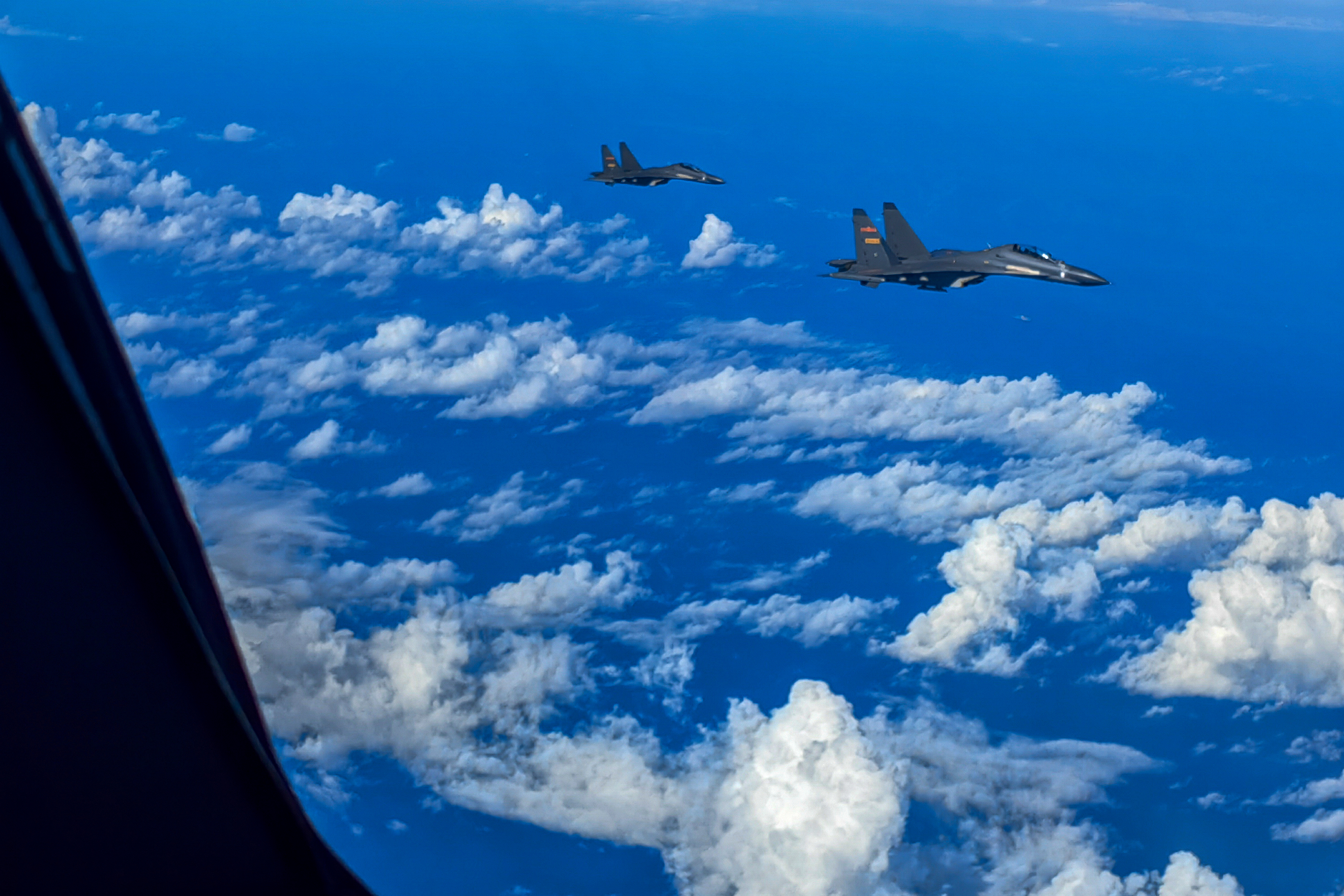

Taiwan has detected a resumption of large-scale Chinese military drills in the Taiwan Strait, including 26 sorties between March 14 and March 15.
The Taiwanese National Defense Ministry announced the spike on March 15 in a regular update on Chinese military activities in the strait.
The Chinese military had suddenly gone quiet in the region on Feb. 27, when Taiwan reported no Chinese military aircraft. This pause lasted until March 7. In the week since, Taiwan has typically detected sorties of two or three aircraft.
Between March 14 and March 15, Taiwan detected 26 military aircraft, 16 of which crossed the median line of the Taiwan Strait, and seven ships.
The Chinese Communist Party (CCP) considers Taiwan its territory despite never having controlled the self-ruled island. CCP leader Xi Jinping has stated that one of his top priorities is seizing the island and has ordered the Chinese military to be capable of doing so by 2027.
The sudden pause in Chinese military drills coincided with the start of the war in Iran, and its resumption of large-scale exercises follows Taiwan’s decision to authorize an arms package in advance with the United States.
Taiwan’s parliament on March 12 authorized $9 billion for four arms packages with the United States ahead of deadlines. U.S. lawmakers had raised concerns that Taiwan could not meet its defense spending goals as deadlines to ink the arms deals neared.
The deals include M109A7 self-propelled howitzers, Lockheed Martin-made Javelin missiles, TOW anti-tank missiles, and high-mobility artillery rocket systems. Together, they make up the bulk of an $11.1 billion arms sale announced by the Trump administration in December 2025.
At a press conference on March 14, Taiwanese President Lai Ching-te said Taiwan could afford the $40 billion defense budget because of the positive state of the economy.
“With Taiwan’s economic growth, we can absolutely afford it,” he said. “If we look at the United States’ National Security Strategy, the U.S. emphasizes collective defense and burden-sharing.”
Taiwan’s economy has been growing under booming demand for advanced semiconductors used for artificial intelligence, which Lai said would also be factored into Taiwan’s defense plans.
“In other words, our defense budget is not only a budget for national defense, but also a budget for economic and industrial development,” he said.
This also comes as U.S. and Chinese officials meet in Paris for another round of trade talks ahead of U.S. President Donald Trump’s trip to China at the end of the month.
The U.S. delegation is led by Treasury Secretary Scott Bessent and Trade Representative Jamieson Greer, and the Chinese team is headed by Vice Premier He Lifeng, a member of the CCP’s powerful Politburo and the nation’s economic czar.
The trade talks started on the morning of March 15 at the headquarters of the Organisation for Economic Co-operation and Development in France, according to Chinese state media outlet Xinhua.
Frank Fang, Dorothy Li, and Reuters contributed to this report.