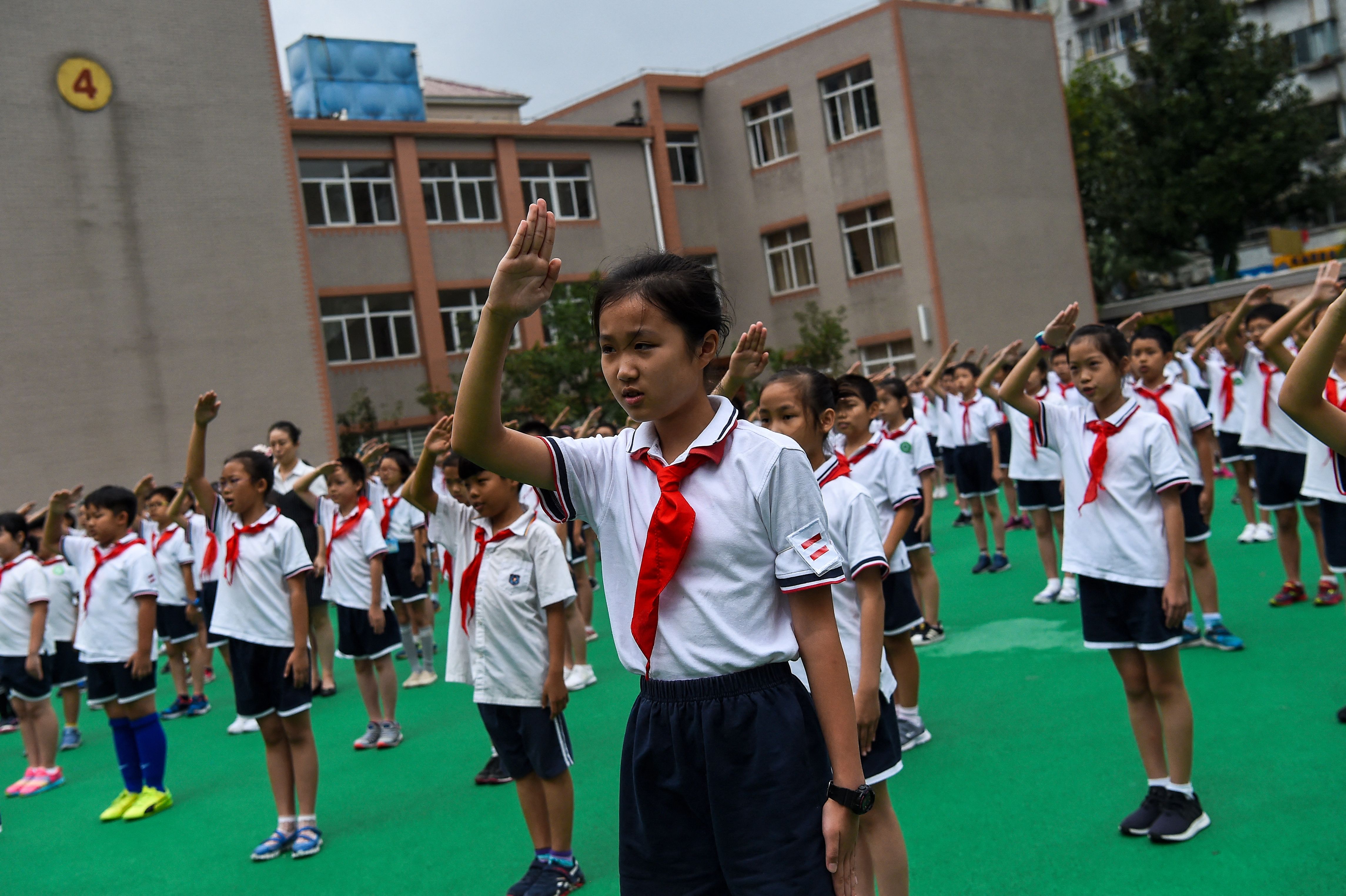
The Chinese Ministry of Education has issued a new set of rules for basic education, raising concerns among scholars, teachers, and students who say the measures are less about improving teaching and more about tightening political control in schools.
The document, released on March 27 and titled the “Negative List for Standardized Management of Basic Education,” lays out 20 “strict prohibitions” for schools. It has already been distributed to education authorities across China, including provincial governments and the Xinjiang Production and Construction Corps (XPCC), with orders to ensure that every school implements it and that all principals and teachers are familiar with its contents.
The XPCC is a Chinese regime paramilitary organization that has been implicated in rights abuses against the Uyghur population in Xinjiang, China.
Several China-based scholars, teachers, and students told The Epoch Times that the document is part of a broader push by the Chinese Communist Party (CCP) to further turn schools into tools of political control, at a time when the regime is increasingly concerned about public dissatisfaction and ideological loyalty.
The individuals interviewed requested anonymity or provided only their surnames out of fear of reprisal.
At the center of the concern is how the rules are structured. The first item focuses on ideology, banning speech and conduct labeled “anti-Party” or “anti-socialist,” as well as remarks that could be seen as damaging the image of the Party or state, insulting leaders or national heroes, or supporting separatism.
A Beijing-based political scholar, identified as Yan, said placing these restrictions first sends a clear signal.
“The document is essentially a political red line, not a teaching guideline,” Yan told The Epoch Times.
“Putting it first shows that the main task of basic education today is to serve the consolidation of CCP rule, while knowledge comes second.”
Yan said the strong push behind the new rules reflects deeper anxiety within the regime.
“Compared with the frenzied propaganda of the Mao era, the forceful rollout of these bans today shows there is widespread dissatisfaction among the public,” he said. “Because it has lost public support, the CCP feels threatened and is using coercive measures like this to protect itself.”
Others say the document strips away any remaining claim that the education system is primarily about learning.
Pan, a retired educator at Beijing’s Renmin University, said the new list shows that political loyalty has overtaken educational principles.
“This is not just a red line. It is a noose around the necks of teachers and students,” Pan told The Epoch Times. “By putting political loyalty above education, the CCP is showing that students are not individuals who need guidance and growth. They are political materials to be processed. What it wants is not talented people, but obedient ones.”
Expanding Ideological Control
The restrictions go beyond classroom teaching. According to the document, they extend to exam questions, teaching materials, public lectures, online platforms, and even teachers’ electronic devices.
Critics say this means that teachers are not only being monitored in class but are also under pressure to control what they say in their personal and online interactions.
A history teacher in Shanghai, surnamed Wang, said schools increasingly feel like surveillance zones.
“Surveillance is now 360 degrees, with no blind spots,” Wang told The Epoch Times. “Not only do the 45 minutes in the classroom have to stay in line, but even recommending a public WeChat account or posting a personal comment in a parent chat group could get you reported.”
He said the pressure is leading to constant self-censorship.
“This kind of all-around control is pushing teachers into mental self-censorship,” Wang said. “They stay silent out of fear. If even one test option does not match the Party’s line, a teacher’s job could be at risk.”
A Taiwanese student surnamed Wu, who studies at Zhejiang University in Zhejiang, China, described a similar atmosphere from the student side. He said classrooms are equipped with multiple cameras, and interactions between teachers and students are fully recorded.
“The CCP seems very nervous right now,” Wu said. “The school clearly bans anything related to ‘separatism,’ and this kind of indoctrination is very upsetting to us Taiwanese students.”
Wu questioned why the new list was needed, given the level of existing surveillance.
“If they have already installed so much monitoring, why do they still need this ‘negative list’?” he said. “That shows they know this kind of brainwashing is failing. We are not going to be brainwashed.”
Indoctrination Built Into Curriculum
Another major point of criticism is the second rule, which requires schools not to cut time for ideological and political classes, placing them on par with physical education, arts, and labor courses.
Yang, an education researcher in Hunan Province, said the real focus is still political indoctrination.
“Recently, some parents noticed that textbooks now include mandatory phrases like ‘love the Communist Party,’” Yang told The Epoch Times. “What the CCP calls protecting ideological courses is really about taking over young people’s mental space.”
He said the approach is deliberate.
“First, the authorities use the first rule to define what cannot be said. Then they use the second rule to make sure there is enough time for indoctrination,” Yang said. “What is presented as quality education is just a cover. The real goal is political conditioning.”
Yang also dismissed other parts of the document, such as reducing academic pressure and regulating admissions, as largely symbolic. In his view, they do little to address the bigger issue—the state’s growing control over what students learn and what teachers can say.
He said the new rules are part of a broader trend. From standardized national textbooks to a crackdown on private tutoring, authorities are building what amounts to a “prison without walls” within the education system.
Yang Qian contributed to this report.