For three years, the Chinese official in charge of Taiwan policy used his speech at Beijing’s largest cross-strait gathering to drive home one theme: a stern, repeated warning against Taiwanese independence.
This year, he barely mentioned it.
At the Chinese Communist Party’s (CCP’s) 18th Straits Forum, held this week in the southeastern Chinese city of Xiamen, Wang Huning—Beijing’s fourth-ranking leader and its top official on Taiwan—spoke instead of family ties, peaceful exchange, and the two sides of the Taiwan Strait drawing closer.
U.S.-based China analyst Tang Jingyuan, who compared this year’s remarks with Wang’s addresses from 2023 through 2025, said Wang named Taiwan independence only once and gave the rest of his speech to themes of kinship and integration.
Tang, who tracks Beijing’s Taiwan strategy, told The Epoch Times that the softer tone marks a change in method, but not in goals.
He reads it as a sign of weakness: a regime that has concluded it cannot take Taiwan by force anytime soon and is leaning on enticement rather than threats to get what it wants.
Hemmed in by a sweeping purge of its own military command and by renewed pressure from Washington under President Donald Trump, Tang said, Beijing is turning to trade, family ties, and grassroots persuasion to pull the island toward unification.
What Beijing Brought to Xiamen
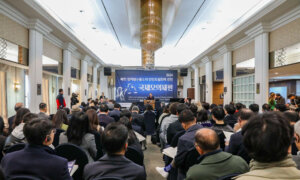
The forum, organized by the CCP’s Taiwan Affairs Office and the local Fujian provincial government, gave Beijing a stage to show off its softer approach. Mainland China used the event to hold a signing ceremony for what it calls “10 Taiwan-related measures,” a package of incentives aimed at the island.
Under the arrangement, according to Chinese state media, China will buy farm and fishery goods from Taiwanese counties including Taitung, Yunlin, and Nantou—such as the sweet custard-like fruit atemoya, pomelos, tea, and grouper. Chinese officials also touted the return of more direct flights and easier travel to Taiwan for some Chinese residents. Travel for Chinese to Taiwan remains restricted following a freeze in Beijing’s issuance of travel permits in August 2019 due to cross-strait tensions.
Beijing rolled out the measures after Chinese leader Xi Jinping met in April with Cheng Li-wun, chairwoman of Taiwan’s pro-Beijing opposition Kuomintang (KMT) or the Chinese Nationalist Party. Cheng won the KMT chairmanship in 2025 as a dark-horse candidate with the hardline pro-unification views of the communist party.
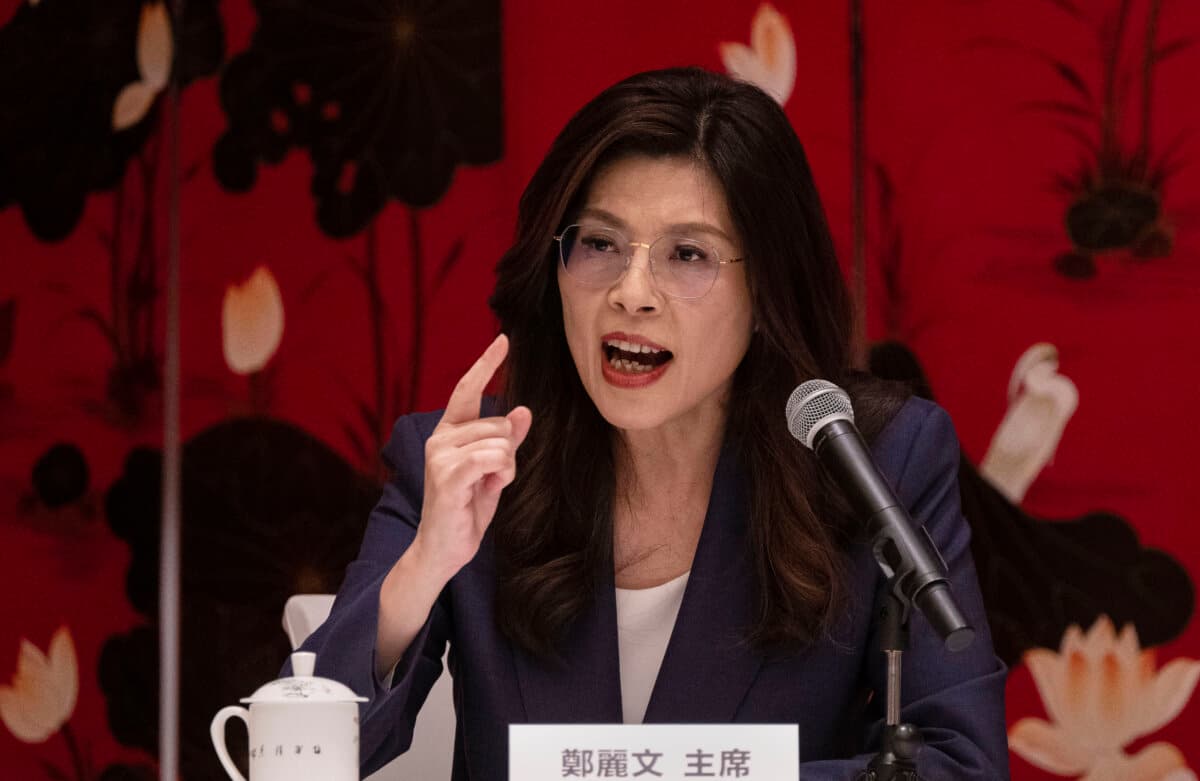
Taiwan opposition party leader Cheng Li-wun of the Kuomintang (KMT) gestures as she speaks at a press conference in Beijing, China, on April 10, 2026. (Kevin Frayer/Getty Images)
Song Tao, who heads the CCP’s Taiwan Affairs Office, and KMT Vice Chairman Chang Jung-kung both spoke at the ceremony. Song claimed the measures had made “positive progress and phased results,” including setting up a standing platform for two-way youth exchanges between the two parties.
Sun Kuo-hsiang, a professor of international affairs and business at Nanhua University in Taiwan, said the forum is more than a cross-strait cultural exchange.
“The Straits Forum is not merely a local or civil exchange activity, but a central-level political platform for Beijing’s Taiwan work,” he told The Epoch Times.
Beijing is using it to signal that it will keep going around the ruling Democratic Progressive Party (DPP) and deal directly with opposition parties, local governments, and community groups, he said—a strategy with an obvious prize as Taiwan heads to local elections in November.
The farm purchases and other “gift packages,” he said, are the reward half of a strategy that pairs pressure with payoff.
Beijing also hopes to project a curated message to the wider world that cross-strait exchange is alive and well, with many Taiwanese backing closer ties—a picture that Sun called false.
Public opinion in Taiwan remains against it: Support for moving toward unification has held at around 6 percent for years, while the largest share of Taiwanese prefer the status quo, and a steadily growing majority identify as Taiwanese rather than Chinese, according to long-running polling by Taiwan’s National Chengchi University’s Election Study Center.
From Threats to Talk of Family
The change was plain in Wang’s language, Tang said.
Tang said that Wang’s speeches from 2023 to 2025 were “completely ... dominated by coercion and intimidation,” and heavy on harsh attacks against what Beijing calls Taiwan independence. This year struck a different note, with Wang stressing that the two sides “are one family,” while calling for “integrated development” and “peaceful exchange.”
Sun saw the same repackaging.
Beijing, he said, is “lowering the grating quality of its united-front language”—the influence work the party uses to win over outsiders—“and switching to softer methods of social infiltration and interest linkage.” The aim is to turn exchange into a web of personal and community contact, he said, by leaning on family, shared culture, and bloodlines. Beijing’s push for unification looks less like a political demand and more like ordinary people getting along, he said.
Buying farm goods fits a familiar pattern, he added. Beijing uses such purchases to build a cycle he described as “punishment, concession, and gratitude”—squeeze Taiwan, ease up, then expect thanks.
Taipei Sees a Trap
Taiwan’s government reads the same forum very differently.
On June 13, Taipei’s top agency for cross-strait policy, the Mainland Affairs Council (MAC), condemned what it called a two-pronged strategy of “false integration, real pressure.”
Talks have stalled, the council said, because the CCP sets political conditions before any dialogue, refuses to acknowledge that the Republic of China—Taiwan’s formal name—exists, and ignores mainstream opinion on the island.
The MAC said it regretted that some Taiwanese opposition figures were echoing Beijing’s talking points.
The contradiction, the MAC argued, is hard to miss. Even as Beijing promotes “integrated development,” its warplanes and ships continue harassing Taiwan with steady “gray-zone” operations—coercive moves that stop short of war.
The pressure is not letting up. According to open-source intelligence company Janes, PLA aircraft flew a record of roughly 3,600 sorties into Taiwan’s air-defense identification zone in 2024—more than double the year before. And in late December 2025, a single drill sent about 130 Chinese aircraft toward the island—90 of them crossing the strait’s median line.
That mix of warm words and military force, the council said, cannot hide Beijing’s aim of annexing Taiwan so it can rewrite the history of the ROC.
A Closing Window for Force
For Tang, the real driver for the change in the CCP’s tone is trouble at home. He pointed to the striking evidence of a power struggle convulsing the upper ranks of China’s military.
In October 2025, Beijing expelled nine generals from the party and the armed forces; among them He Weidong, the second-ranking officer on the Central Military Commission and the first sitting member of that body to be purged since the Cultural Revolution. Also removed was Lin Xiangyang, head of the Eastern Theater Command—the force responsible for operations around Taiwan.
A purge that reaches the commander who would spearhead any attack, Tang argued, throws Beijing’s war plans into disarray.
Pressure from abroad has risen, too, Tang said. With Trump back in the White House resetting U.S. strategy, Beijing faces a harder external environment. Between the turmoil inside the party and the squeeze from outside, he argued, the regime has lost—at least for now—its opening to take Taiwan by force.
That, he said, is why Beijing has fallen back on what it calls “peaceful unification.” In practice, Tang said, that means trying to topple Taiwan’s government from within and install a pro-Beijing leadership—or, failing that, to sow as much chaos as it can and seize control by other means.
The forum, the incentives, and the exchange programs could all become channels to widen that influence, he added.
Sun framed the standoff as a battle for control over the meaning of the dominant narrative.
“Beijing politicizes cross-strait exchange, making it into a unification project,” he said. “Taiwan’s government treats exchange as a united front risk,” opening Taiwan to foreign infiltration.
Amid Beijing’s contradicting messages to the Taiwanese people, the gap in public trust—despite China’s recent friendly gestures—is not closing in Taiwan, Sun said.
Tang’s warning was blunter: As Beijing trades military threats for economic carrots, Taiwan should keep its guard up.
Li Jing and Luo Ya contributed to this report.