
European Union legislators pushed to bolster responses to counter authoritarian regimes’ increasingly brazen attempts to silence their targets abroad, a phenomenon known as transnational repression.
The European Parliament adopted a motion on June 16 condemning transnational repression and foreign interference “in the strongest possible terms.” It called on the European Commission and member states to commit to a “zero-tolerance approach” toward such abuses on European soil.
“Transnational repression has emerged as one of the most serious and overlooked threats to democracy, human rights, and EU member states’ security,” Hannah Neumann, a German lawmaker leading the efforts, said in a statement. “Our report is a first step in countering this.”
The nonbinding measures were passed in a plenary session in Strasbourg with 434 members of Parliament voting in favor, 128 against, and 104 abstaining.
It was the second motion adopted by the Parliament, the bloc’s only directly elected body, in less than a year to call for EU action to protect its residents from these abuses.
The vote came as European Commission President Ursula von der Leyen, U.S. President Donald Trump, and other G7 leaders gathered in eastern France for a summit.
At last year’s meetings, they agreed on a joint statement on transnational repression, defining it as “an aggressive form of foreign interference whereby states or their proxies attempt to intimidate, harass, harm or coerce individuals or communities outside their borders.”

Clockwise from rear left, U.S. President Donald Trump, French President Emmanuel Macron, Canadian Prime Minister Mark Carney, Italian Prime Minister Giorgia Meloni, Japanese Prime Minister Sanae Takaichi, European Commission President Ursula von der Leyen, Qatar Emir Sheikh Tamim bin Hamad Al Thani, Emirati President Sheikh Mohamed bin Zayed Al Nahyan, European Council President Antonio Costa, and German Chancellor Friedrich Merz take part in a working lunch between leaders of G7 and the Middle East, in Evian-les-Bains, France, on June 16, 2026. (Evelyn Hockstein/Pool/Getty Images)
‘Systematic Practice’
The latest EU report identified the Chinese communist regime, Russia, Belarus, and Iran as leading perpetrators, although it noted that dozens of other governments also tried to go after dissidents abroad.
Journalists, activists, academics, politicians, and members of the diaspora community, as well as their families, are among the targets. Even individuals and organizations that defend or assist these victims risk becoming targets themselves.
“Transnational repression cannot be seen as an isolated phenomenon,” Neumann said at a press conference after the motion’s adoption. “It really needs to be seen as a systematic practice employed by authoritarian regimes.”
Freedom House, a Washington-based rights group, documented 1,375 physical forms of incidents—such as targeted killings, abductions, violence, and forced disappearance—worldwide from 2014 to 2025.
But the report highlighted that transnational repression is “significantly under-reported,” including in the EU, because victims fear retaliation against their families or “distrust authorities due to prior experiences in authoritarian contexts.”
In addition to direct repression, authoritarian states attempted to exploit the European systems and institutions as tools of repression, Neumann said.
For instance, when member states hire translation services in asylum processes, they often choose the cheapest option, but these providers may work with certain regimes’ secret services.
“European systems and institutions should no longer be misused as tools of repression within Europe,” Neumann told reporters. “That is one of the loopholes that we have to close. There are many, many more, like freezing of bank accounts, Interpol notices.”
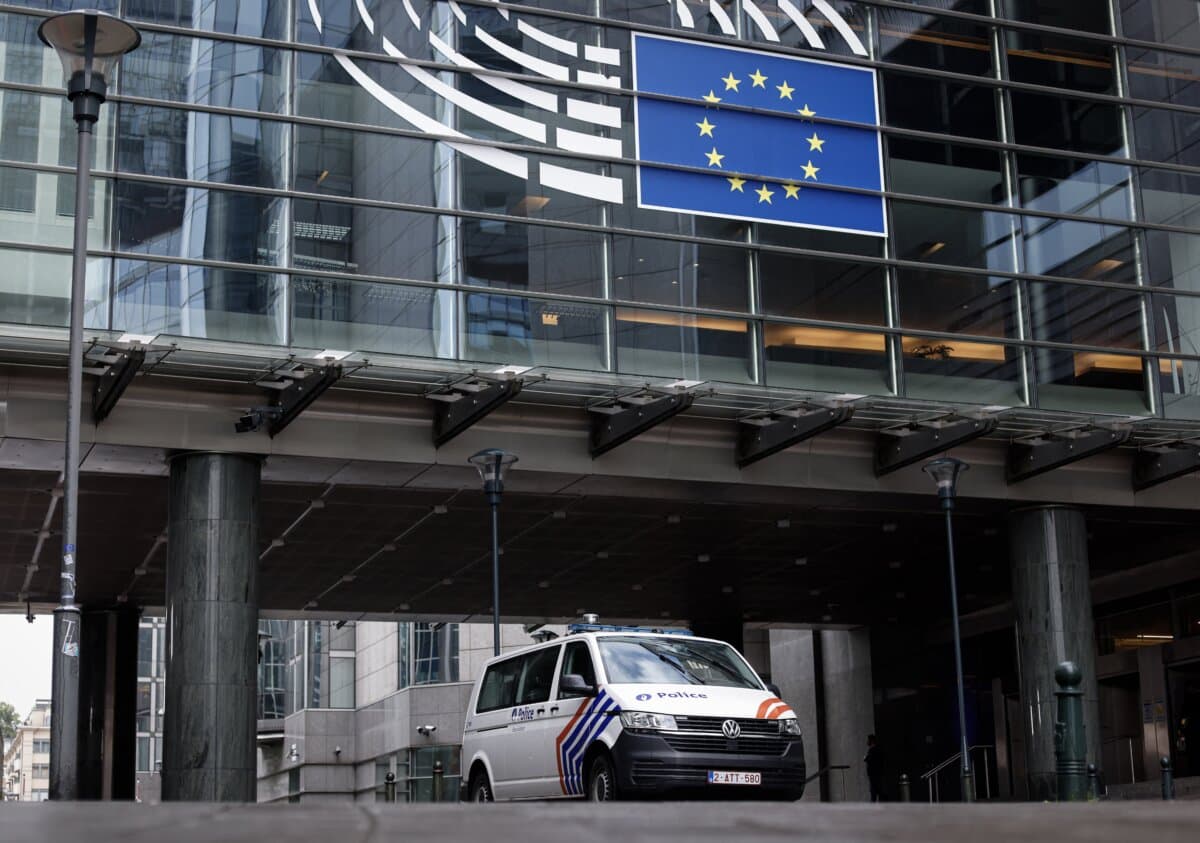
A Belgian police vehicle stationed at the European Parliament building in Brussels on May 29, 2024. (Kenzo Tribouillard/AFP via Getty Images)
The motion proposes more than 80 policy accommodations for the European Commission, the European Council, and member states to consider. The goal is to develop a coordinated, EU-wide strategy to protect residents and defend sovereignty.
One of the proposed measures is establishing an EU-level mechanism to collect data on transnational repression, monitor trends, and report on incidents. It would allow stakeholders to provide inputs and help authorities and member states develop, evaluate, and refine their policies to counter the abuse.
“Transnational repression must be met with consequences,” Neumann told reporters. “So we need to bring to justice individual perpetrators as well as the regimes behind them. These are the core demands.”
‘Milestone’
Among those affected are the people from Hong Kong who left their hometown and moved to EU member states after the Chinese regime imposed a draconian national security law on the former British colony in 2020.
The report noted that Hong Kong authorities had used the security laws to carry out transnational repression. European politicians faced threats of prosecution and extradition, and residents were targeted with arrest warrants and bounty offers.
The Campaign for Hong Kong, a human rights advocacy group, welcomed the adoption of the report, calling it “an important political milestone.”
“The report places transnational repression firmly on the European agenda,” the group said in a statement on June 16. “For many of us, this recognition is long overdue.”
It urged the European Commission and Council to translate it into action.
“The vote matters. What comes next matters more,” it stated.
Brussels has stepped up its efforts in recent years to fight transnational repression, including sanctioning Iranian officials responsible for cross-border coercion and urging the Chinese communist regime to stop the campaign to silence criticism abroad.
A recent study commissioned by the Parliament, released in January, found that compared with actions taken against Moscow and Tehran, European responses to Beijing’s use of transnational repression “appear to have been weaker.”
Eva Fu contributed to this report.