


Australia is to make its largest-ever defence export, having signed-off a A$2.5 billion (US$1.75 billion) deal to supply Canada with the Over the Horizon Radar (OTHR) system.
Australian Defence Minister Richard Marles and Canada’s Secretary of State for Defence Procurement Stephen Fuhr put pen to paper on the deal earmarked last year and signed-off in Canberra on June 22.
“Today’s agreement really is a historic moment for Australia’s defence industry, but it is also a historic moment in the bilateral relationship between Australia and Canada,” Marles said.
Conventional radar can’t detect objects beyond the horizon due to the curvature of the Earth, but OTHR uses two techniques to extend its range to as far as 3,000 kilometres.
One method “bounces” signals off the ionosphere—a layer of the Earth’s atmosphere—back down toward the planet’s surface, far beyond the horizon.
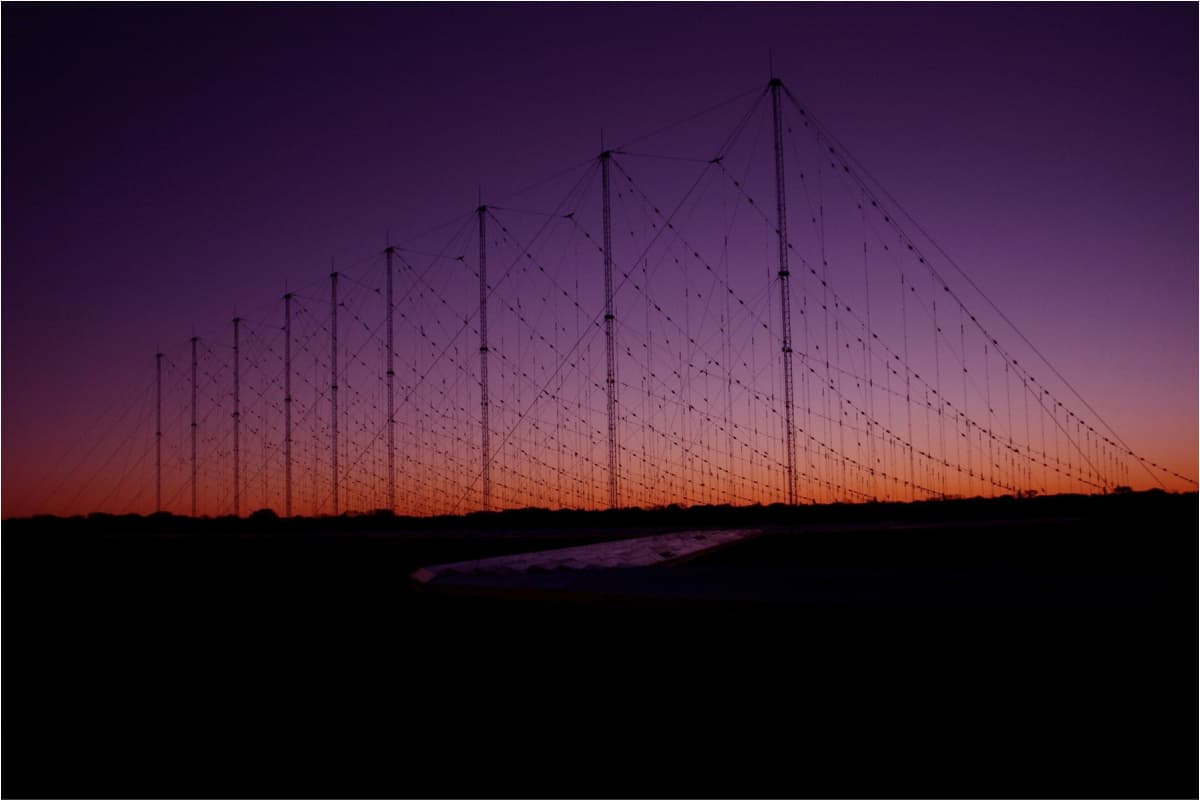
A Jindalee Operational Radar Network(JORN) transmitter site at sunset, Harts Range, Alice Springs. The Jindalee Operational Radar Network (JORN) is a strategic asset used in the Defence of Australia. JORN is a network of three over-the-horizon radars that can detect aircraft and ships between 1000 and 3000km from the northern coastline of mainland Australia. (Courtesy of the LACW Sonja Canty at the Australian Department of Defence)
The echo then travels back via the same path to be picked up by massive receiver arrays. The other approach uses lower frequencies, in which electromagnetic waves physically bend around the Earth’s curvature, usually closely following the ocean surface.
“We can expect this project to create nearly 2,300 jobs annually in Canada over the next five years, expected to contribute nearly $290 million annually to Canada’s GDP over the same period of time,” said Secretary Fuhr.
“And at least 14 Canadian companies will support this effort, either by standing it up or providing in-service support for the duration of the project.”
The deal builds on Canadian Prime Minister Mark Carney’s March 2025 announcement that the two countries develop an Over-the-Horizon Radar capability based on Australia’s world-leading Jindalee Operational Radar Network (JORN). It is the first international sale of the technology and will support over 300 high-value technical jobs at the manufacturer, BAE Systems, and its suppliers.
By combining decades of Australian research into JORN with Canada’s experience with high-frequency radar, the equipment could extend the country’s surveillance throughout the Arctic using what will be known as the Arctic-Over-the-Horizon Radar (A-OTHR).
The total project cost for Canada will be in the vicinity of C$6 billion.
Meanwhile, Canadian Secretary Fuhr said he was also interested in Australia’s Ghost Bat drone, which German officials are also keen to acquire.
“I’m quite interested,” Fuhr said. “Collaborative combat aircraft are a thing, and it seems like Australia has got a bit of a lead there, so I’m curious to see where that’s at.”

A Boeing MQ-28 Ghost Bat drone stands at the Rheinmetall stand at the 2026 ILA Berlin Air Show On its opening day in Schoenefeld, Germany on June 10, 2026. (Sean Gallup/Getty Images)
Broader Cooperation Planned
The announcement marks the first stage of a broader Australia–Canada collaboration on A-OTHR. Both countries say they are committed to exploring further opportunities for joint development and deepening defence-industrial ties.
Australian Prime Minister Anthony Albanese said the agreement would “further strengthen interoperability between trusted partners while driving industrial growth and innovation in both nations.”
“Working together on OTHR systems will support the delivery of early warning and surveillance capabilities in the Indo-Pacific and North Atlantic, contributing to our collective security in an increasingly complex strategic environment.
“As close friends and valued partners, Australia and Canada’s relationship is grounded in decades of operational cooperation, shared strategic interests, and deep collaboration through the Five Eyes partnership,” he said.
Australia is set to commence delivery of Canada’s A‑OTHR capability on July 1 this year.