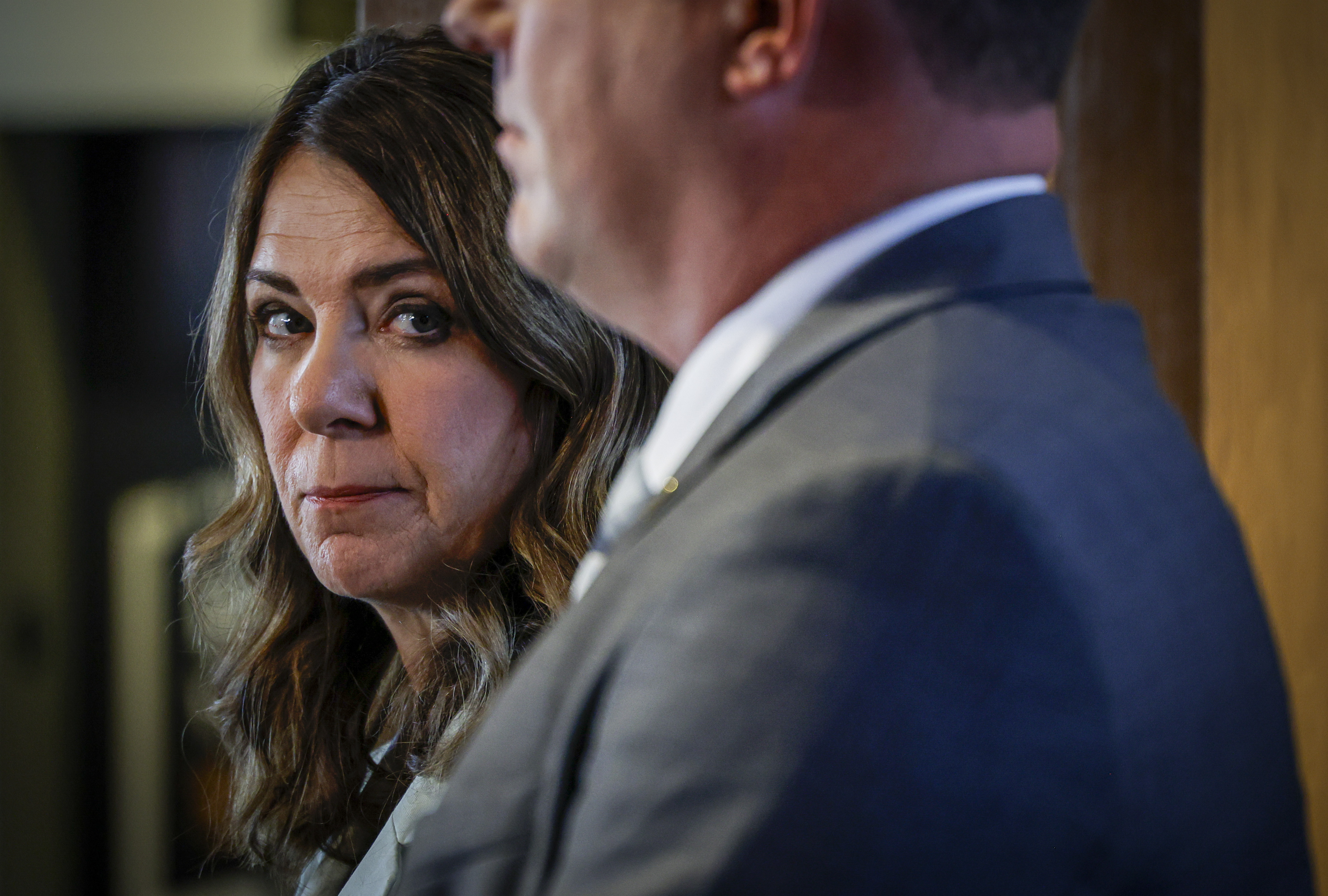
Alberta Premier Danielle Smith says Assembly of Treaty Chiefs should show mutual respect if the chiefs want to maintain good working relations with her cabinet and have their attention, after the assembly called on police to investigate her for “treason.”
The Alberta Assembly of Treaty Chiefs representing Treaties 6, 7, and 8 passed a resolution June 16 calling on the RCMP and auditor general to investigate Smith for treason, citing concerns over handling of Alberta’s referendum question on separation, treaty rights, and Canadian sovereignty.
“I think it’s disgraceful that any government that wants to be taken seriously would level the charges that serious against another government,” Smith said June 17 while answering questions from reporters.
“Look, I’ve had my differences with the federal government, but I have never used language like that,” she added.
Treaty Chiefs’ Resolution
In a June 17
news release about the passage of their resolution the previous day, the Assembly of Treaty Chiefs comprising Treaties 6, 7, and 8 wrote that they had agreed on the need for an investigation into possible “treason” by Smith and her United Conservative Party (UCP) government.
The chiefs wrote that Smith and the UCP may have breached Section 46 of Canada’s Criminal Code in the province’s decision to allow an upcoming referendum question this October about whether Alberta should stay in Canada or begin the legal process to hold a binding referendum on separation.
“We call for this investigation on the basis of the intentional violation of the Treaties; of calling a referendum in the face of severe risks to Canada’s sovereignty and the Treaty Relationship and of failing to take action on the violation of privacy rights of millions of people,” the chiefs wrote.
“Further, Premier Smith and the UCP government have done all this with significant risks of foreign interference and influence.”
The chiefs also said the precursor to the RCMP, the Northwest Mounted Police, had committed to uphold the safety of First Nations people and their land, and said fulfilling that duty should now be carried out by a full investigation of Smith and her government.
Section 46 of the Criminal Code defines treason as waging war against Canada, assisting enemies who are at war with Canada, or using “force or violence” to overthrow the Canadian government or a provincial government. The Criminal Code does not make any mention of referenda or political movements as grounds for potentially constituting treason.
‘Check Themselves’
In further comments June 17, Smith cited a “very collaborative” relationship between her government and First Nations but said that chiefs should “check themselves” in lodging such accusations as treason.
“I would ask the treaty chiefs to check themselves, because we have a very collaborative relationship between our government and our ministers,” she said.
“I want that to continue, but this kind of overwrought language has no place in a democracy,” the premier added.
The premier further said that her government has a strong track record of engaging with First Nations leaders and regularly meeting with them, including one-on-one meetings with herself, her ministers, and groups of ministers.
Smith contrasted this with the federal government; she says that chiefs told her the prime minister had “never” responded to their concerns by convening cabinet ministers to meet with them.
“You know what the answer is? Never. It doesn’t happen ever,” Smith said.
“So that is the kind of relationship we want to continue to have with the Chiefs, but it can only be done if they show as much respect for my government as we have shown for them.”
Smith said that she has backed indigenous leaders in their past efforts to seek more autonomy and stronger relationships with Ottawa and she asks for the same mutual respect as Alberta navigates its own relations with the federal government.
“When they were pursuing a new relationship with Ottawa, I cheered them along,” Smith said. “We are pursuing a new relationship with Ottawa that respects our jurisdiction, and I would ask that they'd be respectful of that.”
Upcoming Vote
Alberta’s non-binding question on whether the province should remain in Canada or start the process to hold a binding referendum on separation was announced May 21 by Smith. It will be one of 10 referendum measures put to Albertans on an Oct. 19 municipal election ballot.
Smith’s decision to include the question came in the wake of a May 13 ruling by Justice Shaina Leonard of the Alberta Court of King’s Bench quashing a citizen-led petition to hold a separation referendum. In her ruling, Leonard held that the province had erred in allowing a drive to collect signatures for the petition to move forward without having adequately consulted First Nations.
Smith called the court’s ruling “anti-democratic,” and Alberta filed an appeal against the decision June 11. The group behind the petition drive, Stay Free Alberta, has also said they plan to appeal the court’s decision.