A Feb. 4 phone call between U.S. President Donald Trump and Chinese leader Xi Jinping has renewed concern in Taiwan that cross-strait issues could become a bargaining chip as Washington and Beijing negotiate on trade and security.
In the days that followed, U.S. and Taiwanese officials emphasized that policies have not changed. A U.S. State Department spokesperson told The Epoch Times on Feb. 8 that the administration’s commitment to Taiwan remains unchanged and urged Beijing to stop pressuring the island.
“This Administration has been very clear that the enduring U.S. commitment to Taiwan continues, as it has for over four decades,” the spokesperson said. “We urge Beijing to cease its military, diplomatic, and economic pressure against Taiwan and instead engage in meaningful dialogue with Taiwan.”
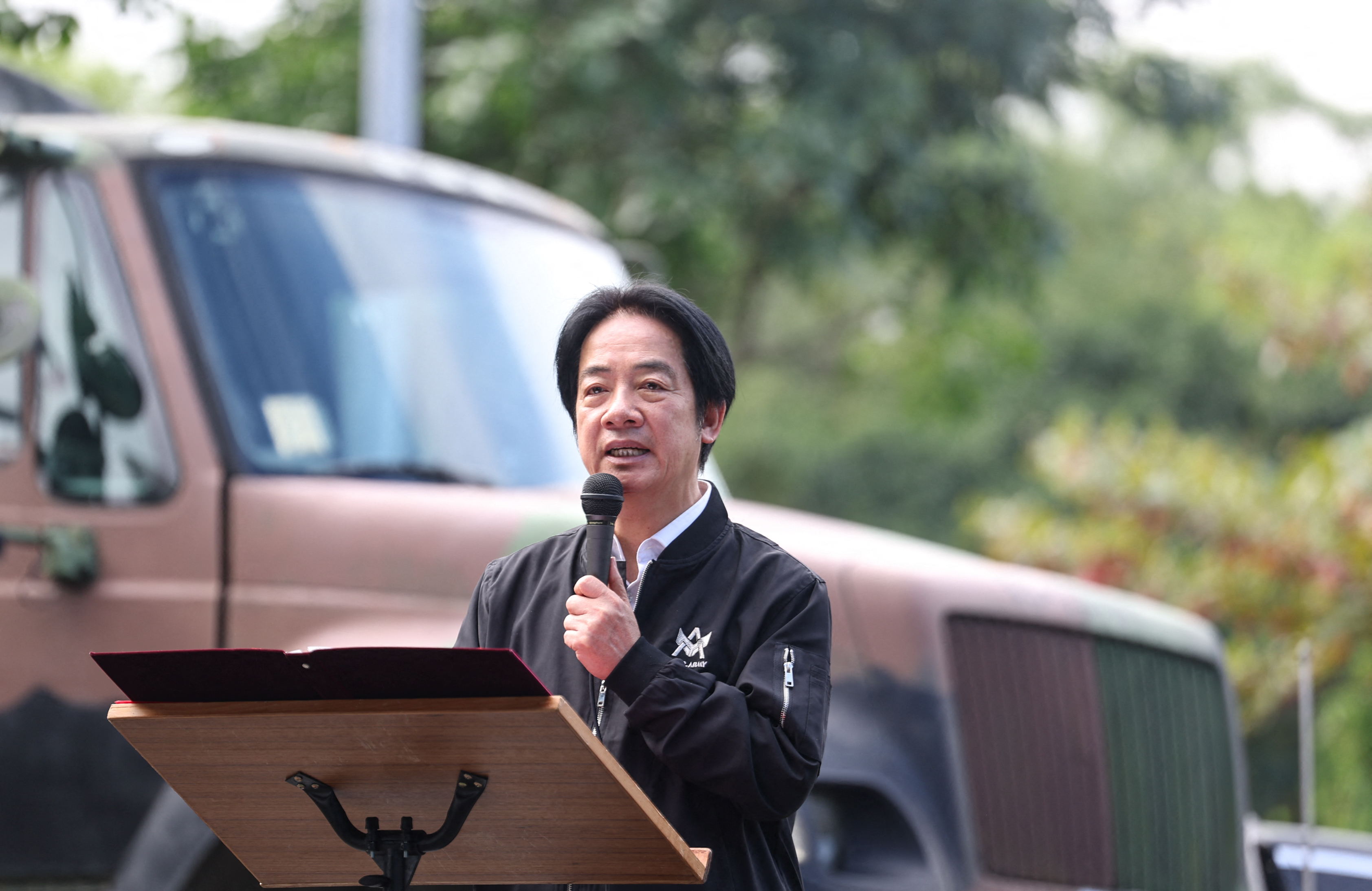
Taiwanese President Lai Ching-te on Feb. 5 also sought to reassure the public that relations between Taiwan and the United States remain strong and unchanged.
“Taiwan–U.S. relations are rock solid,” Lai told reporters, noting that ongoing cooperation projects are continuing.
Arms Sales Remain a Flashpoint
The renewed focus on Taiwan comes as the Trump administration and Congress move forward with major defense-related spending that includes support for Taiwan.
On Feb. 3—just hours before the Trump–Xi call—Trump signed a sweeping omnibus appropriations bill that includes more than $1.4 billion to support security cooperation with Taiwan.
The Consolidated Appropriations Act ended a four-day partial government shutdown and bundled five bills covering defense spending, national security, and State Department-related programs.
The roughly $1.2 trillion package includes $1 billion for the Taiwan Security Cooperation Initiative under the “Operation and Maintenance, Defense-Wide” program, with funding available through Sept. 30, 2027.
It also sets aside $150 million to replace defense materials and reimburse defense services provided to Taiwan, and directs at least $300 million in foreign military financing to support Taiwan’s defense needs.
Those provisions land on top of an arms sale announced in December, which the administration valued at more than $11.1 billion, described at the time as the largest bundled arms sale to Taiwan in U.S. history.
Beijing routinely condemns U.S. arms sales to Taiwan, arguing that they violate its “one China” principle. Washington has long said such sales are consistent with U.S. law and policy.
The issue of U.S. arms sales to Taiwan remains one of the most sensitive points in U.S.–China relations. According to Chinese state media, Xi raised the issue directly during his call with Trump.
The U.S. State Department declined to comment on pending arms transfers.
Lai: Taiwan’s Core Position Unchanged
Speaking to reporters in central Taiwan, Lai said Taiwan’s core position has not shifted and that communication with Washington remains smooth and direct. His remarks came a day after Trump and Xi
held their first call in more than two months, a conversation Trump later described as “long and thorough” and “very positive.”
Trump said the leaders discussed a wide range of issues, including trade, the Russia–Ukraine war, Iran, and China’s purchases of U.S. oil, natural gas, and agricultural products. He also said he expects to visit China in April.
Although Trump did not publicly detail any discussion on Taiwan, Chinese state media reported that Xi urged the United States to “handle arms sales to Taiwan with caution.”
With that backdrop, Lai laid out several points he said remain constant: Taiwan and China are “not subordinate to each other,” U.S. commitments under the Taiwan Relations Act and the Six Assurances remain in place, and the United States continues to work with allies and partners to maintain peace and stability in the Indo-Pacific.
Beijing continues to claim Taiwan as part of its territory and has not ruled out using force to take control of the island. Taipei has repeatedly rejected those claims, stressing that only the people of Taiwan can decide their future.
US Policy on Taiwan
After the Trump–Xi call, Taiwan’s Central News Agency cited an unnamed White House official
saying that the U.S. “one China policy” remains based on the Taiwan Relations Act, the three U.S.–China joint communiqués, and the Six Assurances to Taiwan.
“There is no change to our policy with respect to Taiwan,” the official was quoted as saying.
The Taiwan Relations Act is a U.S. domestic law passed by Congress after Washington switched diplomatic recognition from Taipei to Beijing in 1979. It governs ongoing relations with Taiwan, including security cooperation, arms sales, trade, and cultural exchanges.
The Six Assurances, first conveyed to Taiwan in the 1980s, involve assurances that the United States has not agreed to set a date for ending arms sales to Taiwan, will not consult Beijing on those sales, will not mediate between Taipei and Beijing, will not revise the Taiwan Relations Act, has not changed its position on Taiwan’s sovereignty, and will not pressure Taiwan to negotiate with China.
Eva Fu and Reuters contributed to this report.