News Analysis
U.S. President Donald Trump was re-elected a year ago, and it didn’t take long for him to have a major impact on Canada and its politicians, who have since juggled with their approaches.
From compliance to defiance and back again, Canadians have been on a one-year roller-coaster ride as their leaders continue pressing for change or chasing an elusive deal to soften U.S. protectionism and prevent larger economic fallout.
The response has been varied between political stripes and between federal and provincial levels, with the Team Canada approach not always holding and some reversing their previous stances.
Early Threat
After Trump was elected on Nov. 5, 2024, speculation was rife about looming tariffs on Canada, as he had implemented them during his first presidency and had campaigned heavily on the measure for the 2024 presidential election. A few days after Trump issued his first specific
threat of tariffs against Canada on Nov. 25, 2024, citing concerns over illegal immigration and drug trafficking across the border, then-Prime Minister Justin Trudeau flew to visit the president-elect at his Mar-a-Lago resort in Florida.
The meeting was notable for what became the first of many instances of Trump referring to Trudeau as a “governor” of Canada, the coveted “51st” U.S. state. Trudeau had reportedly told Trump that Canada’s economy would not survive U.S. tariffs, to which Trump responded that in that case, Canada should join the United States.
Ottawa’s response to Trump’s threat was to draw up a border security plan, funded with $1.3 billion, which included very publicly deploying newly rented Black Hawk helicopters to bolster the RCMP’s ability to patrol stretches of the boundary.
Trump did not bat an eye and went forward with announcing a first set of tariffs on Canada shortly after he took office.
Ottawa responded by announcing counter-tariffs on $155 billion worth of U.S. goods. Canada eventually became the only country along with China to impose counter-measures on the United States.
With the brewing trade war, Trump and Trudeau spoke in early February and the president paused his tariffs for one month as Canada announced the appointment of a “fentanyl czar” and the listing of Mexican drug cartels as terrorist organizations.
This was still not enough for Trump, who went ahead with imposing his first set of tariffs on Canada in early March. This was quickly followed by new universal U.S. duties on steel, aluminum, and autos.
Changing Tune
It’s in this context that the federal election was contested, with Mark Carney promising to stand up to Trump, including with counter-tariffs, and saying he’s the best candidate to negotiate a deal. Declaring that the old relationship with the United States was “over” and that Trump was “attacking Canadian families” with his tariffs, Carney also set his sights on bringing down federal internal trade barriers and speeding up the construction of major projects.
The Conservatives initially focused their proposed response to the Trump tariffs by saying Canada needs to cut taxes and to “unleash” free enterprise and the energy sector by removing policies standing in the way of resource development.
But as the Liberals began to rise in the polls amid Trump’s tariffs and 51st state comments and amid Trudeau’s resignation, the Tories also ramped up their comments against Trump and stressed the need for counter-tariffs.
Tory Leader Pierre Poilievre called for retaliation against the United States early in the campaign, while stressing the need to diversify trade, break down internal trade barriers, and cut taxes.
The Tories, however, during the election generally stayed closer to their message on affordability and tough-on-crime policies, which had helped them increase their support in the previous two years. It was not enough to protect their 20-point lead in the polls they had over the Liberals in late 2024.
A key distinction in the Tory approach was to call for the repealing of Liberal laws and policies that the party says is impeding economic growth. This call remains alive today, and in recent days ahead of the federal budget, the party has pressed for removing what it calls “hidden taxes” on food, such as the industrial carbon tax on farmers.
Poilievre’s criticism has not been directed at Trump in recent days, but rather at how Carney has handled the negotiations. “No deal, no win, no elbows, no jobs,” he said on Nov. 2, also faulting Carney for not keeping the provinces aligned.
In addition, the Tories have accused Ottawa of making concessions to Trump while getting nothing in return. In a bid to move trade talks this summer, Carney pledged to rescind the Digital Services Tax and cancelled most counter-tariffs against the United states.
In explaining his decision, Carney said these had been policies of the previous government. “The approach that the previous government put in place in terms of retaliation, and that we kept on for a period of time—the reality is that Canada was one of only two countries that had retaliatory tariffs on,” he said on Oct. 27.
Carney added that the value of the counter-measures was diminishing and that there’s a domestic cost to the imposition of tariffs, which increases over time.
“So we took the decision. We stand by it in terms of taking those down, taking those off, and then we made the progress that we did,” he said about getting closer to reaching a trade deal on steel, aluminum, and energy, which had been taking place prior to the airing of Ontario Premier Doug Ford’s TV ad.
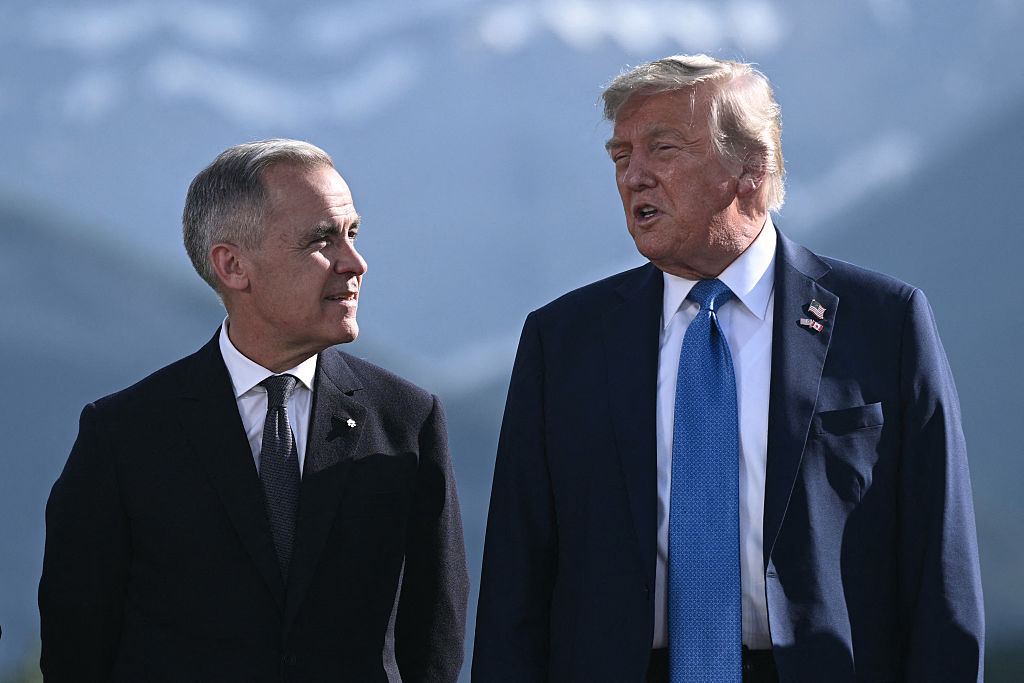
Carney, for the first time since the April election, repeated his comments about Canada’s changing relationship with the United States publicly in a rare Oct. 22 televised address ahead of the release of the Nov. 4 budget, saying the relationship between the two countries “will never again be the same.” But he stayed away from criticizing the Trump administration directly. The two have had a cordial relationship in their meetings, with Trump saying he likes Carney and the Canadian prime minister calling Trump a “transformational president.”
While Carney’s public adversarial stance toward Trump is no more, Premier Ford has maintained the same position that was instrumental in his government winning a third consecutive majority government in February.
Ontario’s Ad Offensive
The latest controversy around Ontario’s anti-tariff TV ad for American audiences laid bare the absence of a united front among the first ministers. Trump on Oct. 23
cancelled trade talks because of the ad, which uses audio from a
1987 radio address by former President Ronald Reagan. In the ad, Reagan speaks positively of free trade and critically of tariffs.
Ford did not express any regrets for airing the ad, saying on Oct. 24 that he had achieve his goal of reaching a large U.S. audience.
The premier on Oct. 27 said Carney saw the TV commercial before it aired in the United States. Carney subsequently said, on Nov. 1, that he had told Ford not to air it, adding “you saw what came of it.”
Trump said the ad was meant to interfere with the U.S. Supreme Court’s review of his tariff orders, with arguments starting on Nov. 5.
Ford has kept a combative stance toward Trump since the president made his first tariff threat against Canada in late November last year. Ford had expressed a sense of betrayal over the move, saying it was “like a family member stabbing you in the heart.”
The Ontario premier received increased coverage not only because he heads Canada’s most populous province, but also because he chaired the Council of the Federation at a time when Trudeau was a lame-duck prime minister, having announced his decision to resign so that a new Liberal leader and prime minister could take over. Chairing of the council was passed on to P.E.I. in July.
Ford at one time threatened to block energy exports to U.S. states, and he eventually slapped them with a 25 percent surtax when Trump introduced sectoral tariffs on steel and aluminum in March. He suspended the surcharge shortly after following Trump’s threat that he'd double the steel and aluminum tariffs, with Ford saying he had agreed to stop the measure because he secured a meeting with the U.S. commerce secretary in Washington.
Ford called a snap election in January and won a third-straight majority government in February. He campaigned on the promise of taking a hard line against Trump to help the province’s economy, which relies heavily on the auto sector that is subject to U.S. tariffs.
Carney similarly used this strategy to bring the Liberals from the edge of electoral abyss to a strong minority government. The federal Liberals’ approach, however, has not remained as steady as Ford’s.
Other Premiers
B.C. Premier David Eby has also adopted a hard stance toward the United States, with his province implementing a number of counter-measures. Similar to Ontario’s provincial liquor
stores, BC Liquor has
removed all American products from its shelves. Eby, however, has not pushed for more counter-tariffs, saying more such measures won’t help change the president’s mind.
Eby was also planning to launch an anti-tariff ad campaign in the United States, as his province’s lumber sector is hard hit by tariffs, but he put on the brakes after the fallout from Ontario’s ad. He said there should be coordination with Ottawa on such initiatives.
“Going forward, we’re going to ensure that our communications are aligned when the time comes to speak with the Americans,” Eby said during an unrelated news conference on Nov. 3 with Canada-U.S. Trade Minister Dominic LeBlanc.
Other provincial premiers’ approaches have ebbed and flowed.
Alberta Premier Danielle Smith had taken a diplomatic approach to the incoming U.S. administration. She visited Trump at Mar-a-Lago a few days before he took office, stating there should be no export tariffs placed on her province’s oil and gas sales to the United States, as Ottawa at one time was saying it wouldn’t rule out the measure. But after Trump imposed his first wave of tariffs, Smith also supported the Trudeau government’s counter-measures.
Alberta initially had taken a path similar to that of the other provinces to prevent U.S. liquor from reaching store shelves in March, but it cancelled the import ban in June.
Smith also supported Carney’s decision to lift counter-tariffs in September, saying she believes in “strong, consistent diplomacy” to solve trade issues. Smith, like the federal Tories, also says the proper response to economic challenges is to repeal federal laws and regulations that block resource development.
Saskatchewan’s approach has been similar to Alberta’s, initially stopping the import of U.S. liquor in March before resuming purchase and distribution in June.
Saskatchewan Premier Scott Moe has called for a diplomatic resolution to the trade issues early on, and for Ottawa to refrain from imposing new counter-measures along the way.