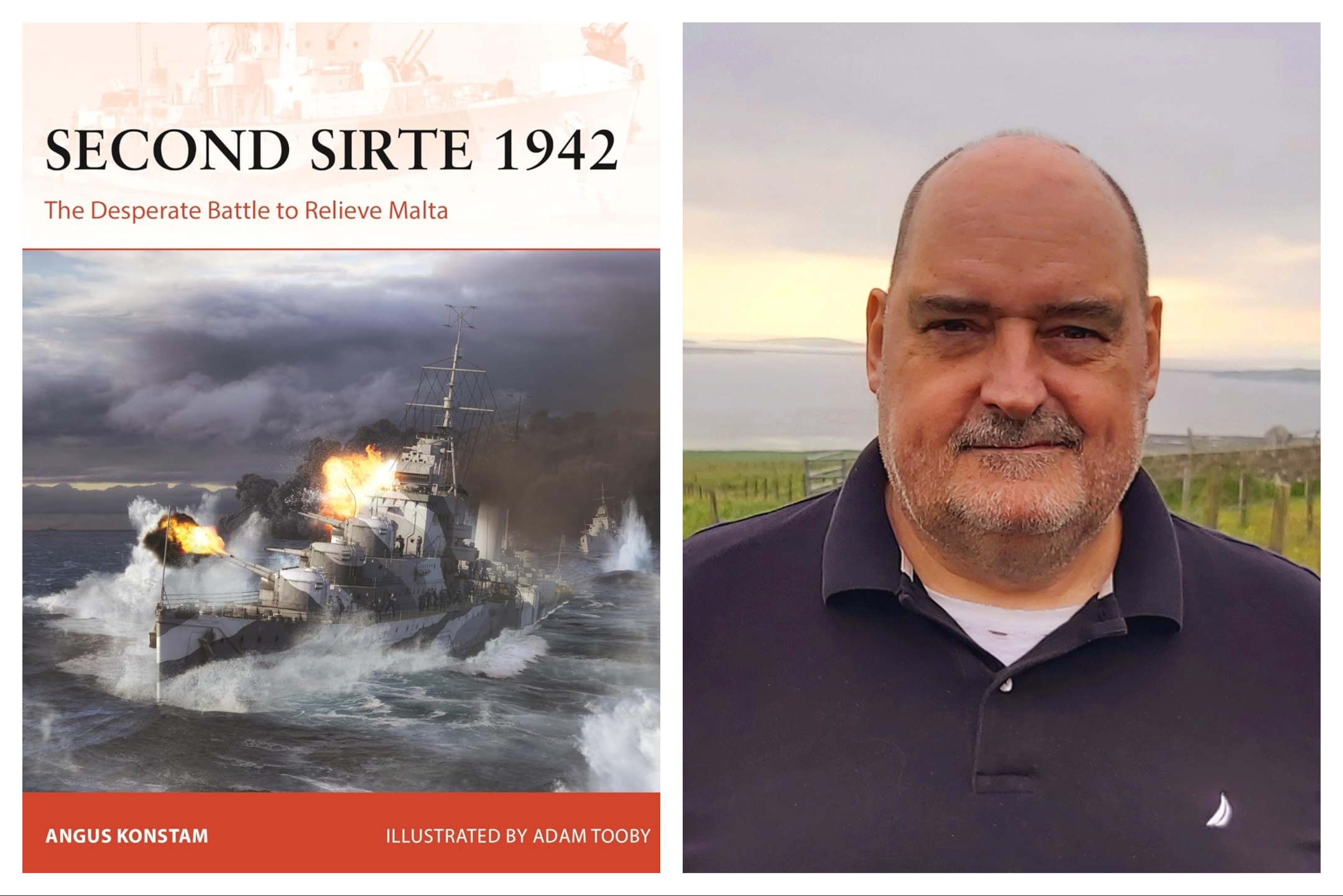
When the French fell to the Germans in the summer of 1940, it left the British on its own to fend off the Axis Powers. After this fall, the British Mediterranean Fleet was forced to move from the island of Malta to a port in Alexandria. There were still British on the island, along with the Royal Air Force (RAF), who needed supplies. The task of resupplying, which required sailing a treacherous length of 830 miles, was full of risks. In Angus Konstam’s new work, “Second Sirte 1942: The Desperate Battle to Relieve Malta,” readers go on a high-seas adventure that pits an undersized naval fleet against a larger Italian fleet led by Adm. Angelo Iachino, as well as Italian and German fighter planes.
Before this naval battle took place in late March 1942, the British had consistently been on the receiving end of bad news. From mines and U-boats, numerous cruisers and destroyers had been damaged, sunk, or forced to scuttle.
On land, things began to take a turn for the worst with the arrival of German Field Marshal Erwin Rommel. The British Mediterranean Fleet under the overall command of Adm. Andrew Cunningham was being spread thin. The fleet’s tasks were threefold: “the support of the 8th Army in North Africa, the cutting of Italian supply routes between Italy and Libya, and the resupply of Malta.”
The latter being a very tall task, Cunningham and Adm. Sir Philip Vian orchestrated an elaborate plan to give the fleet, and the convoy it was protecting, the best chance of arriving safely.
An Elaborate Plan
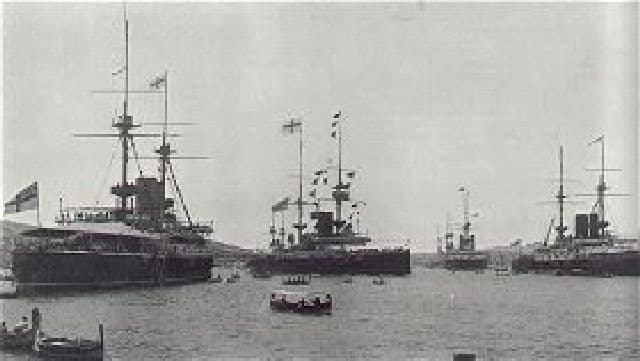
British warships, at Malta, in 1902. (PD-US)
The pace at which the convoy could cruise was slow. British command projected the journey from Alexandria to Malta would take approximately four days. The convoy and its escort would be sailing the majority of the time through enemy waters known as Bomb Alley. As Konstam notes, though, the British Royal Navy had one very important technical advantage over the Italians: radar. This advantage was most beneficial at night, allowing the British to keep an eye on enemy ships, while the Italians remained blind, and therefore aloof, until daylight.
Additionally, the plan of action included aerial attacks by the RAF on North African enemy bases to create a diversion from the operation’s objective. For the most part, these distractions served their purpose. The RAF was also able to provide protection for a portion of the journey, but due to logistics, it was forced to return to Alexandria, leaving the escort and convoy to make the final leg on its own.
A Naval Chess Match
For a rather brief book, Konstam filled the pages with plenty of details. More importantly for readers, his gift for dramatic narrative shines through. The author is one of the finest writers on naval activities, especially wartime activities, and his description of the final engagement during the Second Battle of Sirte is suspenseful and dramatic.
Konstam moves the narrative seamlessly between the various admirals and captains of both the British and the Italians. Readers are treated to a maneuver-by-maneuver breakdown of the final engagement, which became known as the Medina Melee. Smoke screens, rough seas, antiaircraft barrages, shelling from miles away, torpedo launches, and the chess-like responses between the opposing sides all make for an engaging read.
Indeed, it was a chess match on the Mediterranean with the Italians having the only queen. The Italian fleet was led by one of the most powerful ships on the sea: the modern battleship Littorio, with its nine 15-inch guns capable of firing 12 miles.
A Race Against the Clock
Firepower and naval capability were obviously instrumental, but it was the clock that proved to be both adversary and ally for each side. Konstam, to his credit, uses time as a means of building the suspense around the action. Could the British survive the daylight hours in order to make it close enough to Malta and therefore receive aerial coverage and thus drive away the Italians? Could the Italians destroy the convoy before nightfall and before the British neared Malta? “Second Sirte 1942” combines reticence and courage as both sides demonstrate a willingness to fight without being reckless.
Although neither side technically won, both sides felt they had achieved a victory of sorts. Overall, the battle was a draw. Strategically, it was a chess match masterclass. Indicative of just how well each side performed, specifically the British, Konstam quotes Adm. Cunningham in his recollection of the battle: “I shall always consider the Battle of Sirte on March 22nd 1942 as one of the most brilliant naval actions of the war, if not the most brilliant.”
“Second Sirte 1942” was a wonderfully engaging and informative read. Along with Konstam’s stellar writing was Adam Tooby’s highly detailed and beautiful battle scene illustrations. As always, Osprey’s 3D maps throughout the book help readers with geography and the battle’s tactical maneuvers. A very good book about a relatively obscure naval battle and ideal for World War II history buffs.
’Second Sirte 1942: The Desperate Battle to Relieve Malta‘
By Angus Konstam
Osprey Publishing: July 15, 2025
Paperback, 96 pages
What arts and culture topics would you like us to cover? Please email ideas or feedback to features@epochtimes.nyc