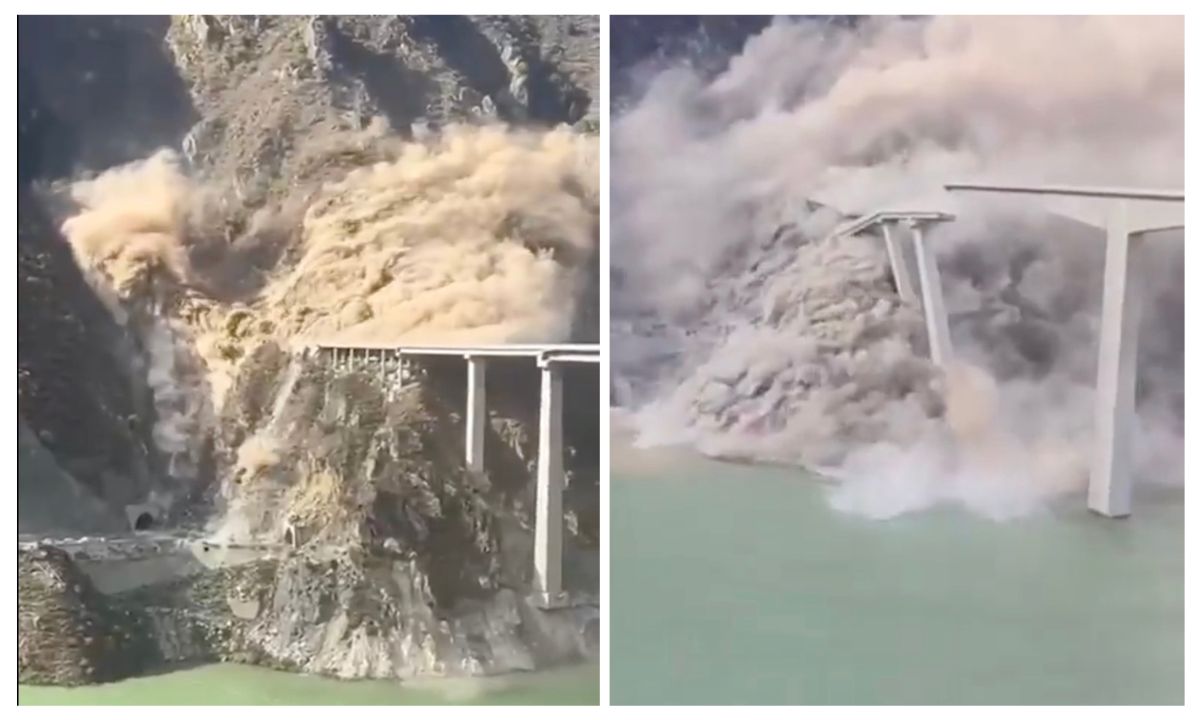
A major bridge in China’s Sichuan province collapsed on Nov.11, just 10 months after it was completed and before it had opened to traffic.
The Hongqi Bridge spans 2,687 feet, with a 722-foot main span and a 564-foot-high central pier. Authorities hailed it as a regional infrastructure milestone.
Chinese state-controlled media blamed a landslide for the collapse. Videos circulating online show a slope giving way and the approach span being destroyed, while the main bridge remains mostly intact.
Expert: Location Matters
Zhu Xueye, a bridge engineer from China currently based in New York, said the landslide triggered the failure. “The accident started with a slope collapse, which then took out the approach span,” he said.
He noted the main bridge itself appeared structurally sound but criticized the site selection, saying that visual footage shows the slope has a clear history of landslides. This made crossing it with a bridge approach highly questionable from an engineering standpoint, according to Zhu.
Building in such terrain requires detailed geological studies. Zhu explained that drilling, sampling, and analyzing soil and rock mechanics are essential to ensure stability. It is unclear whether the Hongqi Bridge received adequate study.
The bridge sits on steep slopes, estimated at 45–60 degrees, according to Zhu’s analysis. Even stable bedrock cannot fully prevent topsoil and rock from sliding, especially under rain or seasonal changes.
The approach spans were placed directly on these unstable slopes. Zhu said a safer method would have been to flatten the hill or reinforce the slope before construction. Instead, piers were built on top of it, leaving them vulnerable.
When Political Considerations Take Precedence
China’s big infrastructure projects often carry political and economic weight. Zhu said officials’ decisions can prioritize speed, cost, or local prestige over safety.“This isn’t really a technical or engineering problem,” he said. “There are political considerations behind it.”
Zhu suggested that deadlines, budget limits, or local interests may have pushed construction into risky areas.
While some Chinese netizens have questioned whether contractors were fully paid or if cost-cutting affected quality, Zhu said that, in this case, the landslide was likely the decisive factor, not poor materials or workmanship.
Similar Risks for Other Bridges in China
China has built thousands of mountain bridges over the past decades. While the country’s engineers are highly experienced, failures like the Hongqi Bridge highlight systemic vulnerabilities, according to Zhu. He further warned that similar risks exist for other bridges in mountainous regions, indicating the collapse shows the tension between rapid infrastructure development and engineering safety standards. Landslides in mountainous areas are often predictable. Ignoring them can be catastrophic, he said.
The Hongqi Bridge is now an important lesson for China. Even with skilled engineers and modern design, political considerations, rushed projects, and environmental risks can lead to disastrous consequences, he said.
“These big projects are never really technical problems—they’re political ones,” Zhu said. “So, for this bridge, I think the choice of location is telling. If people look into it later, they’ll probably find something significant about why it was built there [and] why it had to cross that particular little hill.”
Yi Ru contributed to this report.