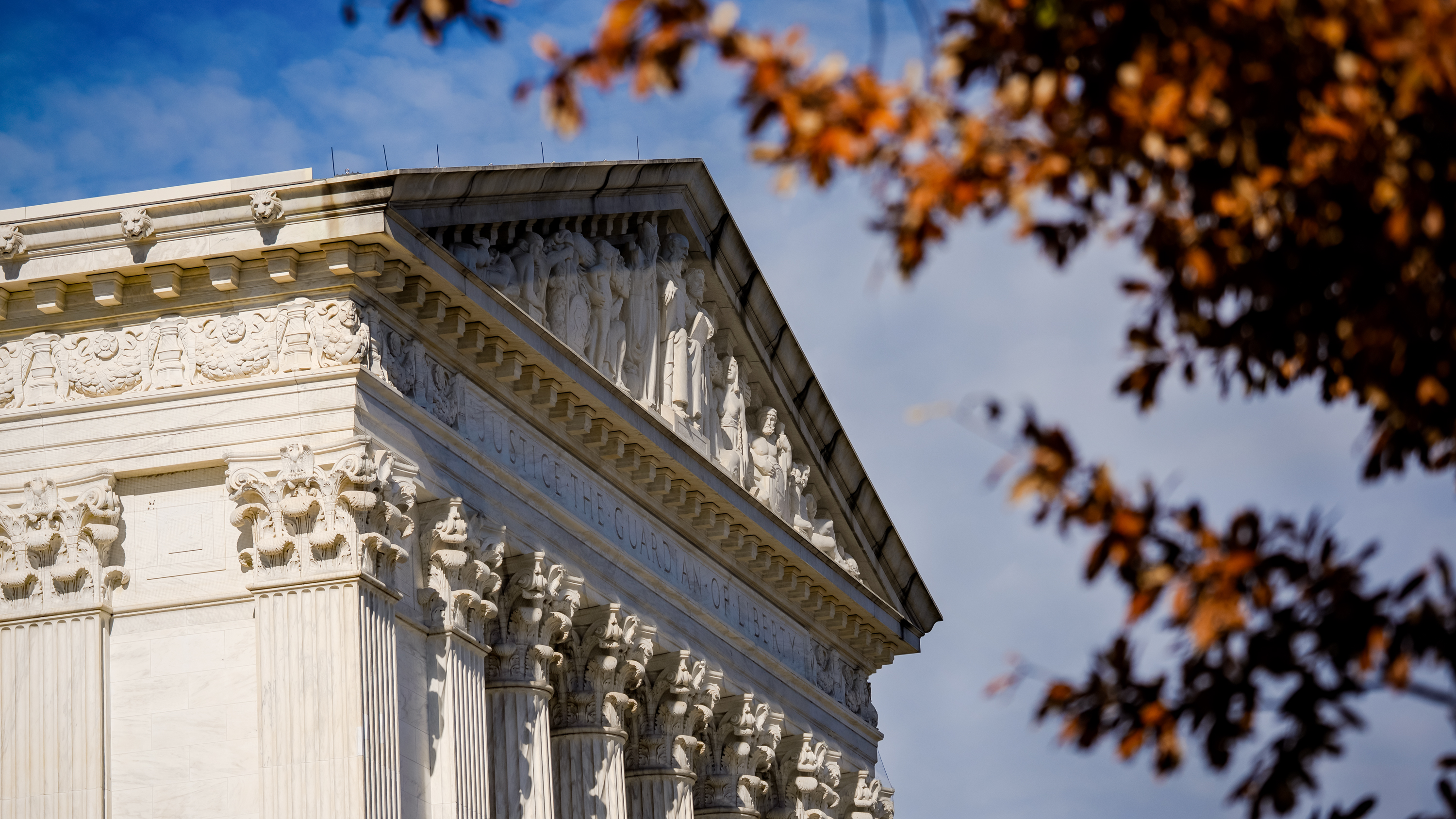

The Supreme Court is expected to hear two cases in coming weeks that could determine how far Americans may go in holding government officials accountable for purportedly violating their rights to religious freedom.
While the Constitution and federal law prohibit such violations, the legal system is still working out how Americans may use two laws in particular—the Religious Land Use and Institutionalized Persons Act and 42 U.S. Code, Section 1983—for things such as financial damages.
In Landor v. Louisiana, which is set for oral argument on Nov. 10, the court is expected to consider whether the former law allows individuals to seek money damages.
On Dec. 3, the Supreme Court is expected to hear Olivier v. City of Brandon, which focuses on whether individuals can bring Section 1983 lawsuits over laws they have already been guilty of violating.
Rastafarian Prisoner
Damon Landor is a devout Rastafarian who abides by what court papers describe as a “Nazarite Vow” to not cut his hair.
According to Encyclopedia Britannica, Rastafari is a political and religious movement that started in Jamaica in the 1930s.
Despite Landor’s religious interest in maintaining his dreadlocks, prison guards in Louisiana held him down and shaved his head to the scalp.
When Landor lost his hair, the U.S. Court of Appeals for the Fifth Circuit had already ruled in a separate case that forcing inmates to cut their dreadlocks was illegal.
Landor attempted to show a copy of this ruling to a prison guard, but the guard threw it in the trash.
He followed by suing prison officials in their individual capacities and sought money damages under the Religious Land Use and Institutionalized Persons Act.
A portion of that law states that individuals can “obtain appropriate relief against a government” and defines “government” as including “any person acting under color of state law.”
Similar phrasing can be found in a sister statute known as the Religious Freedom Restoration Act, which Congress passed in 1993 to protect the free exercise of religion.
Because the Supreme Court held in 2020 that the Religious Freedom Restoration Act allowed money damages, Landor argued that its sister law should as well.
When the Fifth Circuit reviewed Landor’s lawsuit, it stated that it “emphatically” condemned the treatment he received but that only the Supreme Court could address the issue.
The judges pointed to a case from 2009 known as Sossamon v. Lone Star State of Texas.
At the time, the circuit court stated that the Religious Land Use and Institutionalized Persons Act did not allow lawsuits targeting officers in their individual capacities, as Landor’s did.
In judging Landor’s case, the circuit court acknowledged that the Supreme Court’s decision from 2020, in a case known as Tanzin v. Tanvir, allowed money damages under the sister statute.
But, the judges said, they could not ignore their own precedent on a different law without a more direct ruling by the Supreme Court.
Spending Clause
Part of their reasoning was based on a provision of the Constitution known as the spending clause.
That clause gives Congress the power to collect taxes and other forms of revenue “to pay the debts and provide for the common defence and general welfare of the United States.”
According to the Supreme Court, the Religious Land Use and Institutionalized Persons Act was enacted under that authority.
Its sister law, by contrast, was enacted under the powers Congress has under the 14th Amendment.
In the Fifth Circuit’s view, the Religious Land Use and Institutionalized Persons Act was like a contract, with liability assigned to the parties involved. That liability, it said, should apply only to actual parties to the contract such as a state government that receives federal funding.
Because guards in their individual capacity are not parties to a particular contract, they cannot be held liable in that capacity.
Landor said this approach was wrong and that the court should not use a “strict contract” analogy.
In a brief to the Supreme Court, Landor’s attorneys argued that these types of lawsuits and the associated damages were necessary to deter violations of the law.
Controversial Street Preacher
Landor had also sued under 42 U.S. Code, Section 1983, which similarly allows individuals to sue the government over alleged violations of their civil rights.
That particular law is not the subject of his appeal to the Supreme Court, but it is the subject of another case from Mississippi.
In 2021, street preacher Gabriel Olivier was arrested in Brandon, Mississippi, for violating a city ordinance governing where people can protest during events.
According to court documents, a group of people, including Olivier, showed up to a concert in 2021 and called people “whores,” “Jezebels,” and other names.
When he got to court, Olivier pleaded no contest and was given a suspended sentence of 10 days in prison.
In a subsequent civil lawsuit filed under Section 1983, Olivier alleged that the city’s ordinance violated the First Amendment and other rights.
But because of a Supreme Court precedent on Section 1983, Olivier was unable to proceed with his lawsuit. That precedent, known as Heck v. Humphrey, states that under Section 1983, lawsuits cannot be brought if success in them “would necessarily imply the invalidity of a prior conviction.”
Olivier had sought an injunction or block on the city ordinance because it was unconstitutional. According to the Fifth Circuit, that would necessarily imply that his conviction was invalid.
When Olivier appealed his loss in the Fifth Circuit, he told the Supreme Court that his lawsuit would not invalidate his previous conviction. Instead, it was focused on preventing a future prosecution rather than backward-looking damages such as the ones that were at issue in the Heck case.
Another difference from Heck focused on habeas relief, or the ability to challenge one’s detention.
The subject of the lawsuit, Roy Heck, had been detained as part of a 15-year sentence and filed petitions for habeas relief.
However, Olivier was never actually detained and therefore never got the opportunity to request habeas relief. That is important, because Olivier told the Supreme Court that habeas was the means by which he could have challenged the constitutionality of the city’s ordinance.
The city of Brandon responded that Olivier was misinterpreting the court’s decision in Heck v. Humphrey, namely by assuming that it depended on whether someone had been able to request habeas relief.
What really mattered, according to the city, was whether Olivier’s lawsuit was a “collateral attack” on his original case.
“Under [Olivier’s] rule, the courthouse doors would be opened to millions of new convicted plaintiffs,” the city stated in its brief.