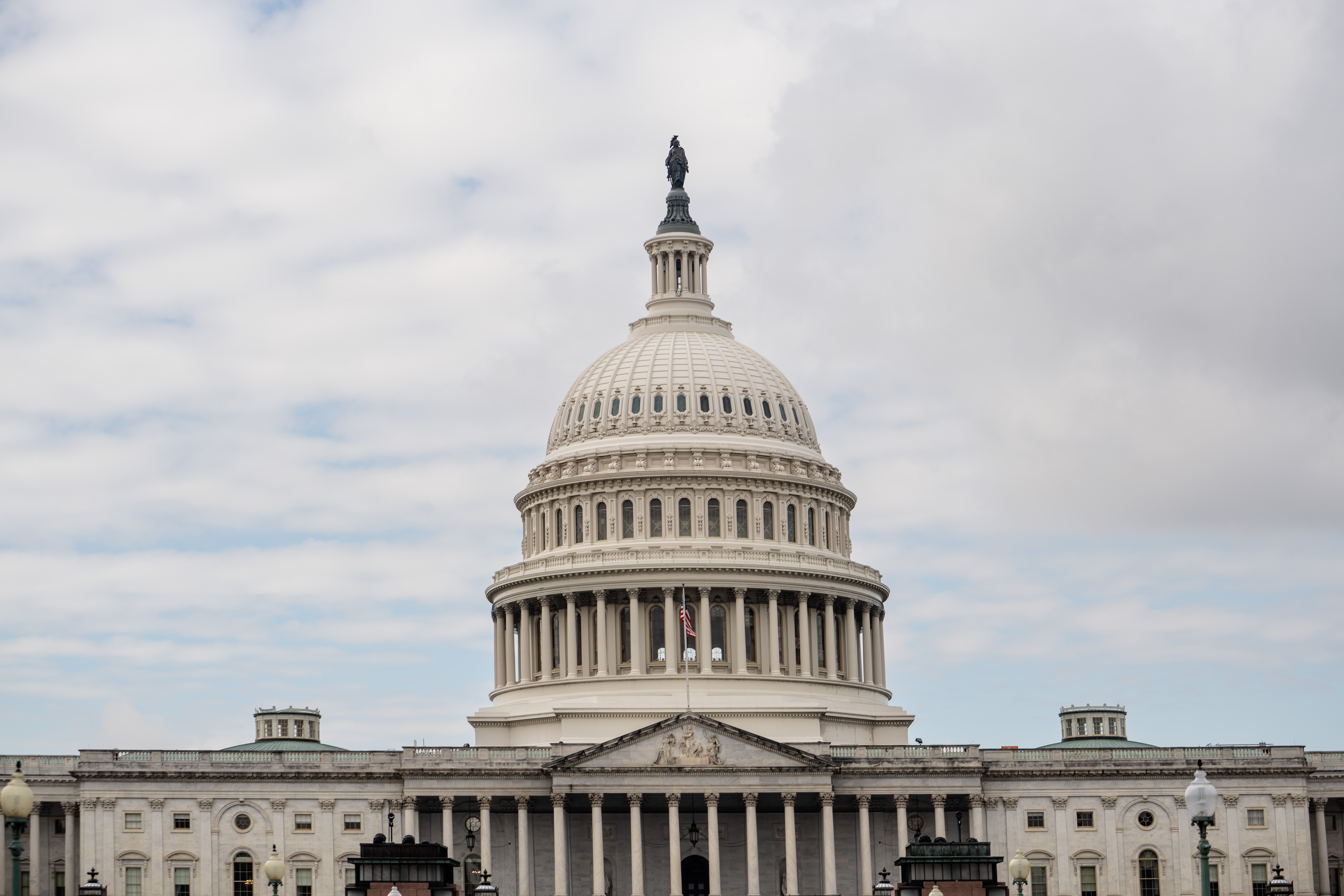

WASHINGTON—The current lapse in government funding is now the longest in U.S. history.
At 36 days as of Nov. 5, the ongoing shutdown has surpassed a record set during the first Trump administration.
Senators surpassed their previous high-water mark just hours after voting down a short-term continuing resolution (CR) to fund the government. The result marked the 14th such failure for the Republican-backed CR, which has not met the 60-vote threshold to advance despite winning support from a majority of the upper chamber.
Senators voted 54–44, falling short of the 60 votes needed for advancement. Sens. Catherine Cortez Masto (D-Nev.), John Fetterman (D-Pa.), and Angus King (I-Maine) continued to vote with Republicans to approve the bill. Sen. Rand Paul (R-Ky.) was again the lone Republican voting against it.
During a morning news conference, House Speaker Mike Johnson (R-La.) predicted that the latest bid to end the shutdown would fail.
“It is absolutely unforgivable,” he said of Democratic opposition to the Republican-led CR, which would effectively maintain government funding at current levels.
Ahead of the vote, Senate Majority Leader John Thune (R-S.D.), who previously said he was “optimistic” that the shutdown could end this week, said, “I hope—I hope—that there are at least those five Democrats out there who will look at the pain that people are experiencing and will say, ‘Enough is enough.’”
Senate Minority Leader Chuck Schumer (D-N.Y.) highlighted the start of open enrollment for health insurance. Affordable Care Act premium tax credits are set to expire—a point of contention Democrats have wanted to resolve before reopening the government—which means that Americans are looking at higher premium tax credits.
“The Senate deserves to see serious negotiations when it comes to health care,” he said. “Republicans’ outrageous delay has cost Americans already too much.”
During a Nov. 4 news conference, Schumer vowed that Democrats will “keep fighting day after day, vote after vote.”
Yet there have been some signs of momentum this week toward a resolution, including talk from Republicans of a new CR extending into either December or January.
The longer timeline is generally favored by conservatives.
The new funding patch could open up the breathing room for Senate business, including normal government funding, that the original CR was intended to provide to lawmakers.
“The hope and expectation would be that we could get appropriations bills on the floor considered and passed so that we can fund the government through the normal appropriations process,” Thune told reporters on Nov. 4.
“Nobody wants a year-long continuing resolution.”
Yet Axios has reported widespread support for such a CR among the Republicans in the conservative House Freedom Caucus.
Speaking to reporters on Nov. 4, House Majority Leader Steve Scalise (R-La.) sounded open to some combination of a CR and a minibus, that is, a package made up of some but not all appropriations bills.
He also did not rule out the possibility of the House coming back into session on Nov. 7.
“We’re looking at what happens in the Senate,” Scalise said.
Sen. Mark Kelly (D-Ariz.) told The Epoch Times that he is “generally optimistic” that a resolution is coming soon. Yet he added a note of skepticism.
“I think this whole exercise has been a couple steps forward, two steps back,” he told reporters.
Sen. Mike Rounds (R-S.D.), who has been named as a participant in some conversations across party lines, told reporters that “rumors” indicate that an end is in sight but that everyone will have to wait and see.
Sen. Tim Kaine (D-Va.), another participant in those dialogues, told The Epoch Times that he could see a resolution being reached by Republicans without a White House meeting with President Donald Trump.
“[Republicans are] sort of waiting for [Trump’s] green light—and they’re unsure, because he’s so unpredictable,” he said.
A third lawmaker said to be involved in negotiations, Sen. Gary Peters (D-Mich.), told reporters that talks have sped up.
When asked whether he thinks that Republicans are operating in good faith during these conversations, he said, “I would hope so.”
Peters’s apparent optimism contrasted with a more pessimistic assessment from Sen. Chris Murphy (D-Conn.).
“I understand negotiations are ongoing, but a failed vote doesn’t solve the problem, and the problem is pretty extraordinary,” he said, referring to increasing insurance premiums.
Schumer was asked on Nov. 4 about the unusually long duration of a caucus held by Senate Democrats.
“We had a very good caucus, and we’re exploring all the options,” he said.