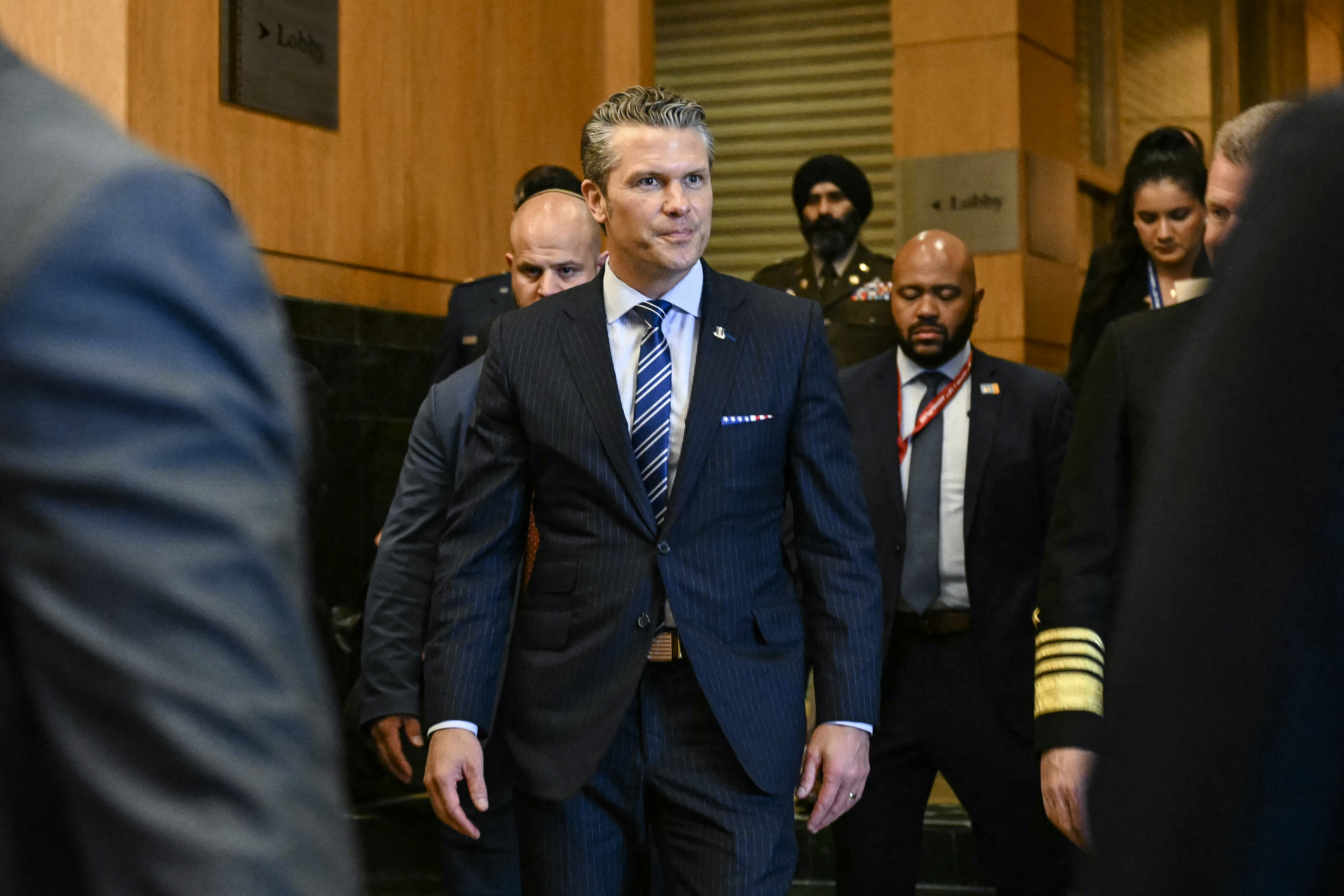


U.S. Secretary of War Pete Hegseth on Oct. 31 raised concerns about Chinese military activities around Taiwan and in the South China Sea during his first in-person meeting with Chinese Defense Minister Adm. Dong Jun.
The meeting in Malaysia, where defense chiefs from Southeast Asia gathered for a summit, came a day after U.S. President Donald Trump met with Chinese leader Xi Jinping in South Korea.
“I highlighted the importance of maintaining a balance of power in the Indo-Pacific,” Hegseth said on X on Thursday evening following talks with Dong.
Tune in to China Watch, a podcast on Chinese politics, technology, and business.
The Pentagon chief said he “emphasized U.S. concerns about China’s activities in the South China Sea, around Taiwan, and towards U.S. allies and partners in the Indo-Pacific.”
While the United States doesn’t seek conflicts, it will “continue to stoutly defend its interests and ensure it has the capabilities in the region to do so,” he added.
Dong reiterated the Chinese Communist Party’s (CCP’s) claims over Taiwan, saying that ”the United States should be cautious in its words and actions on the Taiwan issue,” according to the Chinese defense ministry.
Beijing hopes Washington will “take a clear stance firmly opposing ‘Taiwan independence,’” Dong was quoted by his ministry as telling Hegseth.
The CCP, which has never ruled Taiwan, views the self-governed island as a breakaway province and has not ruled out the use of force to bring it under its control.
To achieve this goal, the Chinese communist regime has ramped up pressure on Taiwan across multiple fronts. That includes carrying out large-scale military drills and flying warplanes near the island on a nearly daily basis, heightening concerns about a potential war in the Taiwan Strait.
U.S. officials have said that Xi has instructed his military to prepare for a 2027 attack on Taiwan. Despite the lack of formal ties, the United States is legally bound to provide Taiwan with the means to defend itself.
Hegseth, who is visiting Asia this week, has warned of the rising security challenges posed by the Chinese regime to the Indo-Pacific region, which he previously described as the “priority theater.”
“The threats we face are real and they are urgent. China’s unprecedented military buildup and its aggressive military actions in the region speak for themselves,” Hegseth said at a joint press conference with Japanese Defense Minister Shinjiro Koizumi in Tokyo on Oct. 29.

Japanese Defense Minister Shinjiro Koizumi (L) and U.S. Secretary of War Pete Hegseth inspect an honour guard before their meeting at the Japanese defense ministry in Tokyo on Oct. 29, 2025. (Takashi Aoyama/Pool/AFP via Getty Images)
He welcomed Tokyo’s commitment to boost defense spending, saying that the U.S.–Japan alliance is “critical to deterring Chinese military aggression, to responding to regional contingencies, and keeping our countries safe.”
On Oct. 31, after the meeting with Dong, Hegseth also sat down with several other top defense officials, including those from India and the Philippines.
US–India Defense Framework
Hegseth unveiled a 10-year defense framework with India, following a meeting with Indian Defense Minister Rajnath Singh.
“This advances our defense partnership, a cornerstone for regional stability and deterrence,” Hegseth stated on X. “Our defense ties have never been stronger.”
The Indian defense ministry described the meeting as “cordial and constructive,” stating that the defense chiefs discussed ways to strengthen U.S.–India defense ties and review their security and technology cooperation.
Both leaders also affirmed their commitment to maintaining a free, open, and rules-based Indo-Pacific, according to the ministry.
It noted that the defense agreement would provide “policy direction” for U.S.–India security ties and mark “a new era of collaboration across all pillars of the bilateral relationship.”
US–Philippines Joint Task Force
The United States also formed a new joint task force with the Philippines to strengthen cooperation and increase military readiness in areas such as the contested South China Sea, the Pentagon said after Hegseth met with Philippine Defense Secretary Gilberto Teodoro Jr.
Task Force-Philippines “will increase operational cooperation, improve combined planning, and enhance interoperability, particularly in the South China Sea,” according to a statement from Pentagon spokesman Sean Parnell.
Hegseth also said on X that the United States “will work relentlessly to reestablish deterrence in the South China Sea and advance our alliance.”
Reuters contributed to this report.