
WASHINGTON—Paul Simon, the Silent Generation songwriter, once sang that a character was “born at the right time.”
Rep. Nancy Pelosi (D-Calif.), one of the last Silent Generation leaders in Washington, might know the feeling.
The lawmaker, who announced on Nov. 6 that she will not seek reelection, has led a powerful and polarizing career, one timed well to rack up female firsts and shepherd a more progressive Democratic Party through 21st-century wins, and losses, in the House.
Now, a leader who has helped steer her party to the left is departing at the Democrats’ time for choosing. The election of democratic socialist Zohran Mamdani has emboldened progressives even as others warn of the need to court moderates in 2026.
After the 1994 Gingrich Revolution cemented Republican control of the House for more than a decade, Democrats swept the chamber in the 2006 midterm election, and Pelosi became its first female speaker the following January. She would go on to help design the Affordable Care Act, or Obamacare, before Republicans reclaimed the body for eight years.
During President Donald Trump’s first term, she emerged as a symbol of resistance against him and his party. He was impeached twice while she was speaker. Though dogged by allegations of suspicious stock trading by her husband, she went on to spearhead a major infrastructure bill and other key legislation during the first half of President Joe Biden’s term in office.
The San Franciscan’s story began more than half a century earlier on the East Coast.
Pelosi was born Nancy D’Alesandro in Baltimore in 1940.
Hers was a political family. Her father, Thomas D’Alesandro Jr., was a Democratic congressman who later served as Baltimore’s mayor. Her brother, Thomas D’Alesandro, III, became mayor of Baltimore less than a decade after his father left office.
In 1961, she attended the inauguration of President John F. Kennedy.
The future congresswoman attended Trinity College in Washington, D.C. In Washington, she met Georgetown University student Paul Pelosi, whom she married in 1963. The two would have five children.
She and her young family moved to San Francisco in 1969—a memorable moment in that hub for the 1960s counterculture.
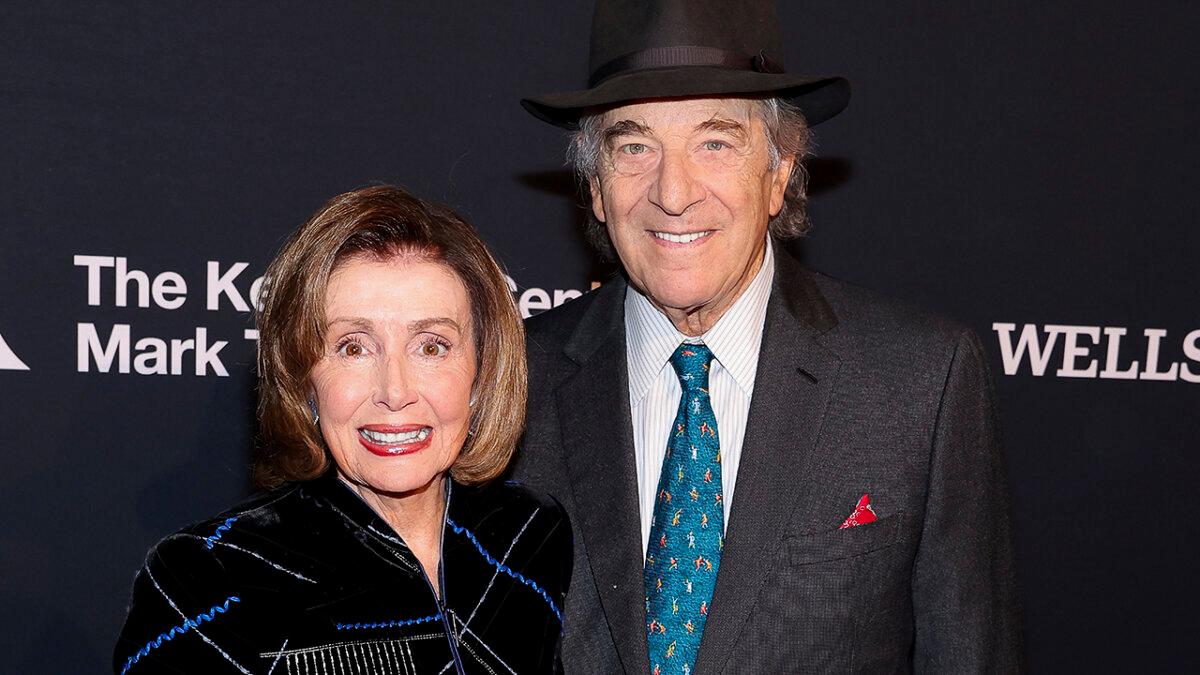
Nancy and Paul Pelosi attend the 24th Annual Mark Twain Prize for American Humor performance at the Kennedy Center in Washington on March 19, 2023. (Paul Morigi/Getty Images)
Political Rise
A skilled fundraiser from her early days in the party, Pelosi by 1977 was a Democratic National Committee member from California. She later helmed the California Democratic Party as its first female chair.
In 1984, when she led the host committee for the Democratic National Convention in San Francisco, the New York Times described her as “probably the least known of the key women at the Democratic National Convention” beyond California.
Pelosi was elected to Congress in 1987 from a heavily Democratic area of San Francisco. Her first speech in the House touched on the AIDS crisis.
During the 1990s, she supported both the Brady Bill, mandating background checks for those purchasing firearms, as well as the 1994 crime bill, which boosted law enforcement and prison funding. Pelosi also served on the House’s powerful Appropriations Committee.
In 2001, she became the first female whip in the history of Congress. Two years later, she became the chamber’s first-ever female minority leader, replacing Dick Gephardt of Missouri.
Leading House Democrats
Pelosi rose to speaker of the House in 2007, after Republicans faced significant losses during the 2006 midterms.
Many of her major legislative wins came during and soon after 2008, when Barack Obama was elected president amid a global financial crisis.
During the final months of the Bush administration, she backed the Emergency Economic Stabilization Act, a measure that bailed out failing banks.
Under Obama, the House passed the Dodd-Frank Act, a change to banking regulations that also created the Consumer Financial Protection Bureau.
Pelosi also played a key role in stewarding the Affordable Care Act, or Obamacare, into law. Congress also passed the Recovery Act, a stimulus package.
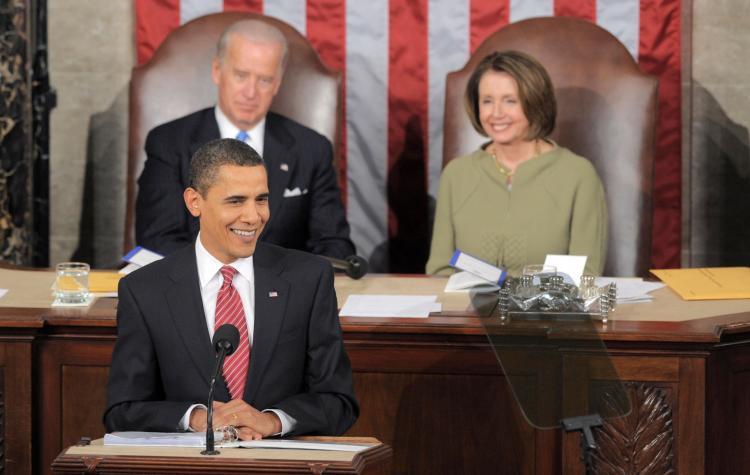
President Barack Obama addresses a joint session of Congress as Vice President Joe Biden and House Speaker Nancy Pelosi look on at the Capitol in Washington on Feb. 24, 2009. (Saul Loeb/AFP/Getty Images)
Opposition to the Recovery Act, Obamacare, and related legislation among conservatives and libertarians coalesced into the Tea Party movement, while bank bailouts seeded the broadly left-wing Occupy Wall Street movement of 2011.
Against the backdrop of the Great Recession, Republicans reclaimed the House in 2010, and Pelosi became minority leader—a position she would retain despite repeated challenges from Democrats seeking to replace her.
During Trump’s first term, Pelosi was defined by images of staunch progressivism—from tearing up a copy of the president’s State of the Union address to taking a knee after the death of George Floyd.
Pelosi played a key role in investigating alleged Russian interference in the 2016 election. As speaker, she led the impeachments of Trump, first in 2019 and then in 2021 after the Jan. 6 Capitol breach.
During the first half of Biden’s presidency, Pelosi led the way on important legislation, including a significant infrastructure bill and legislation to boost domestic semiconductor manufacturing, the CHIPS and Science Act.
The Build Back Better Act, a reconciliation bill to advance Biden’s priorities, passed the House in 2021 but fell short in the Senate as Democrats warred among themselves. Congress ultimately passed a compromise measure, the Inflation Reduction Act.
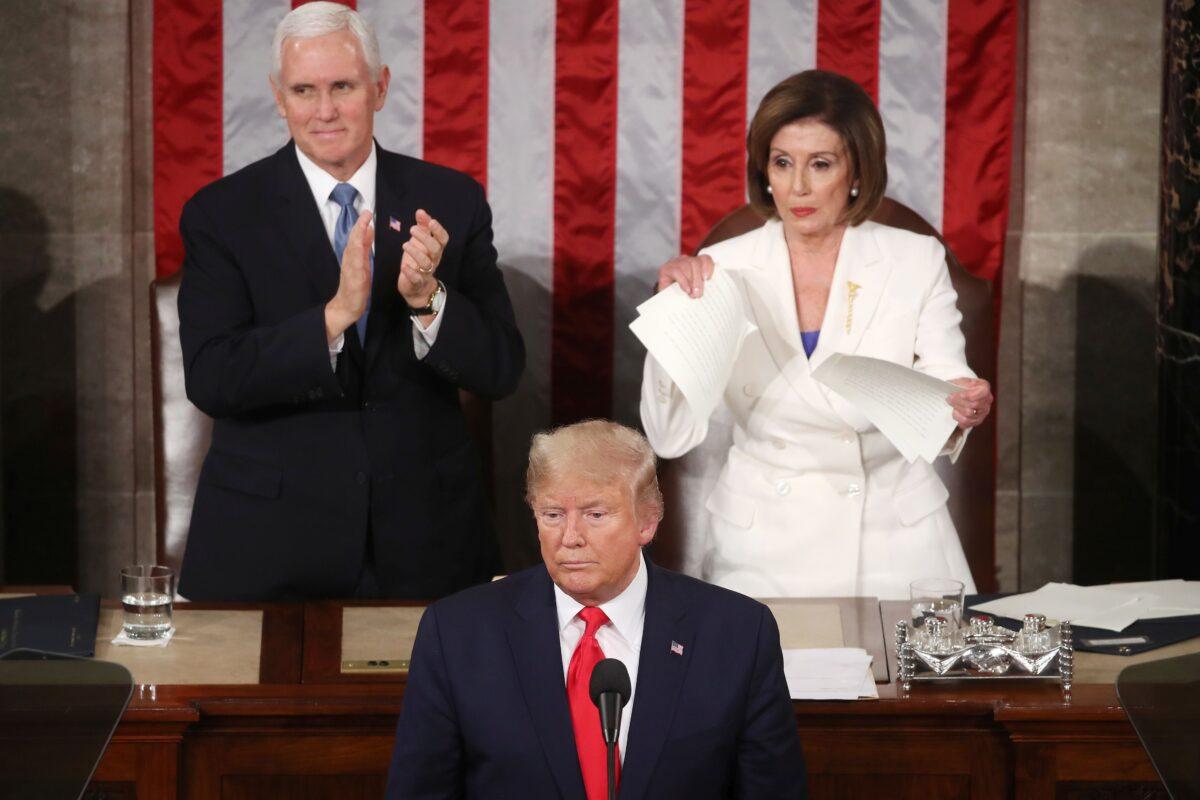
House Speaker Nancy Pelosi rips up the State of the Union speech after President Trump's address in the House of Representatives on Feb. 4, 2020. Trump delivered his third State of the Union to the nation the night before the Senate was set to vote on his impeachment. (Mark Wilson/Getty Images)
Republicans have accused Pelosi and her husband of having benefited from insider information on the stock market, pointing to some trading activities ahead of moves by the government. She has denied those allegations.
In July 2025, Pelosi threw her support behind the HONEST Act, bipartisan legislation that would limit trading by lawmakers and their families.
Timing Her Departure
Pelosi’s announcement comes less than a year after President Joe Biden—another major Democrat from the Silent Generation—left the White House.
Days after the 2024 election, the Californian lamented the fact that Biden had not stepped aside sooner to let Vice President Kamala Harris lead the Democratic ticket.
Her own departure from the speakership came midway through the Biden administration. Pelosi helped groom the congressman who would succeed her as House Democratic leader, Rep. Hakeem Jeffries (D-N.Y.). She endorsed him for the role soon after the 2022 midterm elections.

House Minority Leader Hakeem Jeffries attends a hearing on the government shutdown in Washington on Oct. 22, 2025. (Madalina Kilroy/The Epoch Times)
Pelosi timed her retirement news for another inflection point among Democrats, who have been assessing the direction of their party after suffering losses in 2024.
California state Sen. Scott Wiener, who is to Pelosi’s left on many issues, announced a bid to unseat her on Oct. 22.
On Nov. 4, democratic socialist Zohran Mamdani was elected mayor of New York City—one of many Democratic victories during an off-year Election Day.
One day later, Rep. Jared Golden (D-Maine)—one of the last Blue Dog moderates in Congress—announced that he would retire in 2026.
Correction: A previous version of this article misstated the year of Nancy Pelosi’s marriage. The Epoch Times regrets the error.