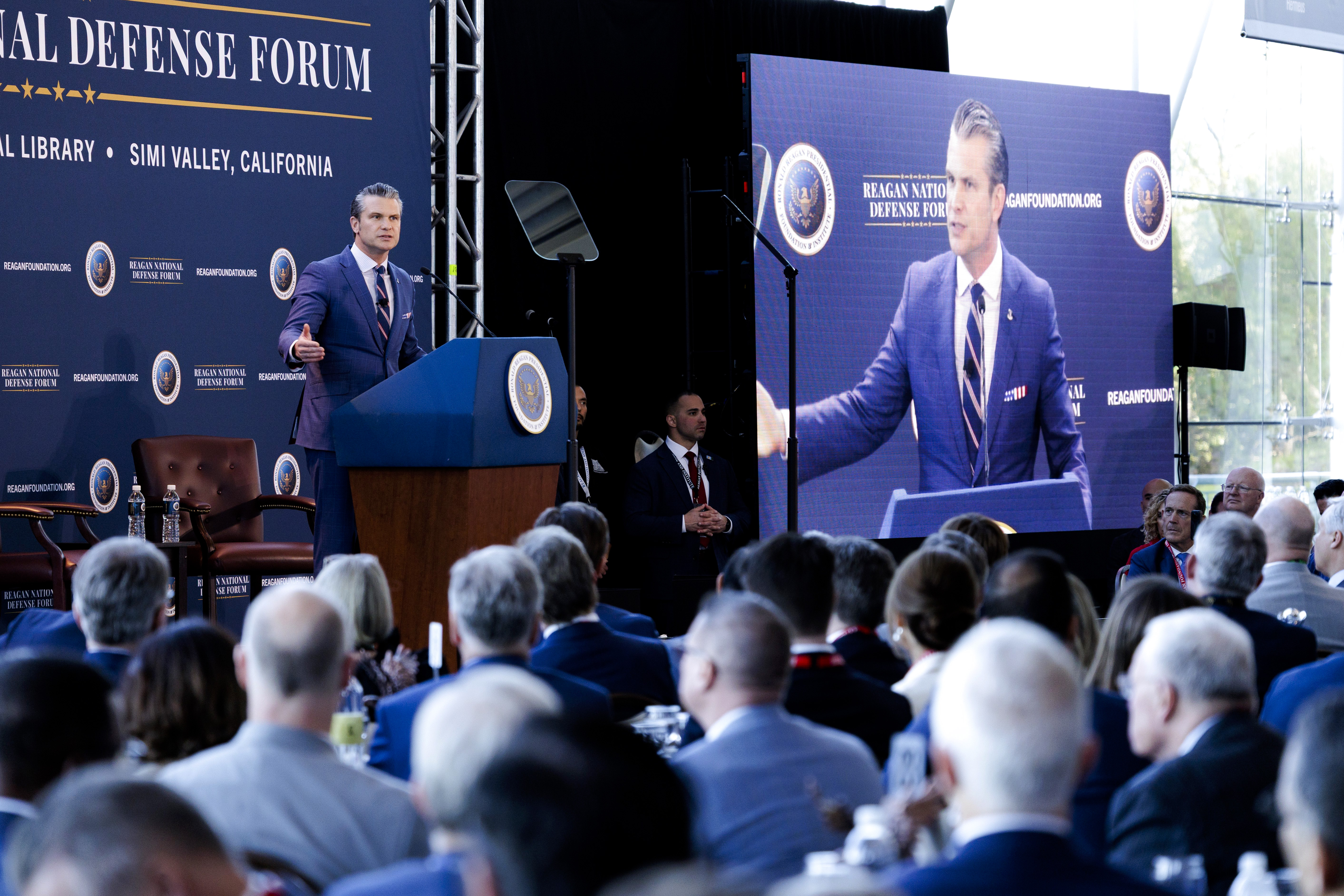

SIMI VALLEY, Calif.—Secretary of War Pete Hegseth articulated the emerging “America First” national defense strategy of President Donald Trump’s second term in a keynote speech before the 2025 Reagan National Defense Forum on Dec. 6.
“The War Department will not be distracted by democracy-building, interventionism, undefined wars, regime change, climate change, woke moralizing, and feckless nation-building,” he said.
“We will instead put our nation’s practical, concrete interests first.”
Hegseth said the Pentagon would support this foreign policy approach by bolstering U.S. power in the Western Hemisphere, deterring China, shifting burdens in other areas of the globe onto regional allies and partners, and overhauling the U.S. arms industry.
The secretary of war’s policy remarks largely mirrored a new national security strategy the White House laid out on Dec. 5. His remarks also serve as a preview of a more detailed national defense strategy that the Pentagon is preparing.
At times throughout his remarks, Hegseth drew parallels between Trump and the forum’s namesake, President Ronald Reagan. He cast Trump as the “rightful heir” to Reagan’s legacy.
“It’s President Trump who has inherited and restored President Reagan’s powerful but focused and realistic approach to national defense,” he said.
Shifting Global Priorities
As he laid out the emerging burden-sharing strategy, Hegseth called for allies and partners around the world to embrace their martial heritage.
“Our allies are not children; they’re nations capable of doing far more for themselves than they have,” he told the Reagan National Defense Forum.
Earlier this year, the Trump administration pressed NATO members to commit 5 percent of their annual gross domestic product to military and defense.
Along with burden-sharing in Europe, Hegseth called for a balancing of responsibilities with partners in the Indo-Pacific region to check the ambitions of communist China. Hegseth said the United States is not trying to dominate or humiliate China.
With allies and partners taking on more responsibility for the security in their respective corners of the world, Trump is seeking to place more focus back on the Americas.
The Trump administration’s growing focus on the Western Hemisphere, which the White House has called the “Trump Corollary” to the Monroe Doctrine, calls for U.S. forces to target transnational cartels and help block illegal immigration and drug trafficking into the United States.
Already, U.S. forces have conducted numerous lethal strikes on suspected drug boats operating in the waterways around South America and Central America and Trump has raised the prospect of additional U.S. military operations on land-based targets.
“The Monroe Doctrine is in effect, and it is stronger than ever under the Trump Corollary: a commonsense restoration of our power and prominence in this hemisphere,” Hegseth told the forum.
Senate Democrats, along with Sens. Rand Paul (R-Ky.) and Lisa Murkowski (R-Alaska), challenged the recent U.S. strikes near Latin America and sought to limit further military operations in the region absent their authorization. The measure failed in a 49–51 vote.
The operations have faced additional scrutiny in recent days, after The Washington Post reported that Hegseth ordered follow-up attacks on the stranded survivors of a Sept. 2 strike that targeted a suspected drug boat. Amid the furor, Hegseth said that he was not directly involved in the follow-up strike decision but that he backed the commander of the operation, Navy Adm. Frank “Mitch” Bradley.
Lawmakers called Bradley to testify about the Sept. 2 strike in a closed-door setting on Dec. 4. They remain divided over the incident.
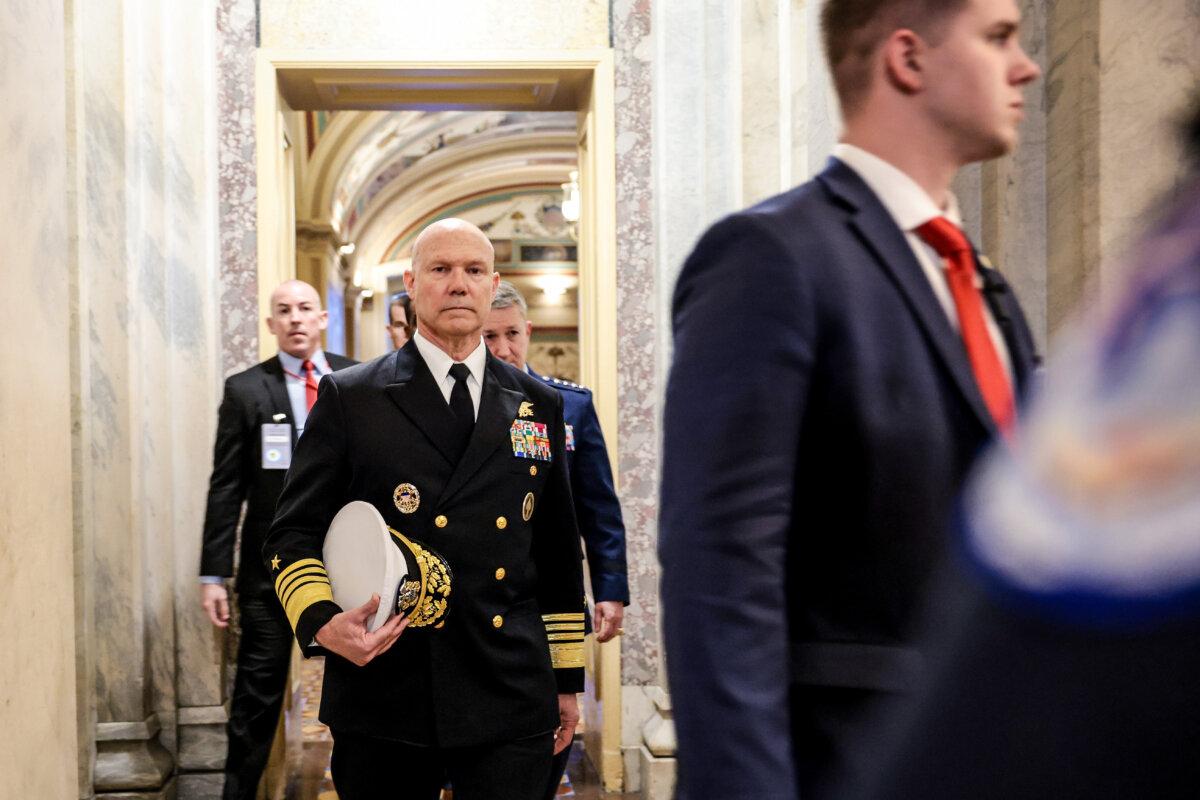
Navy Adm. Frank Bradley departs from the U.S. Capitol on Dec. 4, 2025. (Anna Moneymaker/Getty Images)
In an earlier panel discussion at the Reagan National Defense Forum on Dec. 6, Rep. Adam Smith (D-Wash.), the ranking member on the House Armed Services Committee, said he is supportive of efforts to halt drug trafficking through the region but harbors concerns about the recent operations.
“I want to stop the drugs,“ Smith said. ”I’m not sure that this is exactly the best way to go about doing it, and the legality of it does matter.
“I mean, President Trump has decided that we’re going to have the death penalty for drug dealers, and he’s going to be judge, jury, and executioner with no due process, no probable cause, and no congressional approval.”
Throughout his keynote speech, Hegseth rebuffed critics of the ongoing military operations in the Caribbean Sea and eastern Pacific.
“Our borders shouldn’t be the first line of defense for the American homeland,” he said. “They should be the last line of defense. And that’s why we’re prioritizing our fight against cartels throughout the Western Hemisphere.”
Revamping Armsmaking
Calls to overhaul the U.S. arms industry are not new to the Trump administration.
Amid fighting in Ukraine and numerous flashpoint conflicts across the Middle East in recent years, strategists and policymakers have raised concerns as to whether the U.S. arms industry can meet the demand for existing weapons and innovate to keep pace with evolving threats on the battlefield.
In the past year, the Pentagon has halted the M10 Booker light tank and Constellation-class frigate programs amid cost concerns and disagreements over the requirements for the two programs.
In November, Hegseth laid out a series of reforms the Pentagon will pursue to improve the arms acquisition process and bolster the domestic arms industry.
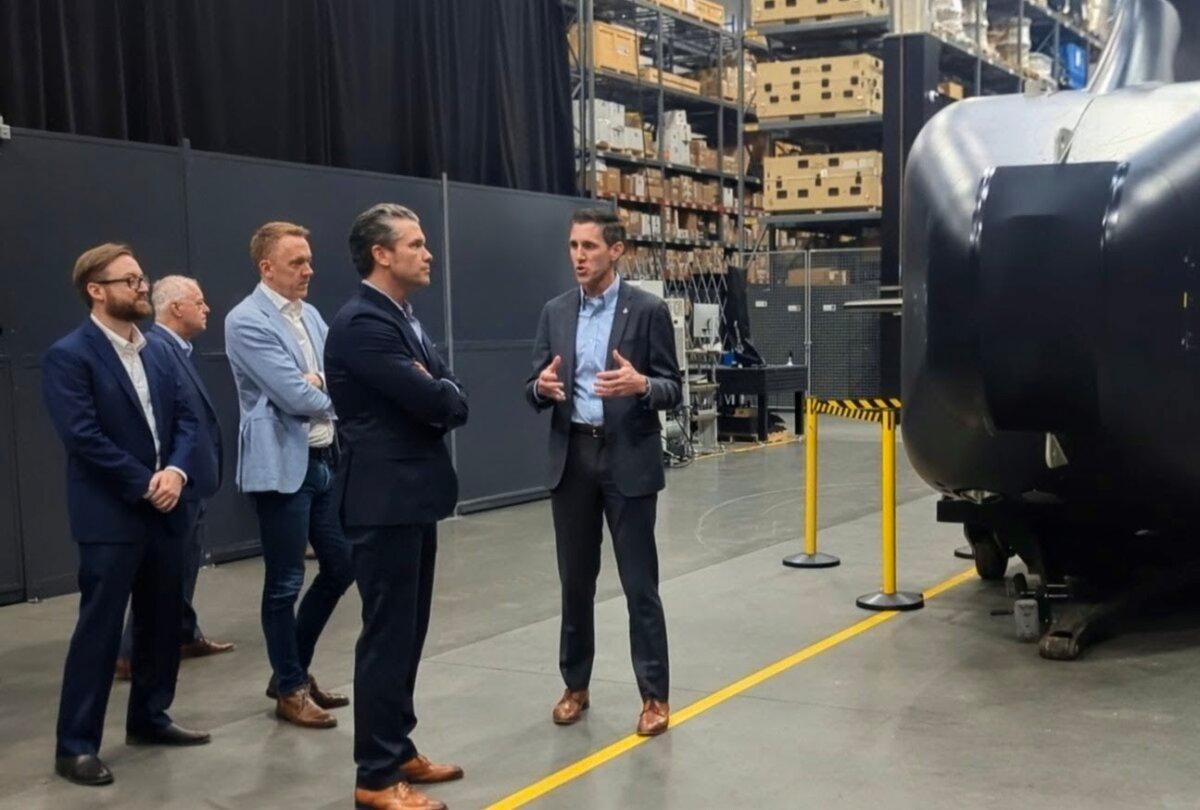
Andrew Nuss (R), head of growth and strategy for the maritime division of Anduril Industries, speaks with War Secretary Pete Hegseth about the Dive-XL underwater autonomous vehicle program during a tour of Anduril's corporate campus in Costa Mesa, Calif., on Dec. 5, 2025. (Ryan Morgan/The Epoch Times)
“President Trump is hell-bent on maintaining and accelerating the most powerful military the world has ever seen; the most powerful, the most lethal, and most American-made,“ Hegseth said on Dec. 6. ”The arsenal of freedom.”
The day before his Reagan National Defense Forum remarks, Hegseth toured defense industry facilities across Southern California.
At his first stop, the secretary of war toured the Anduril Industries corporate campus in Costa Mesa, California. There, he saw an under-construction unmanned fighter jet known as the YFQ-44 Fury, which the Air Force is considering for its Collaborative Combat Aircraft program. Anduril also showcased its Dive-XL underwater autonomous vehicle and its EagleEye augmented reality helmet display.
Anduril’s founder, Palmer Luckey, said his company seeks to simplify the manufacturing process for many of its weapons, moving away from exquisite but hard-to-make systems and toward ones that can be rapidly produced and improved.
“We’ve designed a lot of our systems to be manufactured by the types of machines and the types of skillsets ... that you would see in the automotive industry,” Luckey said.
During his visit to the Anduril facility, Hegseth praised the company’s approach to innovation.
“We’re going to compete, we’re going to move fast, we’re going to do open architecture, we’re going to innovate, we’re going to scale, and we’re going to do it at cost,“ he said. ”I think I just described the mission of Anduril.”
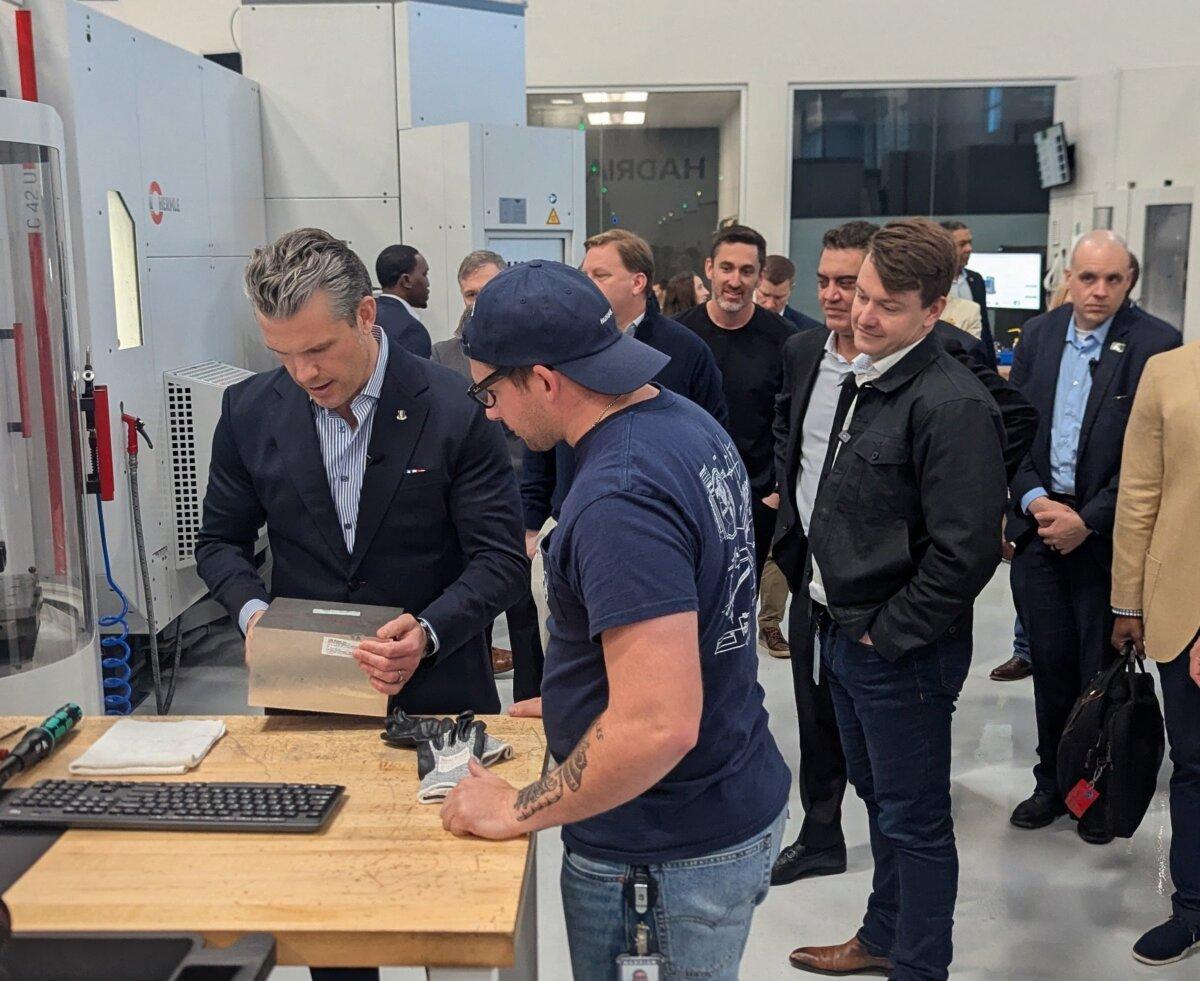
Secretary of War Pete Hegseth prepares to mill a satellite component during a tech demonstration at a Hadrian manufacturing facility in Torrance, Calif., on Dec. 5, 2025. (Ryan Morgan/The Epoch Times)
After his Anduril tour, Hegseth stopped at a manufacturing facility operated by Hadrian in Torrance, California. The company operates highly automated factories to produce precision parts for aerospace and defense industry partners.
During Hegseth’s visit, Hadrian showcased its production process, inviting the secretary to load an aluminum block into a computer numerical control mill to assemble a test component for a satellite.