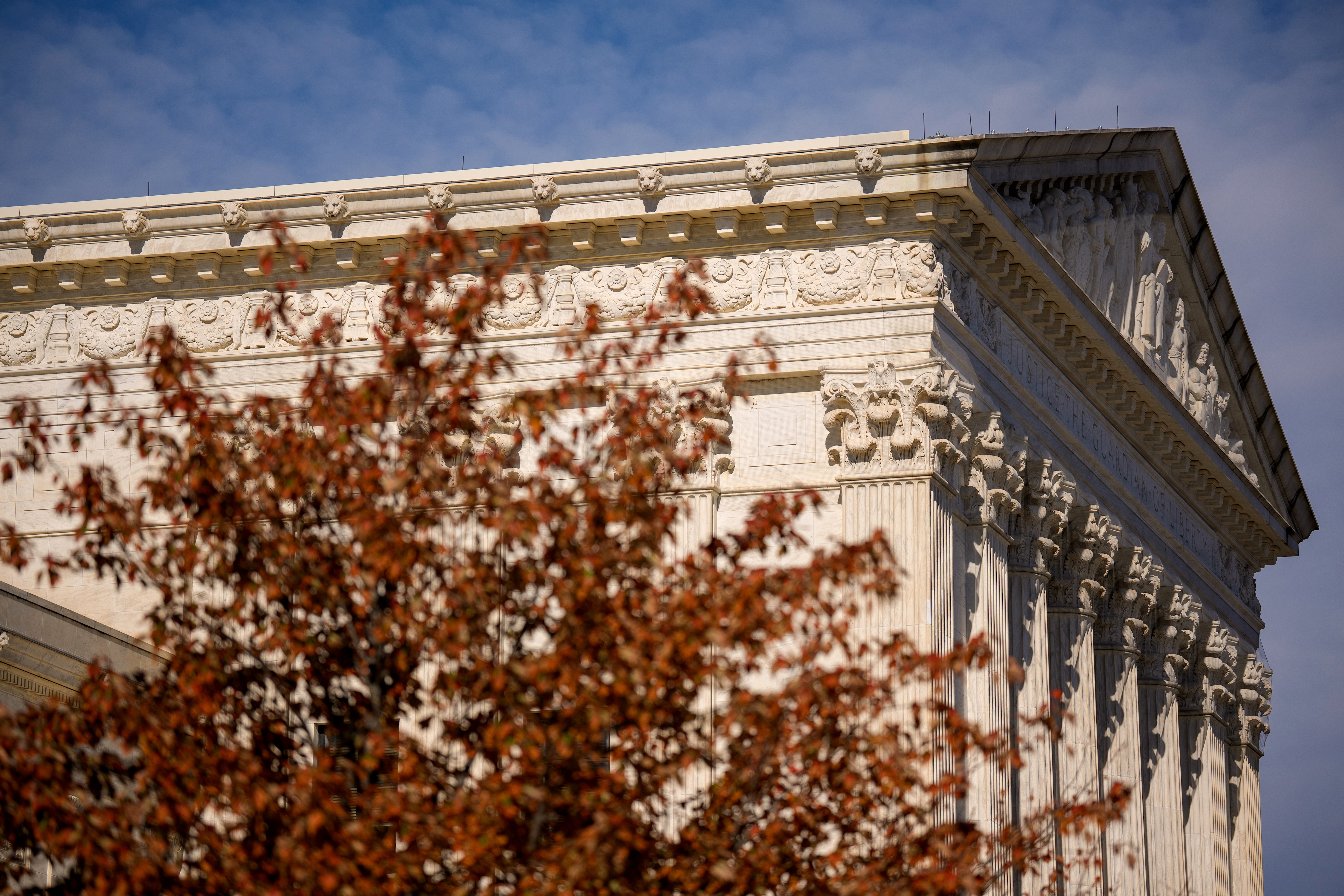

The Supreme Court seemed divided on Nov. 5 over whether to salvage a large portion of President Donald Trump’s tariffs in the face of challenges to their legality.
During oral argument lasting more than 2.5 hours, many of the justices asked questions indicating they thought the Trump administration was reading too much into an emergency powers law passed by Congress and that the president was potentially breaching the nation’s separation of powers.
Questions from some of the justices, however, suggested that Congress intended to give presidents broad authority in the face of emergencies.
So far, multiple federal courts have ruled that Trump’s reciprocal tariffs, as well as some related to drug trafficking, exceeded what Congress allowed under a law called the International Emergency Economic Powers Act.
That law allows presidents to take various actions, including regulating imports, in response to a declared emergency. The statute does not include the word “tariffs.” The Supreme Court is expected to issue a ruling not only on whether the law allows presidents to impose tariffs but also on whether Trump’s tariffs in particular are authorized by the law.
During oral argument, the justices asked about something known as the Major Questions Doctrine, which states that administrative agencies need clear congressional authorization before making decisions of major economic or political importance.
Solicitor General D. John Sauer told the court that the doctrine didn’t apply to Trump’s tariffs because they were in the realm of foreign affairs, where presidents generally have more discretion.
Chief Justice John Roberts seemed somewhat sympathetic to the administration, noting that the tariffs were “foreign-facing.” However, he pressed Sauer on the doctrine and told him that it seemed like it would be applicable to the case.
Roberts also noted that the Act didn’t use the word tariffs. Justice Brett Kavanaugh, meanwhile, suggested that Congress didn’t have to use the word “tariff” for that option to be available for the president.
Kavanaugh and Justice Amy Coney Barrett both indicated it was odd for Oregon Solicitor General Benjamin Gutman to view the law as allowing sweeping embargoes but not tariffs, which could be more limited.
“That doesn’t seem to have a lot of common sense behind it,” Kavanaugh told Gutman.
Often considered a swing vote, Barrett questioned whether Congress had ever used the phrasing of regulating imports to allow tariffs. When Sauer raised a lower court opinion in that vein, Barrett said that it was an “intermediate appellate court decision” and asked him again whether any law had granted tariff authority through that phrasing.
Justice Neil Gorsuch suggested “regulate” was “capacious” and indicated some of the law’s phrasing may allow tariffs.
Justice Ketanji Brown Jackson was skeptical, suggesting that Congress was using the International Emergency Economic Powers Act to constrain presidential authority rather than intending for him to have “unlimited authority.”
One of the questions the Supreme Court is considering is: Assuming Congress did grant Trump the authority to impose his tariffs, did it violate the nation’s separation of powers in doing so?
Both Justice Elena Kagan and Gorsuch indicated that the administration’s legal theory would allow Congress to grant the president too much power. At one point, Gorsuch seemed concerned that the administration’s legal theory would allow the president to declare war or regulate commerce with foreign nations.
The justices most sympathetic to Trump’s position appeared to be Justices Samuel Alito and Clarence Thomas, who pressed the other side with hypotheticals about how the president could use tariffs and fees.
Trillions of dollars in economic activity are at stake, while losing the case could remove a tool for Trump’s broader economic agenda. Meanwhile, the businesses that sued Trump described his tariffs as imposing hundreds of billions of dollars in new taxes.
Treasury Secretary Scott Bessent, who said he would attend oral argument, has said the government could invoke other authorities to implement tariffs, although they are “not as efficient, not as powerful.”
Neal Katyal, a former acting U.S. solicitor general representing businesses, told the court on Nov. 5 it should view the tariffs as taxes that are outside the scope of the law passed by Congress. Kagan and Sonia Sotomayor seemed to agree, describing tariffs as a form of taxation—a power that the Constitution gives to Congress.
Sauer disputed that characterization, arguing that while the tariffs raised revenue, they should primarily be viewed as a form of regulation. He also told Kavanaugh that the regulation of imports has historically been understood to include tariffs. Later, in argument, Kavanaugh told Gutman that tariffs had been described by the court as an exercise of a constitutional power other than taxation.